Middle East
Israel and Lebanon Sign US-Brokered Framework to Wind Down Their Conflict
The trilateral accord, signed in Washington after four days of talks, sets a conditional path for a limited Israeli pullback tied to Hezbollah's disarmament, but defers the hardest questions.
By Léa Hoffmann · · 4 min read
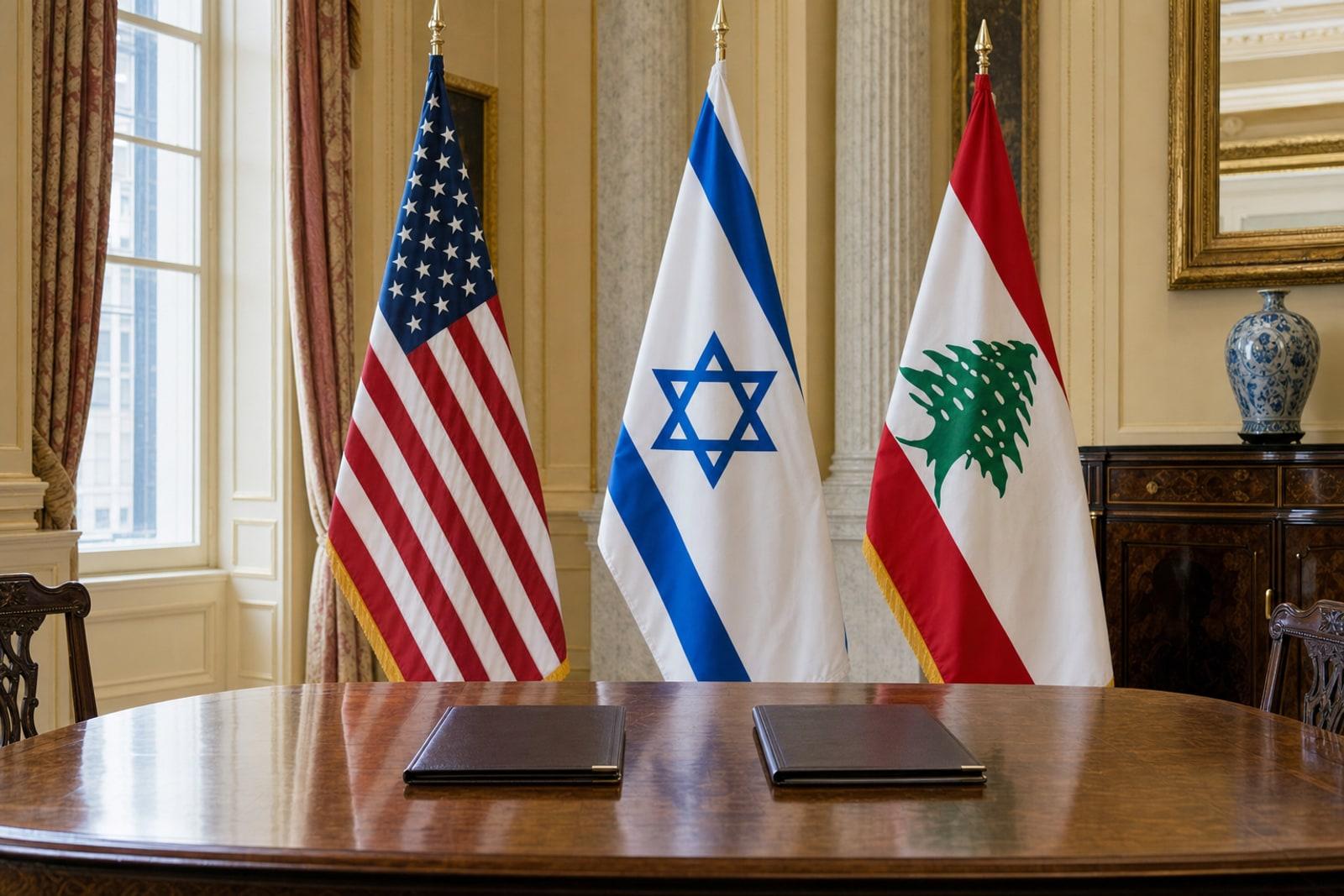
Israel and Lebanon, two states that have never signed a peace treaty and remain technically at war, put their names to a US-brokered framework agreement on 26 June that maps a conditional path toward ending their conflict — while deferring its most contentious elements.
The trilateral accord was signed at the US State Department after four days of talks in Washington, the culmination of a negotiating track that opened in April. It was inked at ambassadorial level — by Israel's envoy to Washington, Yechiel Leiter, and Lebanon's ambassador, Nada Hamadeh — with US Secretary of State Marco Rubio presiding and signing for the United States. Hezbollah, the Iran-backed movement whose weapons sit at the heart of the deal, was not at the table.
Rubio set expectations deliberately low. "It's the beginning of the beginning," he told the ceremony, adding that the agreement "establishes a clear and structured process to restore Lebanon's sovereignty, disarm Hezbollah and dismantle its terrorist infrastructure."
What the framework commits the two sides to
The 14-point document declares the parties' intent to "conclusively end the conflict" through a "reciprocal, sequenced process, with clear conditions," according to reporting by CNN and Al Jazeera. In practice, that sequence puts disarmament before withdrawal.
Its central mechanism is a pair of "pilot zones" in which the Lebanese Armed Forces will assume exclusive control, to the exclusion of all non-state actors. Prime Minister Benjamin Netanyahu said the two areas were chosen on the recommendation of the Israeli military: one south of the Litani River, the other north of the Litani inside an expanded Israeli security zone. The Lebanese army is to take over each zone only after Hezbollah's infrastructure there has been dismantled and verified.
The agreement also creates a standing body to police the process:
- A trilateral Military Coordination Group for Lebanon (MCG4L), facilitated by the United States, to oversee implementation and help train and strengthen the Lebanese army.
- An "immediate" US pledge of $100 million in humanitarian assistance, coordinated with the United Nations.
- A separate $30 million, reported by Al Jazeera, to reimburse the Lebanese Armed Forces for peace-support costs.
A pullback that is real but small
For all its language about ending the conflict, the framework leaves Israel's footprint largely intact. Israeli forces keep their security zone along the so-called Yellow Line and retain what officials described as operational freedom to act against threats. Only after Hezbollah is verifiably disarmed — first in the pilot zones, then across Lebanon — will Israel "progressively redeploy." There is no fixed timetable, and Al Jazeera estimates Israel still holds roughly a fifth of Lebanese territory.
The most important thing is, first of all, that Israel remains in the security zone in southern Lebanon. This is a major achievement, and we will maintain it as long as Hezbollah has not disarmed. — Benjamin Netanyahu, Prime Minister of Israel
That conditionality is the deal's defining feature. Israel secures a written, US-backed commitment to Hezbollah's disarmament without surrendering the leverage of its continued presence; Lebanon secures a path to recovering its south without an immediate withdrawal it could not enforce.
Beirut hails a first step; Hezbollah rejects it
Lebanon's leadership framed the signing as a beginning rather than a settlement. President Joseph Aoun called it "the first step on the road toward restoring Lebanon's sovereignty over all of its territory, without the slightest compromise," and looked ahead to a future "free of occupation, prisoners, and external tutelage." Prime Minister Nawaf Salam said the framework aims to "achieve Israel's full withdrawal from all Lebanese territory, restore the state's sovereignty, and facilitate the return of its citizens," anchoring it in UN Security Council Resolution 1701, the Taif Agreement and the 2024 cessation-of-hostilities declaration.
Hezbollah was unsparing. Secretary-General Naim Qassem said "Israel must leave unconditionally" and rejected any normalisation of ties. Hezbollah lawmaker Hassan Fadlallah charged that the authorities' course amounted to "unilateral, gratuitous concessions that will only undermine the country." The movement's opposition matters: the framework asks the Lebanese state to disarm a group that remains both armed and politically entrenched, and that was excluded from the talks that produced the plan.
What is genuinely new — and what is not
The novelty is real. For the first time, Israel and Lebanon have signed a shared document, named concrete pilot zones, stood up a joint US-run coordination mechanism and committed on paper to a disarm-then-withdraw sequence backed by American money. After a year of war and an uneasy truce, that is a meaningful shift in form.
The limits are equally real. There is no peace treaty, no normalisation, no timetable and no full withdrawal — only a conditional, partial pullback dependent on a disarmament that Hezbollah has vowed to resist. Prisoners and a complete Israeli departure remain aspirations voiced in Beirut, not commitments in the text. As Rubio himself conceded, the work is only beginning. Whether the framework becomes a turning point or another unimplemented blueprint will be decided not in Washington's signing room but along the Litani.
Frequently asked
- What does the Israel-Lebanon framework agreement actually cover?
- It is a 14-point trilateral framework committing the two sides to end their conflict through a sequenced process: the Lebanese army takes exclusive control of two pilot zones around the Litani River once Hezbollah is disarmed there, while Israel keeps its security zone until disarmament is verified. It creates a US-run Military Coordination Group and includes US funding, but sets no timetable.
- Who signed the agreement and at what level?
- It was signed on 26 June 2026 at the US State Department at ambassadorial level — Israel's ambassador Yechiel Leiter and Lebanon's ambassador Nada Hamadeh — with US Secretary of State Marco Rubio presiding and signing for the United States. Hezbollah was not part of the talks.
- How did Lebanon, Israel and Hezbollah react?
- President Joseph Aoun and PM Nawaf Salam welcomed it as a first step toward full sovereignty and an eventual Israeli withdrawal. Netanyahu called keeping the security zone 'a major achievement.' Hezbollah rejected the deal, with leader Naim Qassem insisting Israel must leave unconditionally.
- Is the conflict between Israel and Lebanon now over?
- No. The two states remain technically at war with no peace treaty or normalisation. The framework is a conditional roadmap with no fixed timetable; any Israeli withdrawal depends on Hezbollah's disarmament, which Hezbollah has vowed to resist.
Sources(10)
- 1What is the framework agreement signed by Israel and Lebanon?Al Jazeera · aljazeera.com
- 2US announces framework agreement between Israel and LebanonAl Jazeera · aljazeera.com
- 3Israel to withdraw from two areas in Lebanon under newly signed agreementCNN · cnn.com
- 4Israel and Lebanon ink framework deal for ending conflict, including minor IDF withdrawalThe Times of Israel · timesofisrael.com
- 5Israel and Lebanon sign framework agreement with U.S. in 'first step' toward peace, Rubio saysNBC News · nbcnews.com
- 6US-Israel-Lebanon sign trilateral framework agreement aimed at dismantling HezbollahThe Jerusalem Post · jpost.com
- 7Israel and Lebanon sign framework deal, paving way for future peace talksYnetnews · ynetnews.com
- 8Lebanese Leaders Outline Framework Agreement Goals Following U.S.-Brokered DealProfile News · profilenews.com
- 9Joint Statement of the United States, Republic of Lebanon, and State of Israel on the Latest High-Level Trilateral MeetingU.S. Department of State · state.gov
- 102026 Israel–Lebanon peace talksWikipedia · en.wikipedia.org
Related by topic