European security
NATO jet downs drone over Latvia as origin and route remain unconfirmed
An Italian Eurofighter shot down a drone over Latvia, but authorities had not identified its origin, route, payload or intended target as crews searched for wreckage.
By Camille Reuter · · 4 min read
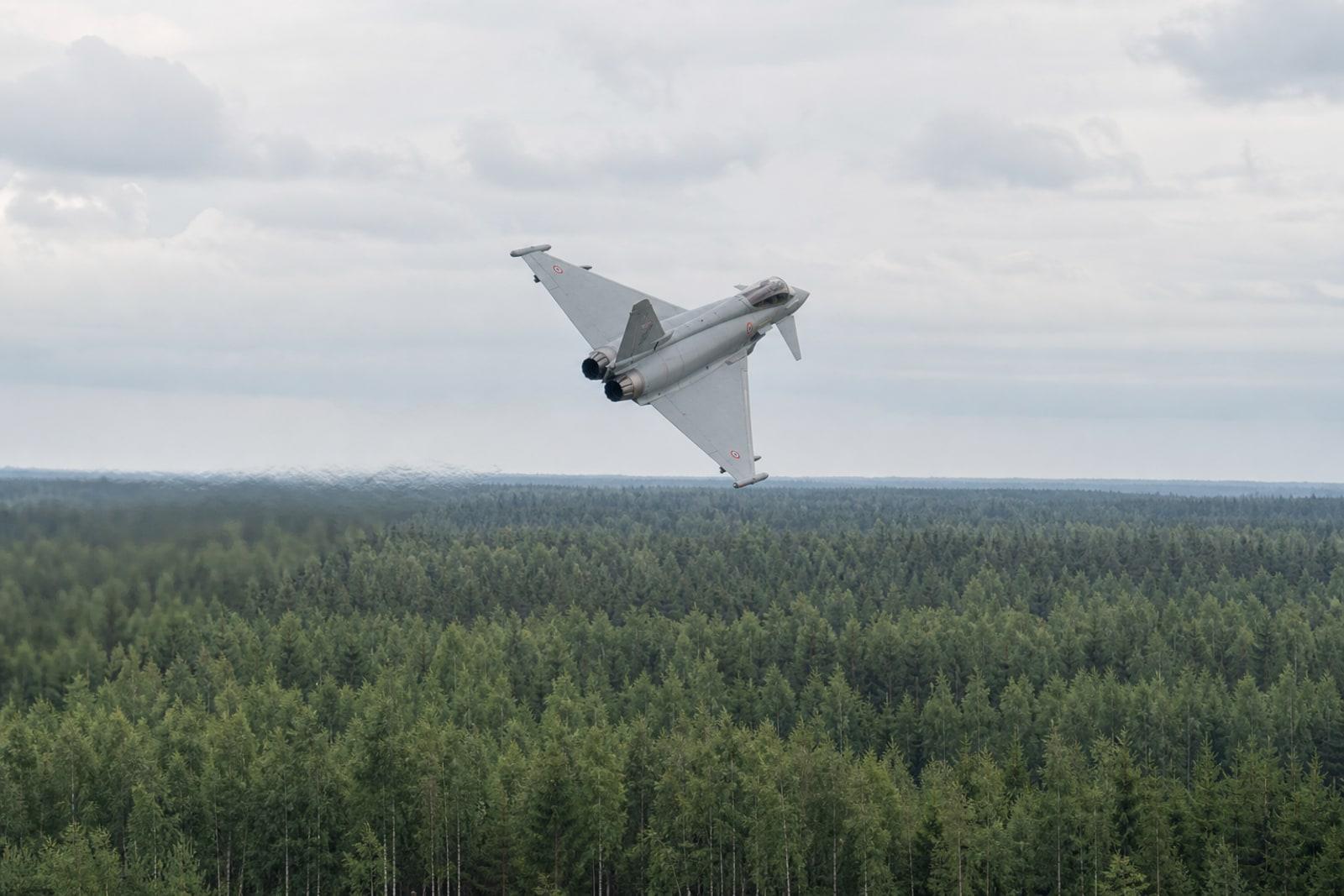
An Italian fighter jet operating under NATO command shot down a drone that entered Latvian airspace early on Friday, Latvian authorities and the alliance said, in an interception that underscored the mounting burden of protecting Europe’s eastern flank from unmanned aircraft.
The basic facts of the operation are clear. Two Italian Eurofighters were scrambled after the drone was detected over Latvia and one of them brought it down, NATO spokesperson Allison Hart said. Two Turkish fighter jets were also deployed. Associated Press and El País, citing Latvian and NATO officials, independently reported the interception.
What remains unconfirmed is equally important. Latvian authorities have not publicly identified who launched the drone, where it started, its flight path, whether it carried a payload, or its intended destination. Troops were searching for debris in woodland near Rugāji, a village in the eastern Latgale region, about 35 kilometres from the Russian border.
Latvian officials said the aircraft had entered the country “as a result of Russian electromagnetic warfare.” That statement describes the asserted mechanism behind the incursion; it does not establish the drone’s operator or prove that it was launched by Russia. Nor have the authorities publicly said that the aircraft was bound for a specific target or posed an imminent danger to a particular site.
“Obviously long-term we cannot continue by shooting down drones with very costly interceptors,” NATO Secretary General Mark Rutte said in June.
Interception, then investigation
Hart’s confirmation makes this a NATO-controlled air-defence response, rather than a unilateral Latvian engagement. Speaking to EFE, she said in Spanish: “Podemos confirmar que hoy, a primera hora, se ha ordenado el despegue de emergencia de dos aviones Eurofighter italianos en respuesta a la presencia de un dron sobre el espacio aéreo letón. Uno de los Eurofighter derribó el dron.”
Latvia’s military did not provide a public identification of the object before the search began. Its spokesperson, Iveta Berzina, told Latvian public broadcaster LSM that the origin could not yet be disclosed because the area had not been searched. That restraint matters. Drone incursions near a war zone can be caused by deliberate operations, navigation failures, electronic interference or a combination of factors. The evidence needed to distinguish among them commonly lies in the wreckage, flight data and intelligence assessment.
The Friday incident also brought a civilian-protection response. AP reported that people in five eastern Latvian municipalities were warned about an airspace threat and told to shelter. The operation ended with the destruction of the drone, but the investigation now determines what can responsibly be concluded about the threat.
A recurring eastern-flank problem
This was not the first such episode in Latvia this year. On 8 June, the Latvian Defence Ministry said fighters assigned to NATO’s Baltic Air Policing mission shot down a foreign drone in Latgale after it entered Latvian airspace amid Russian electromagnetic warfare. In a later press conference, Rutte also said French jets on Baltic Air Policing duty had intercepted and destroyed a drone that entered Latvia.
The two episodes should not be collapsed into a single explanation. The June incident was attributed by Latvian authorities to electronic warfare effects; Friday’s aircraft has not yet been identified. But together they show why a small drone, even before its origin is confirmed, can trigger a multinational response across the alliance’s north-eastern border.
The immediate tactical success comes with a strategic cost question. Eurofighters provide speed, sensors and a proven command structure, but they are high-value manned aircraft. NATO has been examining cheaper ways to detect and defeat drones. Its Baltic Trust exercise, held in Riga from 3 to 14 August, focused on integrating counter-unmanned-aircraft systems, rapid response and common tactics. NATO says the effort is intended to help turn experimental counter-drone systems into deployable capabilities.
- The interception confirms that NATO aircraft can be rapidly tasked against an airspace intrusion over Latvia.
- The drone’s origin, route, payload and intended target remain unconfirmed pending the recovery and examination of wreckage.
- The episode reinforces the case for layered, lower-cost counter-drone defences alongside fighter aircraft.
Why Luxembourg has a stake
For Luxembourg, the immediate event is far from its territory, but the political and defence consequences are shared. Luxembourg was among the 12 states that signed the Washington Treaty in 1949, a status recorded by both the Luxembourg government and NATO. The alliance’s response to incursions over Latvia therefore speaks directly to collective deterrence, air-defence investment and the rules governing use of force in allied airspace.
The immediate lesson is not that Friday’s drone was an attack by a named state; the evidence does not yet support that conclusion. It is that Europe’s air-defence challenge is becoming routine: identify a fast-moving object, protect civilians, establish command authority, intercept where necessary, and avoid turning an incomplete early account into a geopolitical certainty. The recovery operation in eastern Latvia is central to answering the questions still open.
Frequently asked
- Who shot down the drone over Latvia?
- NATO spokesperson Allison Hart said one of two scrambled Italian Eurofighters shot it down; Turkish fighters were also deployed.
- Was the drone confirmed to be Russian?
- No. Latvian authorities said it entered amid Russian electromagnetic warfare, but they had not publicly identified its origin or operator.
- Did authorities say the drone was armed or targeting a site?
- No public account had established a payload, intended target or an imminent threat to a specific person or facility.
- Why does this matter to Luxembourg?
- Luxembourg is a founding NATO member, so alliance decisions on collective air defence, deterrence and counter-drone capability directly concern it.
Sources(7)
- 1Russian drones kill a woman and 9-year-old son at home as Ukrainian civilian casualties surgeAssociated Press · apnews.com
- 2Un caza italiano bajo mando de la OTAN derriba un dron de origen desconocido en LetoniaEl País · elpais.com
- 3Joint press conference by NATO Secretary General and the Prime Minister of LatviaNATO · nato.int
- 4Allied fighters shoot down foreign drone in Latvian airspaceMinistry of Defence of Latvia · mod.gov.lv
- 5Baltic Trust (BATT26), 03-Aug-2026NATO · nato.int
- 6Luxembourg and NATONATO · nato.int
- 7European Union and international organisationsThe Luxembourg Government · gouvernement.lu
Related by topic