US–Iran escalation
Iran reports US bridge strikes as Pentagon says targets were military
Conflicting Iranian casualty reports and missile attacks across Gulf states deepen uncertainty as Washington fights for leverage over Hormuz.
By Camille Reuter · · 4 min read
The United States carried out a sixth consecutive night of strikes inside Iran early Friday, while Iranian media reported that bridges, a railway junction and an airport were among the sites hit. Washington described the operation more narrowly, saying it struck dozens of military targets linked to coastal surveillance, air defence, logistics and maritime capabilities.
The gap between those accounts is central to assessing the escalation. The Pentagon has not released target-by-target evidence showing how the reported bridges or the maritime traffic tower at Chabahar contributed to Iranian military operations. Iranian casualty and damage reports also remain unverified and, in one important case, contradictory.
What Iran says was hit
Reports carried by Reuters, the Associated Press and AFP placed much of the overnight damage in southern Iran, close to the Strait of Hormuz and the Gulf of Oman:
- Iranian outlets said bridges around Bandar Khamir and Kahurestan in Hormozgan province were struck. AFP reported two bridges; Reuters said Iranian media later referred to five across the latest wave.
- Mehr news agency said the Bandar Abbas railway junction was hit and two people were wounded. State television said at least one US projectile struck Iranshahr airport in southeastern Iran.
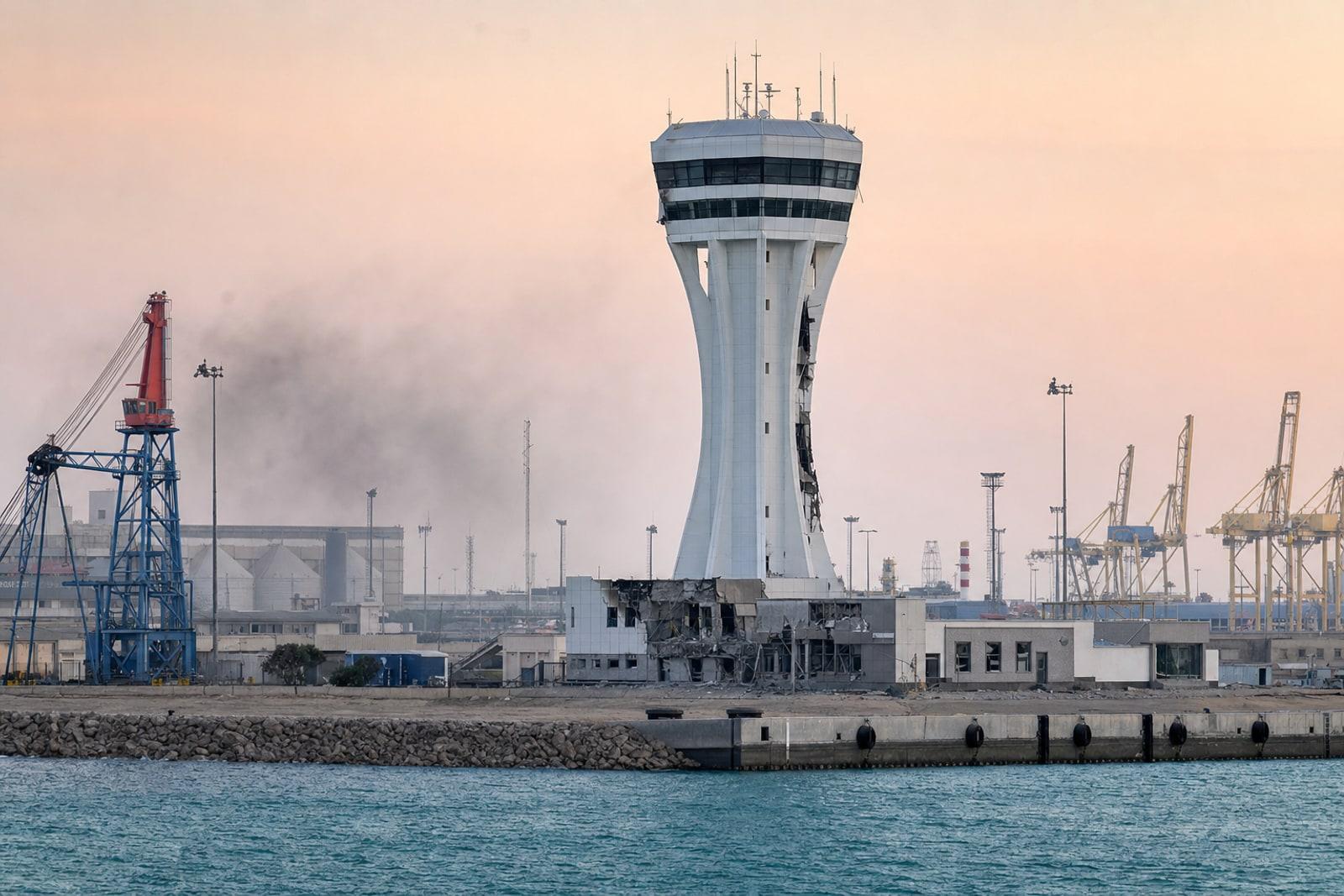
- The AP reported that a further strike appeared to collapse the maritime traffic-control tower at Chabahar port, a Gulf of Oman trade gateway that had already been attacked during the renewed campaign.
The death toll is unsettled. Reuters and the AP carried an Iranian state report of seven people killed in bridge strikes at Bandar Khamir. AFP later said state television revised the toll for two Hormozgan bridges to three dead and nine wounded. None of the news agencies independently verified the figures. The most responsible conclusion is therefore that fatalities were reported, but their number was not established by independent evidence as of Friday morning.
CENTCOM's own release identified no civilian infrastructure. It said fighter jets, aerial drones and warships used precision munitions against military sites.
Washington's rationale — and its legal exposure
The immediate strategic rationale is the Strait of Hormuz. CENTCOM said the strikes were intended to degrade Iran's ability to attack commercial shipping and to hold Tehran accountable for recent attacks on vessels. The White House says Iran violated last month's memorandum of understanding by firing on ships. Tehran and Washington disagree over whether that text permits Iran to manage transit near its coast or requires unrestricted passage.
At the Commander in Chief's direction, CENTCOM is further degrading Iranian military capabilities and holding Iran accountable for recent attacks on commercial shipping.
The administration's broader international-law case predates this week's strikes. In a March 10 letter to the UN Security Council, the United States said its campaign was undertaken under Article 51 of the UN Charter and its inherent right of self-defence. Reuters has reported that legal specialists question whether the scale and duration of the war fit the president's domestic authority without specific congressional approval. The latest CENTCOM statement did not provide a separate legal analysis for attacking bridges.
Under the law of armed conflict, a bridge or other normally civilian object can be attacked only if its nature, location, purpose or use makes an effective contribution to military action and its destruction offers a definite military advantage. The International Committee of the Red Cross also stresses proportionality and precautions to reduce civilian harm. Without evidence about the bridges' use and the anticipated military gain, no firm legal judgment about these particular strikes is possible.
Retaliation pulls US partners closer to the war
Iran said it answered the US strikes with missiles and drones aimed at American facilities in Bahrain and Kuwait, after attacks involving a US-used air base in Jordan. Qatar twice issued shelter warnings on Friday; its authorities said interception debris wounded a child. Jordan's military said it intercepted three incoming Iranian missiles and reported no immediate casualties.
Those attacks do not establish that Gulf governments joined the US offensive. They do show how hosting American forces and operating air defences can draw partners into the conflict even when they act defensively. Qatar is also a mediator, making strikes in its airspace especially damaging to diplomacy.
A second maritime front is another risk. Reuters, citing regional and Houthi-linked sources, reported that Iran had asked Yemen's Houthis to prepare to close the Bab al-Mandeb route if the United States attacked Iranian power infrastructure. Separately, the AP reported that the Houthi leader said his group was ready to escalate against Saudi Arabia. The group has previously disrupted Red Sea shipping.
Trade disruption is already visible
The Strait of Hormuz normally carries about one-fifth of global oil consumption and more than one-fifth of liquefied natural gas trade, according to US Energy Information Administration data. Reuters reported that tanker movements fell to a two-month low this week; the AP, citing Lloyd's List Intelligence, said cargo shipments had already dropped by almost a quarter week on week at the start of July.
That makes the bridge strikes more than a tactical episode. Washington is trying to coerce Iran into loosening control of the strait, but attacks on transport infrastructure give Tehran a stated rationale for wider retaliation against US-linked facilities and potentially another shipping chokepoint. The immediate military picture is clearer than the political end state: both sides can still escalate faster than mediators can rebuild the collapsed truce.
Frequently asked
- What sites were reportedly hit in Iran?
- Iranian media reported strikes on bridges around Bandar Khamir and Kahurestan, the Bandar Abbas railway junction, Iranshahr airport and Chabahar's maritime traffic-control tower. CENTCOM said only that it hit dozens of military targets.
- How many people were killed?
- The number was unresolved as of July 17. Reuters and AP carried an Iranian report of seven deaths, while AFP later reported a revised state-television toll of three dead and nine wounded. None was independently verified.
- Why does Washington say it is attacking Iran?
- CENTCOM says the aim is to degrade capabilities used against commercial shipping and punish Iran for alleged attacks on vessels. The broader US legal case invokes self-defence under Article 51 of the UN Charter.
- Could the conflict widen further?
- Yes. Iran has attacked US-linked facilities across several Gulf states, while reporting indicates a risk that Yemen's Houthis could renew operations around the Bab al-Mandeb shipping route.
Sources(15)
- 1Iran launches fresh attacks after sixth day of US strikesReuters · au.marketscreener.com
- 2US strikes bridges and collapses a tower at a key port as its Iran campaign expandsAssociated Press · apnews.com
- 3US strikes in Iran hit airport, bridges and railway stationAFP via Business Recorder · brecorder.com
- 4U.S. Successfully Completes New Strikes in IranU.S. Central Command · dvidshub.net
- 5US Attacks, Iran Retaliates — But White House Insists Diplomacy Still PossibleRadio Free Europe/Radio Liberty · rferl.org
- 6Mediators still trying to get US-Iran talks back on trackAssociated Press · apnews.com
- 7Hormuz traffic slows to two-month low as renewed US, Iran strikes raise safety riskReuters · investing.com
- 8Oil rises on intensifying US-Iran hostilities, threat of Red Sea closureReuters · au.investing.com
- 9Letter dated 10 March 2026 from the Permanent Representative of the United States to the UN Security CouncilUnited Nations Digital Library · digitallibrary.un.org
- 10Are the US attacks on Iran legal?Reuters · investing.com
- 11Methods and means of warfareInternational Committee of the Red Cross · icrc.org
- 12World Oil Transit ChokepointsU.S. Energy Information Administration · eia.gov
- 13Iran tells Houthis to close Red Sea gateway if US hits power network, sources sayReuters · investing.com
- 14Iran-backed Houthi leader in Yemen threatens escalation with Saudi ArabiaAssociated Press · apnews.com
- 15Chabahar Naval Traffic Control TowerOmran Maroon Engineers Co. · omran-maroon.com
Related by topic