European Union
EU ministers weigh settlement trade curbs as von der Leyen's Israel sanctions package stays blocked
Ten months after Ursula von der Leyen proposed suspending trade preferences with Israel, EU foreign ministers meet in Brussels over a narrower option: curbing some €230m in settlement trade.
By Camille Reuter · · 6 min read
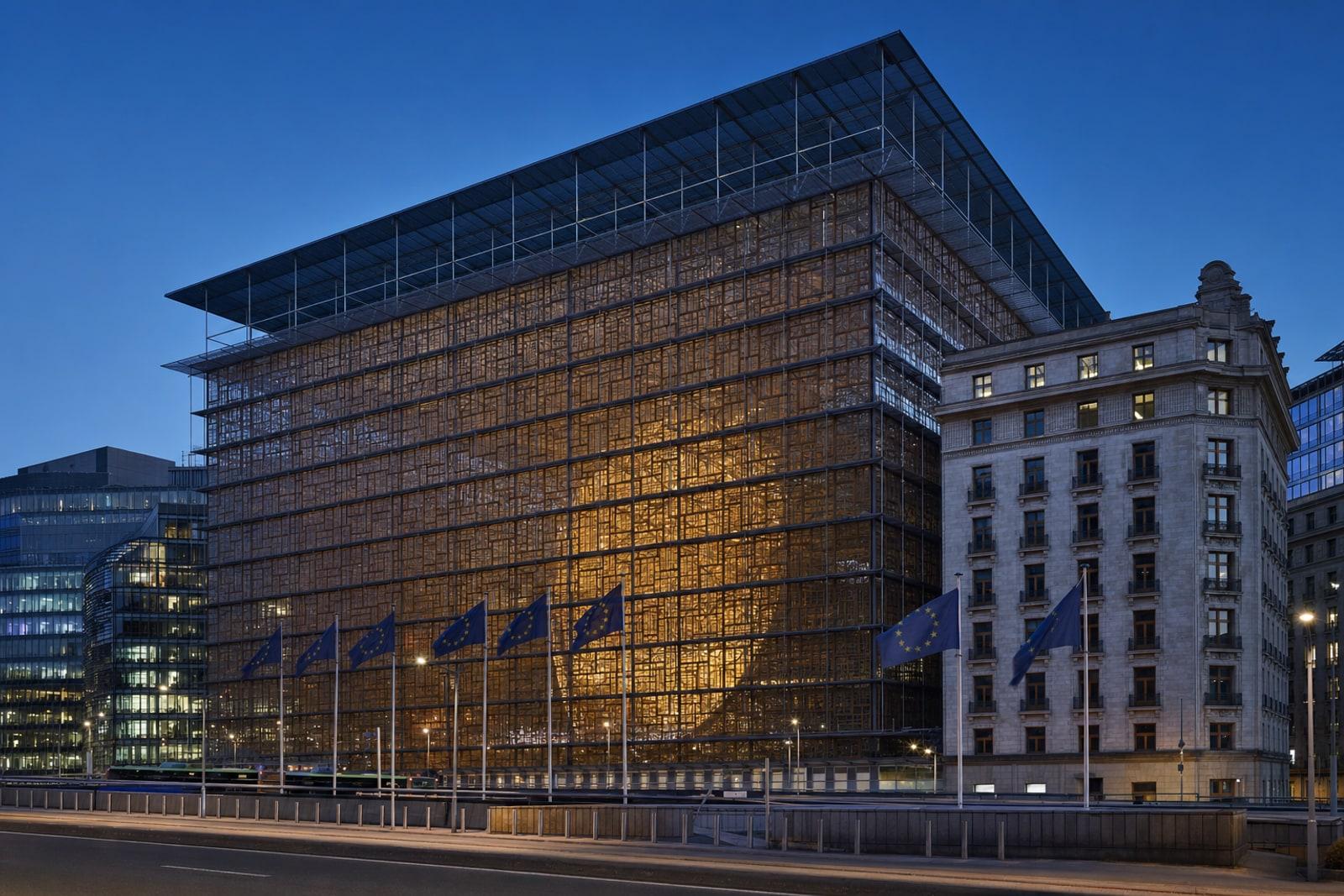
European Union foreign ministers meet in Brussels on Monday with a narrow question standing in for a much larger one: whether the bloc can restrict an estimated €230 million a year in trade with Israeli settlements — ten months after Commission President Ursula von der Leyen proposed far more sweeping measures against Israel that member states have blocked ever since.
An options paper circulated by the European Commission on 8 July sets out three ways to tighten restrictions on goods produced in Israeli settlements in the occupied West Bank: an import licensing regime, tariffs high enough to make the trade prohibitively expensive, or a full or partial import ban, according to Euronews and EUobserver, which reviewed the document. Settlement goods — mostly agricultural produce — are already excluded from the EU's preferential tariff treatment. No decision is expected on Monday; the next formal Foreign Affairs Council is not due until October. The meeting is instead a measure of how far the EU's centre of gravity has shifted on Israel, and of how firmly the bloc's voting rules still hold that shift in check.
A president's shift, a Council's deadlock
For much of the Gaza war, von der Leyen was regarded as one of Israel's most dependable defenders in Brussels. That reputation made her 2025 State of the Union address on 10 September a turning point: she announced the Commission would propose partially suspending the EU-Israel Association Agreement. A week later, the Commission tabled the package — suspension of the agreement's core trade provisions, which would strip Israeli imports of their preferential access to the EU market; sanctions on "extremist ministers", identified in the accompanying proposals as National Security Minister Itamar Ben-Gvir and Finance Minister Bezalel Smotrich, alongside violent settlers and ten members of Hamas's politburo; and a freeze on the Commission's bilateral support to Israel, sparing only civil-society programmes and the Yad Vashem Holocaust memorial.
"Reflecting these principled commitments, and taking into account serious recent developments in the West Bank, we propose to suspend trade concessions with Israel, sanction extremist ministers and violent settlers, and put bilateral support to Israel on hold, without affecting our work with Israeli civil society or Yad Vashem," von der Leyen said on 17 September 2025.
The legal foundation was a Commission review, presented to ministers in June 2025, which found indications that Israel had breached Article 2 of the agreement — the clause making respect for human rights an "essential element" of relations — citing the deteriorating humanitarian situation in Gaza, the blockade of aid and the decision to advance the E1 settlement plan. The stakes were substantial: the EU is Israel's largest trading partner, taking €15.9 billion in imports in 2024 out of €42.6 billion in total goods trade.
The arithmetic, however, was against her. Suspending the trade provisions requires a qualified majority — 15 of 27 states representing 65% of the EU's population — which is unreachable without Germany or Italy, and both oppose it. Sanctioning the two ministers requires unanimity.
What passed, and what stayed blocked
Movement came only when politics changed elsewhere. On 9 May, Péter Magyar was sworn in as Hungary's prime minister, ending Viktor Orbán's 16 years in power — and with them Budapest's veto on parts of the package. Two days later, member states reached political agreement on sanctioning extremist settlers and Hamas operatives, and on 28 May the Council formally listed four entities and three individuals, including the Nachala settlement movement, its director Daniella Weiss, and the Amana settler cooperative.
The ministers proved harder. Pressure intensified in May after Ben-Gvir taunted detained activists from a Gaza-bound aid flotilla, prompting Italy — long among Israel's closest allies in the bloc — to formally request that sanctions against him be put on the EU agenda for the first time. Yet at the Foreign Affairs Council on 15 June, Germany, Austria and the Czech Republic withheld support. "No consensus on that was reached today," EU foreign policy chief Kaja Kallas conceded. The wider trade suspension has fared no better: Czech Foreign Minister Petr Macinka has pledged to fight any suspension of the Association Agreement, in part or in whole.
Von der Leyen has pointedly declined to withdraw the proposals. Speaking in Cork on 3 July, she called the continued expansion of West Bank settlements "utterly unacceptable" and "the violence used to achieve this expansion" abhorrent, noting the trade proposal "remains on the table" and insisting that responsibility now rests with national capitals, which she said could act by qualified majority.
Where the Benelux governments stand
Belgium is among the group of roughly a dozen member states — with France, Sweden, Spain and Ireland — pressing for settlement-trade restrictions, according to EUobserver. Belgium and the Netherlands, along with Spain, have gone further nationally, banning both Ben-Gvir and Smotrich from their territory. Luxembourg has announced no comparable national measure, but Foreign Minister Xavier Bettel was among the sharper voices after the flotilla episode, saying Ben-Gvir's conduct showed "a profound lack of respect, dignity and humanity among members of the government" and asking: "How long will we continue to tolerate this kind of behaviour from politicians?"
A narrower fight, familiar obstacles
Even the modest settlement-goods dossier faces the same structural battle. France and Sweden proposed a licensing regime in a joint letter in April; Germany and the Czech Republic remain wary. Much now turns on the legal basis: framed as trade policy, the measures need only a qualified majority; framed as foreign policy, they need unanimity — and would almost certainly die. Advocates point to the International Court of Justice's 2024 advisory opinion, which said states should refrain from economic or trade dealings that entrench Israel's presence in the occupied territories.
The pressure driving the file is not abating. Israel's cabinet has approved 13 new settlements in the central West Bank, and Smotrich this month declared a "revolution" in settlement expansion. UN humanitarian office OCHA says settler attacks and demolitions displaced more than 3,200 Palestinians between 1 January and 10 July — around 17 people a day, double the daily average of the previous three years. In Gaza, the ceasefire that took effect last October has largely stalled, with NPR reporting that Israel now controls nearly 70% of the territory.
- Adopted: sanctions on extremist settler groups and Hamas operatives (May 2026).
- Blocked: sanctions on Ben-Gvir and Smotrich (unanimity); suspension of EU-Israel trade preferences (qualified majority).
- Under discussion: licensing, prohibitive tariffs or a ban on settlement-goods imports worth about €230 million a year.
Whether Monday's discussion produces a formal proposal will show whether Europe's most divisive foreign-policy file has genuinely shifted — or whether the Commission president's break with her own past remains a gesture the Council cannot, or will not, convert into leverage.
Frequently asked
- What did Ursula von der Leyen propose against Israel?
- On 17 September 2025, following her State of the Union address, the Commission proposed suspending the trade provisions of the EU-Israel Association Agreement — removing Israeli imports' preferential access to the EU market — plus sanctions on ministers Itamar Ben-Gvir and Bezalel Smotrich, violent settlers and Hamas politburo members, and a freeze on bilateral support to Israel.
- Why have the measures not been adopted?
- The trade suspension requires a qualified majority (15 of 27 states, 65% of the EU population), which cannot be reached without Germany or Italy — both opposed. Sanctions on the two ministers require unanimity, and Germany, Austria and the Czech Republic have withheld support.
- What is on the table now?
- A Commission options paper circulated on 8 July 2026 outlines three ways to restrict roughly €230 million a year in imports from Israeli settlements: an import licensing regime, prohibitively high tariffs, or a full or partial ban. Ministers discussed it on 13 July; no formal decision was expected before the next formal Foreign Affairs Council in October.
- Where do the Benelux governments stand?
- Belgium is among the member states backing settlement-trade restrictions, and both Belgium and the Netherlands have banned Ben-Gvir and Smotrich from their territory. Luxembourg has taken no comparable national measure, but Foreign Minister Xavier Bettel has publicly condemned Ben-Gvir's conduct.
Sources(19)
- 1Commission proposes suspension of trade concessions with Israel and sanctions on extremist ministers of the Israeli government and violent settlers (IP/25/2112)European Commission · ec.europa.eu
- 2EU proposes suspension of trade concessions with Israel over Gaza warAl Jazeera · aljazeera.com
- 3EU Commission to slap duties on Israeli goods, Kallas tells EuronewsEuronews · euronews.com
- 4Exclusive: Brussels puts trade ban with Israeli settlements on the tableEuronews · euronews.com
- 5Trade ban on Israeli settlements is the latest test of EU unityEuronews · euronews.com
- 6A ban on Israeli settlement products? Here are the options the EU is consideringEUobserver · euobserver.com
- 7Leaders press EU Commission to draft Israel trade restrictions, after three-month 'frustration'EUobserver · euobserver.com
- 8EU fails to agree on sanctions for far-right Israeli minister Ben-GvirAl Jazeera · aljazeera.com
- 9EU approves sanctions on Israeli settlers after Hungarian backingEuronews · euronews.com
- 10Extremist Israeli settlers: EU lists four entities and three individualsCouncil of the European Union · consilium.europa.eu
- 11Hungary's Power Shift Opens Door for EU Sanctions on IsraelForeign Policy · foreignpolicy.com
- 12Peter Magyar sworn in as Hungary's PM, ending Orban's 16 years in powerAl Jazeera · aljazeera.com
- 13EU under pressure to impose sanctions on Israel's Ben-Gvir after 'unacceptable' flotilla tauntsThe National · thenationalnews.com
- 14Von der Leyen says Israeli West Bank settlements are 'utterly unacceptable' during Cork visitIrish Examiner · irishexaminer.com
- 15Von der Leyen says EU member states hold power to act on Israel sanctionsTheJournal.ie · thejournal.ie
- 16Von der Leyen: 'I will soon present a proposal' on restrictions on products from Israeli settlementsEunews · eunews.it
- 17Israel's Smotrich declares 'revolution' in West Bank settlement expansionAl Jazeera · aljazeera.com
- 18OCHA: Settler violence displaces more Palestinians in 2026 than in all of 2025UN OCHA (via UN Question of Palestine) · un.org
- 199 months into a ceasefire, Israel now controls nearly 70% of GazaNPR · npr.org
Related by topic