Climate
Beyond the heatwave: scientists see Luxembourg's climate turning hotter, drier and stormier
This week's record heat will fade, but hydrologist Laurent Pfister says Luxembourg is locked into hotter, drier summers and violent storms — with lasting risks for water, farming and rail.
By Tom Schmit · · 4 min read
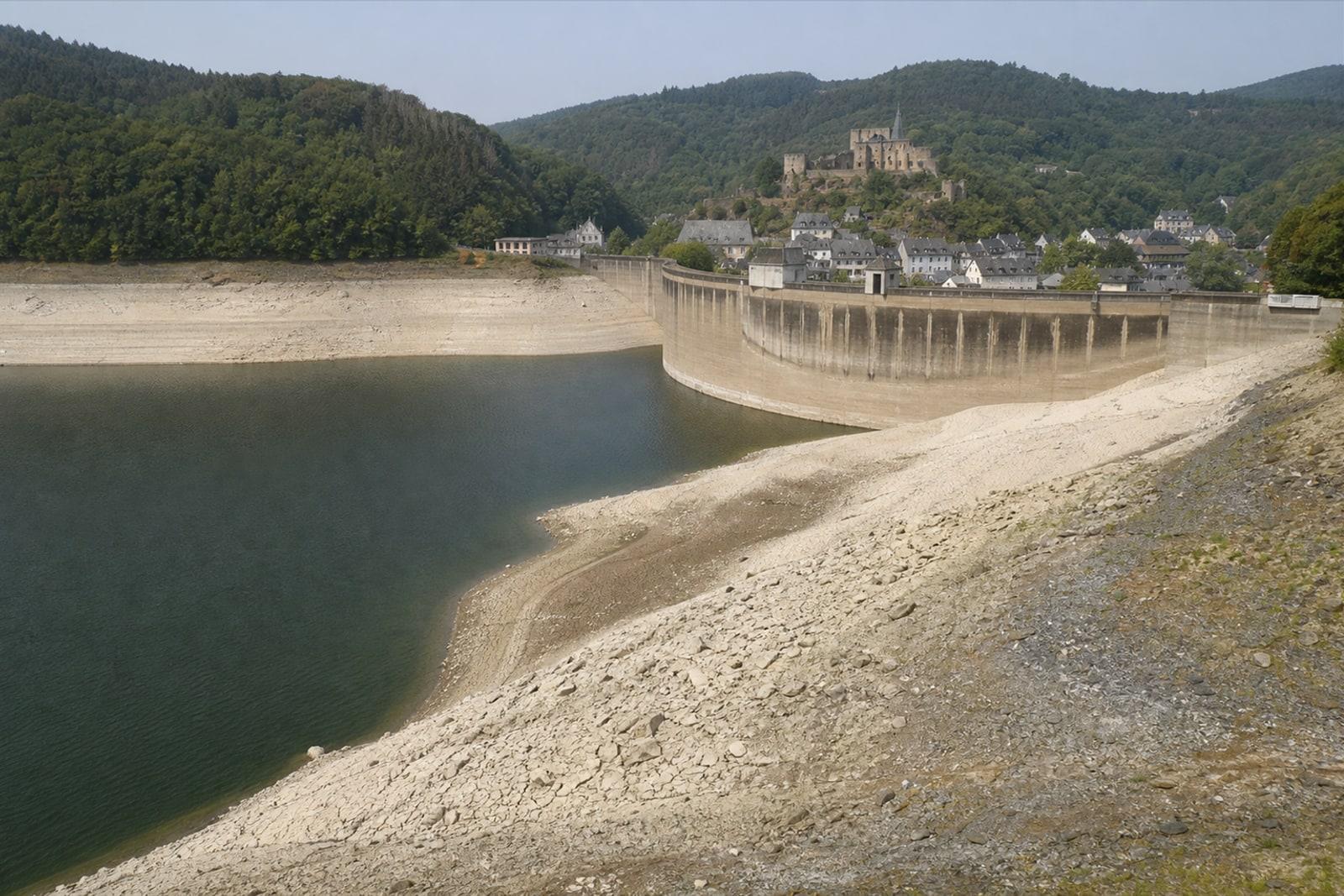
The thermometers that drove Luxembourg toward 40°C this week — triggering a red alert, the suspension of afternoon school classes and even a heat-buckled railway track — will eventually fall back. The conditions that produced them, hydrologists say, will not.
For Laurent Pfister, the hydro-climatologist who heads the Environmental Sensing and Modelling unit at the Luxembourg Institute of Science and Technology (LIST), the late-June heat is a symptom of a deeper, structural change. The Grand Duchy's temperate, rain-through-the-year climate is giving way to something the country was not built for: hotter, drier summers punctuated by sudden, violent downpours — a rhythm closer to the Mediterranean than to the mild north-west Europe of the 20th century.
An intensifying water cycle
Pfister's central point is not simply that Luxembourg will get wetter or drier on average. LIST's projections suggest total annual rainfall will stay broadly unchanged. What is changing is its distribution — and its violence — with long dry spells broken by extreme bursts of rain.
"On parle surtout d'une intensification du cycle hydrologique" — "We are talking above all about an intensification of the water cycle," Pfister told the Luxembourg outlet Infogreen, describing the switch away from steady, year-round rainfall.
That shift is self-reinforcing, he explains. In a heavy downpour, parched ground saturates within minutes, sending water sheeting across the surface and dragging pollutants and bacteria toward rivers and reservoirs; a prolonged drought, meanwhile, bakes and seals the soil so it can no longer soak up rain when it finally arrives. The outcome, in his telling, is a vicious circle of flood and drought rather than a gentle middle ground.
Because today's planning rules were built on a 20th-century climate assumed to be stable, they are losing their grip. "Le climat change en raison de l'activité humaine, ce qui implique qu'il faut revoir progressivement tous nos modèles statistiques" — climate is changing because of human activity, which means all our statistical models must be progressively revised — Pfister has said. Luxembourg's systematic temperature records reach back only to about 1838 and rainfall to 1854, leaving forecasters with a short memory of how extreme the weather can become.
A water supply built for a wetter country
The stakes are clearest at the tap. Luxembourg draws roughly 45% of its drinking water from groundwater springs and about 55% from a single surface source, the Upper Sûre reservoir at Esch-sur-Sûre, treated and distributed by the SEBES utility. The capital leans heavily on the Grès de Luxembourg — the Luxembourg Sandstone aquifer — for around half of its supply. A long drought squeezes both, and the fallback is deeper groundwater that can take millennia to recharge.
The pressure is already visible in the numbers cited by researchers and the water sector:
- Daily abstraction has reached about 130,000 m³, roughly 180 litres per resident, and total water use has roughly doubled in 15 years.
- Households account for about 60% of consumption, industry 23% and agriculture 8%, with around 9% lost to leaks.
- Roughly 100 of the country's 250 groundwater resources are already unusable because of nitrate, pesticide and phosphate pollution.
- University of Luxembourg modelling warns water availability could become a brake on population growth after 2023–2029 without conservation measures.
What the projections show
The trajectory is not hypothetical. The World Bank's Climate Change Knowledge Portal projects mean annual temperatures in Luxembourg rising by roughly 2–4°C or more by the end of the century under high-emissions scenarios, with national estimates of about +1.1°C by mid-century. Summer rainfall (June–August) could fall by 10–20% by 2100, even as winters turn 5–15% wetter, and the country could see up to about five extremely hot days a year by 2050.
Agriculture sits squarely in the crossfire. Farmers and the winegrowers of the Moselle valley already swing between persistent drought, damaging downpours and unseasonal frost, while warmer, drier summers raise the risk of forest fires. Infrastructure is exposed too: this week's track subsidence near Berchem hinted at how heat tests the rail network, while heavier winter rain raises flood risks that can reach the electricity grid. Luxembourg's national adaptation strategy now lists 131 measures meant to brace for exactly this.
A Greater Region under the same sky
Luxembourg's predicament is shared across borders. During the same heatwave, France recorded 44.3°C at Pissos on 23 June and Germany set a national record of 41.5°C on 27 June, part of a European episode linked to more than 500 deaths. The Greater Region's farms, rivers and cities are warming together, and water is increasingly a cross-border concern.
Pfister's prescription is to read the deep past in order to prepare for the future — reconstructing old floods and droughts from tree rings, sediments and archives to stretch a record that instruments alone cannot provide.
"By linking past extreme events to those observed today, we can better assess the impact of human activities and more accurately predict the future evolution of climate and hydrological phenomena," he says. The heatwave will pass. The questions it raises about water, farming and infrastructure, the scientists argue, are here to stay.
Frequently asked
- Is Luxembourg really getting a Mediterranean climate?
- Not literally. Scientists describe a shift toward a Mediterranean-style pattern — hotter, drier summers and concentrated, violent rainfall — rather than the steady year-round rain Luxembourg historically relied on. The annual rainfall total may stay similar, but its timing and intensity change.
- Where does Luxembourg's drinking water come from?
- About 45% comes from groundwater springs and roughly 55% from the Upper Sûre reservoir at Esch-sur-Sûre, distributed by the SEBES utility. The capital depends heavily on the Luxembourg Sandstone (Grès de Luxembourg) aquifer for around half its supply.
- How much hotter and drier could Luxembourg get?
- The World Bank Climate Change Knowledge Portal projects roughly 2–4°C of annual warming by 2100 and 10–20% less summer rain, with up to about five extremely hot days a year by 2050.
Sources(10)
- 1À quoi doit s'attendre le Luxembourg alors que le climat se détracteLuxembourg Institute of Science and Technology (LIST) · list.lu
- 2« Le changement climatique a intensifié le cycle de l'eau »Infogreen · infogreen.lu
- 3Climate and rivers: when the past sheds light on the futureLuxembourg Institute of Science and Technology (LIST) · list.lu
- 4À l'écoute du changement climatique, à travers météo et hydrologieingsci.lu (Ingénieurs et Scientifiques du Luxembourg) · ingsci.lu
- 5Research trends: New models for extreme weatherFonds National de la Recherche (FNR) · fnr.lu
- 6Luxembourg – Mean Projections (CMIP6)World Bank Climate Change Knowledge Portal · climateknowledgeportal.worldbank.org
- 7State of Luxembourg's water supplySustainability Mag · sustainabilitymag.lu
- 8Luxembourg's heatwave becomes a live stress testDelano · delano.lu
- 92026 European heatwavesWikipedia · en.wikipedia.org
- 10Climate and weather in LuxembourgLuxtoday · luxtoday.lu
Related by topic