Passenger rights
EU adopts air-passenger overhaul: what changes at Luxembourg Airport
The three-hour compensation benchmark survives, but new deadlines and self-rerouting rules will change how disrupted passengers pursue refunds and alternative travel.
By Camille Reuter · · 5 min read
The European Union has adopted its first major overhaul of air-passenger rights in more than two decades, preserving the three-hour compensation benchmark while imposing clearer deadlines on airlines and giving stranded travellers a defined right to arrange their own alternative transport.
The Council of the EU gave the legislation final clearance on 13 July, six days after the European Parliament approved the compromise by 646 votes to 12, with three abstentions. That completes adoption, but does not make the rules immediately usable: publication in the EU’s Official Journal is still required.
The regulation will become applicable 12 months and 20 days after that publication. Passengers disrupted today must therefore continue to rely on Regulation 261/2004 and the case law that has developed around it.
The compensation cut that did not survive
The most politically charged change proposed during negotiations was ultimately abandoned. The Council’s 2025 position would have required a four-hour delay for €300 compensation on intra-EU journeys and other flights up to 3,500 kilometres, and six hours for €500 on longer journeys. Parliament resisted those higher thresholds.
The adopted text instead writes the existing court-developed protection into legislation. Subject to exceptions, passengers may seek compensation when they reach their final destination more than three hours late, when a flight is cancelled less than 14 days before departure, or when boarding is unjustifiably denied.
- €250 for journeys of 1,500 kilometres or less.
- €400 for intra-EU journeys longer than 1,500 kilometres and other journeys between 1,500 and 3,500 kilometres.
- €600 for other longer journeys. The airline may reduce this by 50% in specified rerouting cases or when the arrival delay does not exceed four hours.
Those bands broadly reproduce the system currently described by the European Commission. The practical change is legal certainty: a right created through Court of Justice rulings will appear expressly in the regulation.
Airlines will still avoid financial compensation when they prove that extraordinary circumstances directly caused the disruption and that it could not have been avoided even if all reasonable measures had been taken. The adopted text places that burden of proof on the carrier and requires a clear, substantiated explanation to the passenger.
Firm clocks for claims, refunds and new tickets
The more consequential changes concern what happens after disruption. Within 96 hours of the end of a journey that may qualify, the airline must electronically tell passengers about their compensation rights and explain how to submit a request. Passengers will have nine months to claim; the airline must acknowledge the request immediately and, within 30 calendar days, either pay or explain its refusal and identify the available complaint route.
“It makes it clearer for consumers to claim compensation, but it doesn't make it easier.” — Olivia Brown, Euroconsumers
Brown told Euronews that negotiators’ failure to require pre-filled claim forms was a significant missed opportunity. Travellers will still have to initiate compensation claims themselves.
Refunds are more prescriptive. A passenger who chooses reimbursement rather than rerouting must receive the money automatically within seven calendar days of making the request, normally by bank transfer. An airline may offer a voucher only with the passenger’s explicit consent. Its initial validity may not exceed 12 months, and any unused value must be converted into money within seven days after expiry.
The rerouting provisions are particularly important during cancellations:
- The airline must offer comparable travel at the earliest opportunity and may use another carrier, another route, an alternative airport or another transport mode.
- If no comparable option is offered within three hours after the passenger chooses to continue, the passenger may arrange their own rerouting after informing the airline.
- Necessary, reasonable and appropriate costs are reimbursable up to 400% of the original ticket price, normally within 14 calendar days.
That does not create an unrestricted licence to buy any replacement ticket. Passengers will need evidence that they selected continued travel, gave the carrier the prescribed opportunity to respond, notified it before self-rerouting and kept costs proportionate.
What it means at Findel
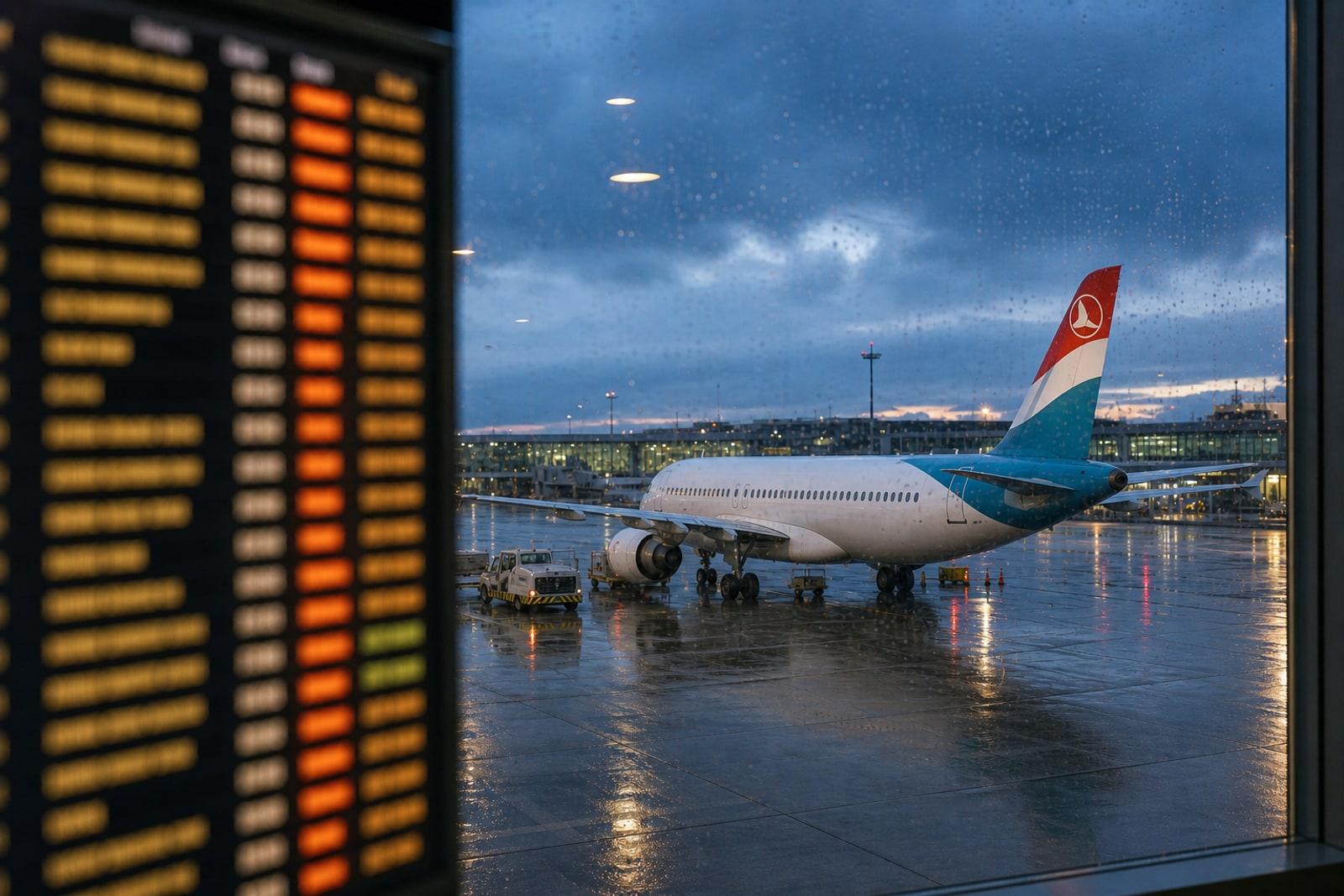
The geographical scope remains unchanged. Every flight departing Luxembourg Airport is covered, whether the operating airline is based inside or outside the EU. A flight arriving at Findel from a non-EU country is covered when an EU airline operates it; an inbound flight operated by a non-EU carrier is not.
For Luxembourg departures, the Directorate for Consumer Protection is the national enforcement body. A passenger should first approach the operating airline and preserve the booking, boarding pass, disruption notices, receipts and correspondence. If the claim remains unresolved, the directorate provides the national complaint route.
Care obligations will also become more detailed: refreshments every two hours, a meal after three hours and every five hours thereafter, internet access, two telephone calls, and hotel accommodation and transfers when an overnight stay is necessary. If the airline fails to provide that care, reasonable passenger expenses must normally be reimbursed within 14 days. In disruptions caused by unavoidable extraordinary circumstances, hotel provision may be capped at three nights, although specified vulnerable passengers and their companions are exempt from that limit.
Other provisions prohibit cancelling a return journey solely because the outbound flight was missed, strengthen adjacent seating rights for children and passengers with specific needs, and require clearer presentation of fares that include hand baggage.
The immediate message for travellers is therefore twofold: the feared four- and six-hour compensation thresholds did not become law, but the new claim and rerouting machinery is not yet in operation. Its start date will be determined by publication in the Official Journal.
Frequently asked
- Do the new EU air-passenger rules apply immediately?
- No. They become applicable 12 months and 20 days after publication in the Official Journal. Existing Regulation 261/2004 and relevant court rulings apply until then.
- Has the compensation threshold increased to four or six hours?
- No. Those thresholds appeared in the Council’s 2025 position but were rejected in the final compromise. The adopted text preserves compensation after an arrival delay exceeding three hours, subject to statutory exceptions.
- When may a passenger book their own replacement travel?
- Under the new rules, a passenger who chooses continued travel may self-reroute if the airline has not offered comparable transport within three hours. The passenger must inform the airline, keep costs reasonable and retain evidence.
- Who handles a complaint about a flight departing Luxembourg Airport?
- The passenger should first complain to the operating airline. Luxembourg’s Directorate for Consumer Protection is the national enforcement body for flights departing from Luxembourg Airport.
Sources(13)
- 1Council gives final clearance for stronger air passenger rightsCouncil of the European Union · consilium.europa.eu
- 2EU Council gives final green light to reform of air passenger rightsAgence Europe · agenceurope.eu
- 3European Parliament achieves upgrade to air passenger rightsEuropean Parliament · europarl.europa.eu
- 4Joint text approved by the Conciliation Committee: air passenger rightsCouncil of the European Union · data.consilium.europa.eu
- 5Inside the EU’s bittersweet deal to update air passenger rightsEuronews · euronews.com
- 6Commission welcomes landmark agreement on revised air passenger rightsEuropean Commission · transport.ec.europa.eu
- 7Council and Parliament reach landmark agreement on stronger EU air passenger rightsCouncil of the European Union · consilium.europa.eu
- 8Air passenger rightsYour Europe · europa.eu
- 9Air passenger rightsGuichet.lu · guichet.public.lu
- 10Passenger rightsLuxembourg Directorate for Consumer Protection · mpc.gouvernement.lu
- 11Accord en conciliation relatif à la révision du règlement européen (CE) n°261/2004Luxembourg Government · mmtp.gouvernement.lu
- 12Council sets position on clearer and improved rules for air passengersCouncil of the European Union · consilium.europa.eu
- 13Passenger compensation for flight delays set to decrease in EuropeLe Monde · lemonde.fr
Related by topic