China's slowdown
China’s growth slows to a three-year low as domestic demand weakens
Second-quarter growth fell to 4.3% as weak spending, investment and property activity contrasted with booming exports and resilient factories.
By Jonas Thill · · 4 min read
China’s economy grew at its slowest pace in more than three years in the second quarter, exposing a widening divide between a powerful export machine and households and businesses that remain reluctant to spend.
Gross domestic product expanded 4.3% from a year earlier in April through June, according to data released by the National Bureau of Statistics on Wednesday. That was down sharply from 5.0% in the first quarter and was the weakest reading since the lockdown-affected final quarter of 2022. The economy grew 0.9% from the previous quarter, while first-half growth stood at 4.7%.
The figures, corroborated by the Associated Press and Reuters, place the second-quarter pace below the lower end of Beijing’s 4.5% to 5% target range for the full year. Stronger performance earlier in 2026 means the annual objective remains attainable, but the composition of growth is becoming a more urgent concern than the headline rate.
Factories advance while spending stalls
The official activity data describe two economies moving at markedly different speeds. Industrial output rose 5.4% in the first half, supported by equipment, technology and export manufacturing. Consumer-goods retail sales increased only 1.3%, however, and June’s gain slowed to 1.0%.
Investment was weaker still. Fixed-asset investment fell 5.7% in the first six months compared with the same period of 2025. Real-estate development investment contracted 18%, while sales of newly built commercial property dropped in both floor area and value. The property slump matters far beyond construction: falling home values have damaged household wealth and confidence, encouraging families to save rather than make discretionary purchases.
“China’s growth model has become increasingly imbalanced,” Eswar Prasad, a professor of economics and trade policy at Cornell University, told the Associated Press.
The World Bank’s July China update had already identified cautious consumption, income uncertainty and falling property prices as persistent constraints. It also found that reduced consumer subsidies were providing a smaller lift than in 2025. The latest official release confirms that the weakness continued into the second quarter.
Exports remain the shock absorber
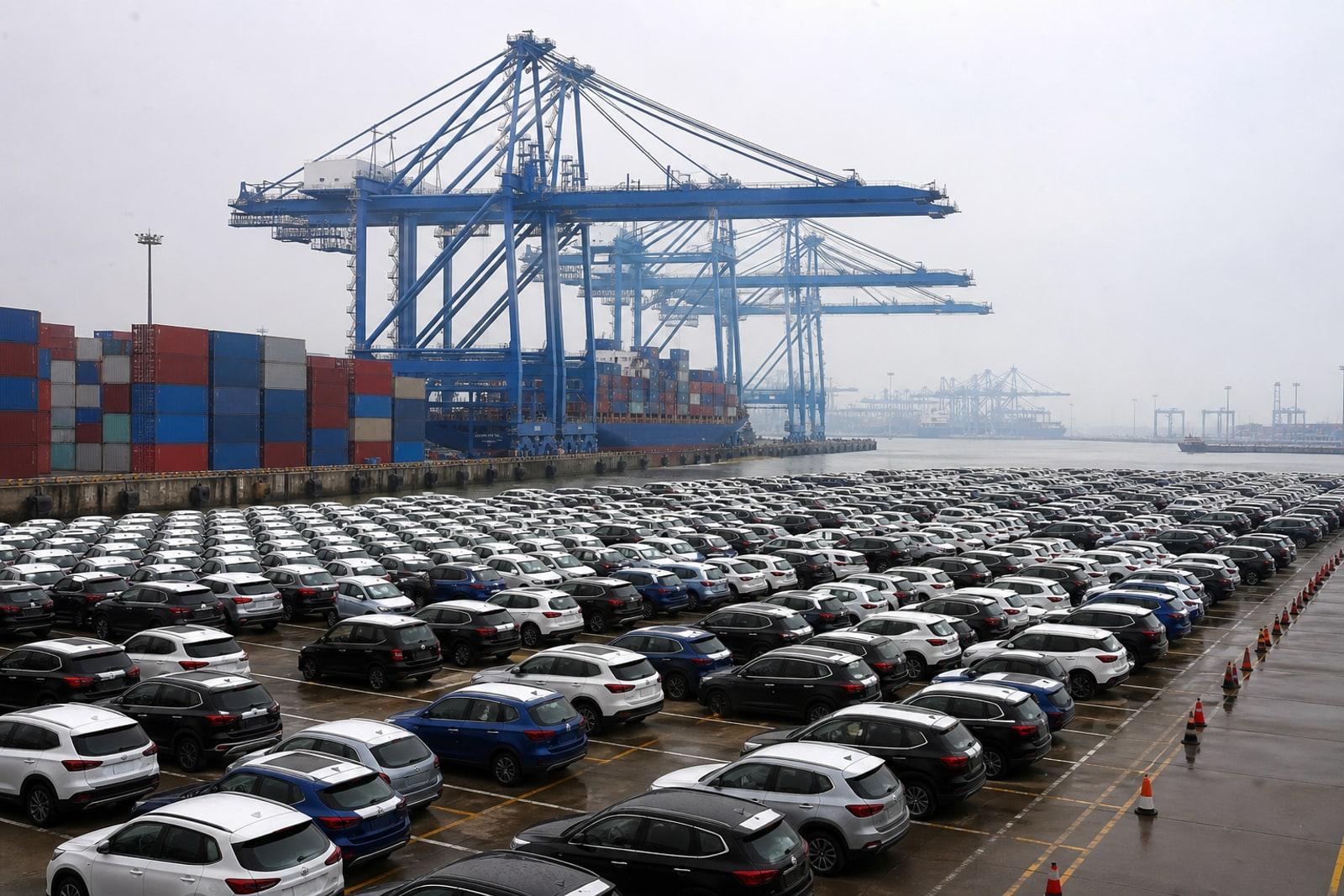
Foreign demand has so far prevented a more severe slowdown. China’s dollar-denominated exports surged 27% from a year earlier in June, while imports increased 36%, according to customs data reported independently by AP and Reuters. The monthly trade surplus reached $125.6 billion.
Much of the increase was associated with semiconductors, computing equipment, electric vehicles and other products benefiting from the global investment boom in artificial intelligence. In yuan terms, the statistics bureau said exports rose 13.4% over the first half and mechanical and electrical shipments increased 20.1%.
This strength is both a cushion and a vulnerability. Overseas orders keep factories operating when domestic buyers are cautious, but they also deepen China’s dependence on customers abroad. If trade barriers rise or global technology investment weakens, the economy would lose the engine currently offsetting its property and consumption problems. Export strength may also reduce Beijing’s immediate incentive to deploy a large stimulus package, even as pressure for measures supporting households increases.
Europe faces a two-sided risk
For Europe, weaker Chinese demand and stronger Chinese supply can hurt at the same time. European manufacturers sell machinery, vehicles, chemicals and high-value consumer goods into China; slower investment and subdued household spending threaten those revenues. Meanwhile, Chinese producers searching for growth abroad can intensify price competition in European markets.
The scale of the relationship makes that tension consequential. Eurostat recorded €199.6 billion of EU goods exports to China in 2025 and €559.4 billion of imports, leaving a €359.8 billion deficit. The European Commission says China remained the EU’s largest source of goods imports, with machinery and vehicles dominating bilateral manufactured-goods trade.
- European exporters: weaker Chinese consumption and capital expenditure threaten sales in sectors already facing soft global demand.
- European producers: additional Chinese exports may increase competitive pressure in vehicles, batteries, machinery, steel and consumer goods.
- Global supply chains: strong Chinese technology production can lower equipment costs, but greater concentration creates exposure to tariffs and geopolitical disruption.
The result is not a simple story of Chinese weakness. A slowdown driven by domestic demand can coincide with greater pressure on competing manufacturers elsewhere because Chinese factories seek more foreign buyers.
What financial markets will watch
The International Monetary Fund’s July outlook forecasts Chinese growth of 4.6% in 2026 and 4.1% in 2027. It expects world growth of 3.0% this year, underscoring the limited room for another large economy to lose momentum without consequences for commodity producers, exporters and corporate earnings.
For investors, the crucial indicators now extend beyond GDP. Retail sales and property investment show whether household confidence is recovering; factory output and exports show how long external demand can compensate; and policy announcements will reveal whether Beijing is prepared to shift more support toward consumers.
Strong exports mean the slowdown is not yet an abrupt break. But they also conceal the depth of the domestic adjustment. If foreign demand fades before consumption and property stabilise, the strain now visible inside China would travel quickly through global trade, industrial profits and financial markets.
Frequently asked
- How fast did China’s economy grow in the second quarter of 2026?
- Official data show real GDP grew 4.3% from a year earlier and 0.9% from the previous quarter. It was the slowest annual pace since the fourth quarter of 2022.
- What caused the slowdown?
- Weak consumer spending, falling fixed-asset investment and an 18% contraction in real-estate development investment outweighed resilient industrial production and exports.
- Why does the slowdown matter for Europe?
- European companies depend on Chinese demand for machinery, vehicles, chemicals and consumer goods, while China’s reliance on exports increases competitive pressure on European manufacturers.
- What should financial markets watch next?
- The key signals are retail sales, property investment, export momentum and whether Beijing directs additional fiscal or monetary support toward domestic demand.
Sources(10)
- 1National Economy Operated within an Appropriate Range with New Growth Drivers Developing Rapidly in the First Half YearNational Bureau of Statistics of China · stats.gov.cn
- 2China’s Q2 economic growth cools to 3-1/2-year low as imbalances worsenReuters · investing.com
- 3China's economy slows to 4.3% annual growth in April-JuneAssociated Press · apnews.com
- 4China Economic Update — July 2026World Bank · thedocs.worldbank.org
- 5July 2026 World Economic Outlook Update: Global Economy in Crosscurrents of War and TechnologyInternational Monetary Fund · imf.org
- 6China’s June exports surge 27% from a year earlier as AI boom drives strong demandAssociated Press · apnews.com
- 7China’s exports ride AI boom as domestic economy strugglesReuters · au.investing.com
- 8EU trade relations with ChinaEuropean Commission · policy.trade.ec.europa.eu
- 9Trade in goods with China in 2025Eurostat · ec.europa.eu
- 10China says talks with EU planned as two sides seek better balanceAssociated Press · apnews.com
Related by topic