Greater Region
Heatwave damages CFL track, disrupting cross-border rail in Luxembourg
Heat-damaged track near Berchem forced CFL to cancel and slow services on its southern cross-border lines, with disruption expected to last into Wednesday as Europe sweltered under a record heatwave.
By Tom Schmit · · 4 min read
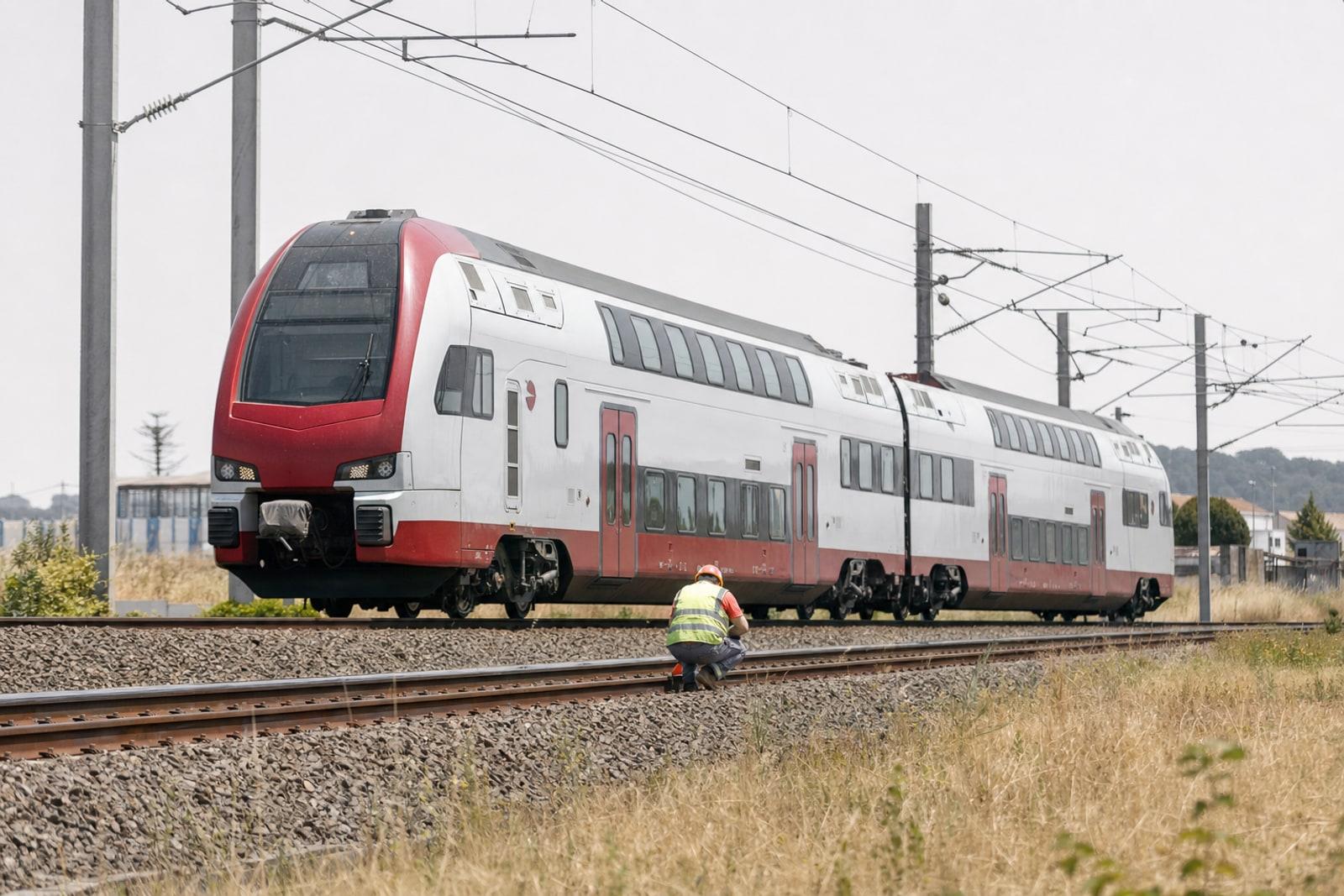
Luxembourg's railway network buckled under a record heatwave on Monday, as the national operator CFL slashed services on two of its busiest southern lines after extreme temperatures damaged the track south of the capital, stranding cross-border commuters travelling to and from France and Belgium.
The disruption struck as MeteoLux, the national weather service, placed the entire country under a red heat warning — its highest alert level — from midday on Monday 22 June. The government said exceptionally high temperatures would intensify through the week, with daytime readings of 36°C to 38°C in the south and averages climbing toward 40°C from Wednesday, accompanied by stifling nights and no rain in prospect.
CFL said a "slight subsidence" of the track had been identified at Berchem, a station on the southern approach to Luxembourg City, after the heat deformed the rails. For safety, the operator closed one track entirely, sharply cutting the capacity of the lines it feeds. The effect on the morning and evening peaks was immediate:
- RE express trains between Luxembourg and Rodange, via Esch-sur-Alzette, were cancelled in both directions between Luxembourg and Rodange;
- RB regional trains between Luxembourg and Pétange, via Esch-sur-Alzette, continued to run in both directions;
- TER cross-border services between Luxembourg, Thionville and Metz ran at reduced frequency, with several trains cancelled outright, while trains still operating crawled through the damaged section at sharply reduced speed.
A track that gave way in the heat
Repairs could begin only overnight, once temperatures had fallen far enough to let crews work safely on the line, CFL said. The operator expected a gradual resumption of traffic between Luxembourg and Bettembourg from 3 p.m. on Wednesday, apologised for the disruption and directed passengers to its app and website for alternatives. Drinking-water fountains were set up at Luxembourg's central station for waiting travellers.
Heat is an old enemy of steel rail. Continuous welded track is laid under tension for a target temperature; when the rail heats far beyond it, the steel expands and can distort, forcing operators to impose speed limits or shut a line until it cools. Overhead catenary wires sag in the heat and can be torn down by a train's pantograph, while on-board air-conditioning struggles in extreme conditions — a combination that pushes railways across Europe to run slower and thinner whenever the mercury spikes.
A region-wide standstill
The Luxembourg disruption was one node in a continent-wide seize-up. In France, the state operator SNCF pre-emptively cancelled dozens of Intercités services — 71 in all, according to industry reporting — citing the risk of air-conditioning failures, while its chief executive, Jean Castex, urged vulnerable passengers to stay off the trains altogether.
"We are advising them to postpone their journey, or at any rate to avoid taking the train during this heatwave period," Jean Castex told reporters, warning that incidents on the strained network could not be ruled out.
Castex pointed to two serious heat-related incidents since the start of the episode, at the Gare de l'Est in Paris and in Toulouse, and to a switch failure on France's Atlantic high-speed line. In Belgium, the national operator SNCB cut rush-hour trains, and red heat alerts were in force across several European countries as the 2026 heatwave drove temperatures toward 40°C.
A commuting lifeline exposed
For the Greater Region — the cross-border labour market spanning Luxembourg, Lorraine in France, Belgium's Wallonia and Germany's Saarland and Rhineland-Palatinate — the stakes are unusually high. Luxembourg counted around 228,300 cross-border workers in 2025, according to STATEC, the national statistics office; roughly 54% commute from France, 23% from Belgium and 23% from Germany, and together they make up close to half the country's workforce. The Esch-sur-Alzette and Thionville–Metz axes are among the most heavily travelled rail corridors carrying that daily flow.
That dependence is precisely what turns a localised heat fault into a regional problem. When a single damaged section near Berchem can sever express services to Rodange and thin out cross-border trains to Metz, the resilience of the corridor — not just its capacity — becomes the issue. Heat-driven disruption has become a recurring feature of European rail summers rather than a freak event, and each episode renews questions about how quickly railway infrastructure is being adapted to a climate that now routinely tests its limits.
For the tens of thousands of workers who rely on CFL to reach their jobs, Monday's failure converted an abstract climate forecast into a concrete commuting disruption: cancelled trains, slow journeys and an uncertain wait for normal service to resume. With the heatwave forecast to peak only mid-week, CFL's overnight repairs offered relief rather than resolution — and a reminder that the Greater Region's busiest rail arteries remain vulnerable to a hotter climate.
Frequently asked
- Which CFL lines were affected by the heatwave?
- The Luxembourg–Esch-sur-Alzette–Rodange and Luxembourg–Thionville–Metz lines, plus services between Luxembourg and Bettembourg. RE trains to Rodange were cancelled, RB trains to Pétange kept running, and cross-border TER services to Metz ran reduced and at lower speed.
- What caused the disruption?
- Extreme heat deformed the track, and CFL identified a slight subsidence at Berchem, south of Luxembourg City. For safety it closed one track, cutting capacity on the lines it serves.
- How long was the disruption expected to last?
- Repairs could only begin overnight once temperatures dropped. CFL expected a gradual resumption of traffic between Luxembourg and Bettembourg from 3 p.m. on Wednesday 24 June.
- Were trains affected elsewhere in Europe?
- Yes. France's SNCF pre-emptively cancelled dozens of Intercités trains and advised vulnerable passengers to avoid travel, while Belgium's SNCB cut rush-hour services, as red heat alerts spread across several countries.
Sources(13)
- 1Heatwave Causes Major Disruptions on CFL Rail LinesChronicle.lu · chronicle.lu
- 2CFL : la circulation des trains fortement perturbée jusqu'à mercrediLe Quotidien · lequotidien.lu
- 3CFL : la canicule perturbe deux lignes à destination d'Esch et de Thionville-MetzLe Quotidien · lequotidien.lu
- 4Canicule : trains fortement perturbés sur les lignes Luxembourg – Esch/Alzette – Rodange et Luxembourg – Thionville – MetzLes Frontaliers · lesfrontaliers.lu
- 5Canicule: plusieurs trains supprimés entre Luxembourg et Metz ce lundiL'essentiel · lessentiel.lu
- 6Red alert: Exceptional heatwave until the end of the weekLe Gouvernement du Grand-Duché de Luxembourg · gouvernement.lu
- 7Red Weather Alert: Heatwave Pushes Temperatures to 38°CChronicle.lu · chronicle.lu
- 8SNCF cancels 71 Intercités services pre-emptively amid heatwaveTrenvista · trenvista.net
- 9Belgium Joins France, Netherlands, Luxembourg, and United Kingdom in Drastic Rail Service Cuts as SNCB Cancels Rush Hour TrainsTravel And Tour World · travelandtourworld.com
- 10Canicule: la SNCF recommande aux personnes « vulnérables » d'éviter de prendre le train (Castex)L'Info Durable · linfodurable.fr
- 11Europe heatwave: These countries have issued red heat alerts as continent sweltersEuronews · euronews.com
- 12Cross-border workers in Luxembourg: who are they and why are they important?Luxtoday.lu · luxtoday.lu
- 13Domestic payroll employment: +0.2% in the second quarter of 2025 and +0.9% over 12 monthsSTATEC / Statistics Portal Luxembourg · statistiques.public.lu
Related by topic