Public transport
Free Public Transport in Luxembourg: What Still Costs Money
Buses, trams and trains are free to everyone inside the country. First class, any journey past the border, and since January the way you buy a ticket are not.
By Léa Hoffmann · · 4 min read
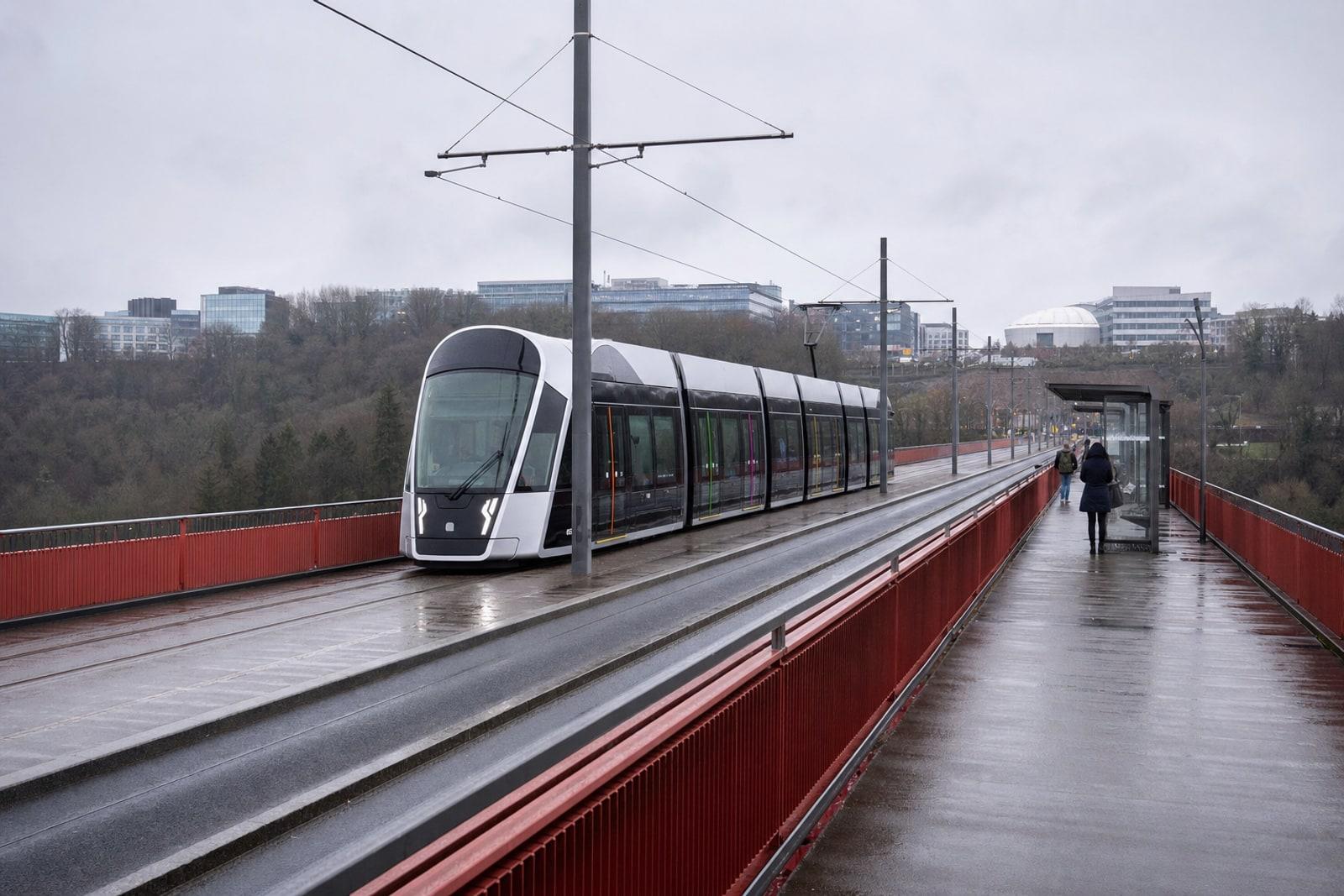
Public transport in Luxembourg has been free to everyone since 1 March 2020, when the Grand Duchy became the first country in the world to make its whole national network free of charge. There is no ticket to buy, no registration, and no residency test: buses, trams and trains carry residents, cross-border commuters and tourists on the same terms. Three things, though, still cost money — and one of them changed this January.
What is free, and for whom
The exemption covers the entire territory of the Grand Duchy and effectively the entire network: RGTR and municipal buses, the Luxembourg City tram, and CFL trains in second class. It does not depend on nationality or residence, so a visitor landing at Findel needs nothing more than to get on a bus.
Less well known is that free travel does not stop precisely at the frontier. Three stations on the other side of it are included, which matters to a great many daily commuters:
Free travel ends at the border, so you will need a cross-border ticket or subscription to travel beyond the Grand Duchy. Free travel also applies to 2nd class train journeys to and from Athus (B), Audun-le-Tiche (F), and Volmerange-les-Mines (F).
Everywhere else, the border is the border. And the checking of it is stricter than most travellers expect: anyone intending to cross must be able to show a valid ticket on request, and that inspection happens no later than the last stop inside Luxembourg. The ticket has to be in hand before the frontier, not bought once across it.
First class is not free
First class exists only on CFL trains — there is no first class on a bus or on the tram — and it has never been covered by the free fare. The national first-class prices are:
- 2-hour ticket: €3, or €24 for a booklet of ten;
- 1-day ticket: €6, or €24 for a booklet of five;
- monthly pass: €60;
- annual pass: €500;
- senior pass, for travellers aged 60 and over: €200.
One restriction catches people out: a national first-class ticket is not valid on international train lines. Boarding a first-class carriage on a service that continues abroad requires a different ticket altogether.
Crossing the border costs money
Every cross-border leg needs its own ticket or subscription. On the cross-border bus network this is the RegioZone fare:
- 2-hour ticket €3; 1-day ticket €5;
- monthly pass €40; annual pass €360;
- Studentepass €130;
- holders of an invalidity card issued in Belgium, Germany, France or Luxembourg travel free.
The Saarbrücken Express coach sits outside that structure and is priced separately, at €5 for two hours, €9 for a day, €85 a month, €750 a year, or €200 for a student pass. Several Belgian routes — among them the Bastogne, Florenville, Virton and Arlon services — run on Belgian TEC fares instead, and on many German routes the Deutschland-Ticket or the regional VRT tariff is accepted as an alternative to RegioZone.
Cross-border trains are a separate category again, with their own tickets rather than the RegioZone bus fare. This is the point most often misunderstood by the people it affects most. Luxembourg's largest commuter rail flows — from Thionville and Metz, from Arlon, from Trier — are not free journeys. The free fare applies to the Luxembourg portion of the network, and the three stations named above are the only foreign ones a second-class passenger reaches without paying. A commuter boarding at Thionville still needs a ticket for the French leg, even though the same train becomes free the moment it is inside the country.
What changed on 1 January 2026
The fare system was simplified and taken fully digital at the start of this year, and the practical consequences are larger than the announcement suggested. A single RegioZone fare now applies across all bus connections between Luxembourg and its neighbours, the Saarbrücken Express aside, replacing the zonal pricing that came before it. CFL also introduced one unified first-class subscription, monthly or annual, valid on every train operating inside the country.
The bigger change is how you pay. The mKaart is no longer valid, and tickets can no longer be bought on board a bus or at a CFL sales centre. Purchases now go through the CFL go app, the CFL International app or the railway's website, through ticket vending machines at selected stations and on platforms, or at a CFL counter. The mShop has closed.
For most people inside Luxembourg none of this alters anything, because they were never buying a ticket to begin with. For the cross-border workforce arriving from France, Belgium and Germany each morning, and for anyone who prefers a first-class seat, the change is real: paying the driver in cash no longer works, and the fallback is an app or a machine. Older guidance is worth treating with caution here — the official English-language page on guichet.lu still carries a last-updated stamp of 2 March 2020, the week the policy began.
Frequently asked
- Is public transport really free in Luxembourg for tourists?
- Yes. The free fare applies to everyone travelling inside the country regardless of nationality or residence, and there is nothing to buy or register. It covers buses, the tram and second-class rail across the whole territory.
- What is not free on Luxembourg public transport?
- Two things. First class on CFL trains, which starts at €3 for a two-hour ticket and runs to €500 for an annual pass. And any journey that continues beyond the border, which needs a RegioZone ticket or subscription.
- Do I need a ticket to travel to France, Belgium or Germany?
- Yes, for almost every route. The exception is second-class trains to and from Athus in Belgium and Audun-le-Tiche and Volmerange-les-Mines in France, which remain free. You must hold the ticket before the last stop inside Luxembourg, because that is where inspection takes place.
- Can I still buy a ticket on the bus or with an mKaart?
- No. Since 1 January 2026 the mKaart is no longer valid and tickets are not sold on board buses or at CFL sales centres. Use the CFL go app, the CFL website, a ticket vending machine or a CFL counter.
Sources(4)
- 1Fares in Luxembourg - official national and cross-border fare tablesAdministration des transports publics (mobiliteit.lu) · mobiliteit.lu
- 2Harmonisation and digitalisation of cross-border and 1st class ticketsAdministration des transports publics (mobiliteit.lu) · mobiliteit.lu
- 3Cross-border ticketsAdministration des transports publics (mobiliteit.lu) · mobiliteit.lu
- 4Using free public transport in Luxembourgguichet.lu · guichet.public.lu
Related by topic