India’s space economy
Skyroot reaches orbit with India’s first privately developed orbital rocket
Vikram-1 placed two satellites in low-Earth orbit, validating a private launch vehicle built with extensive support from India’s state space infrastructure.
By Marc Weber · · 4 min read
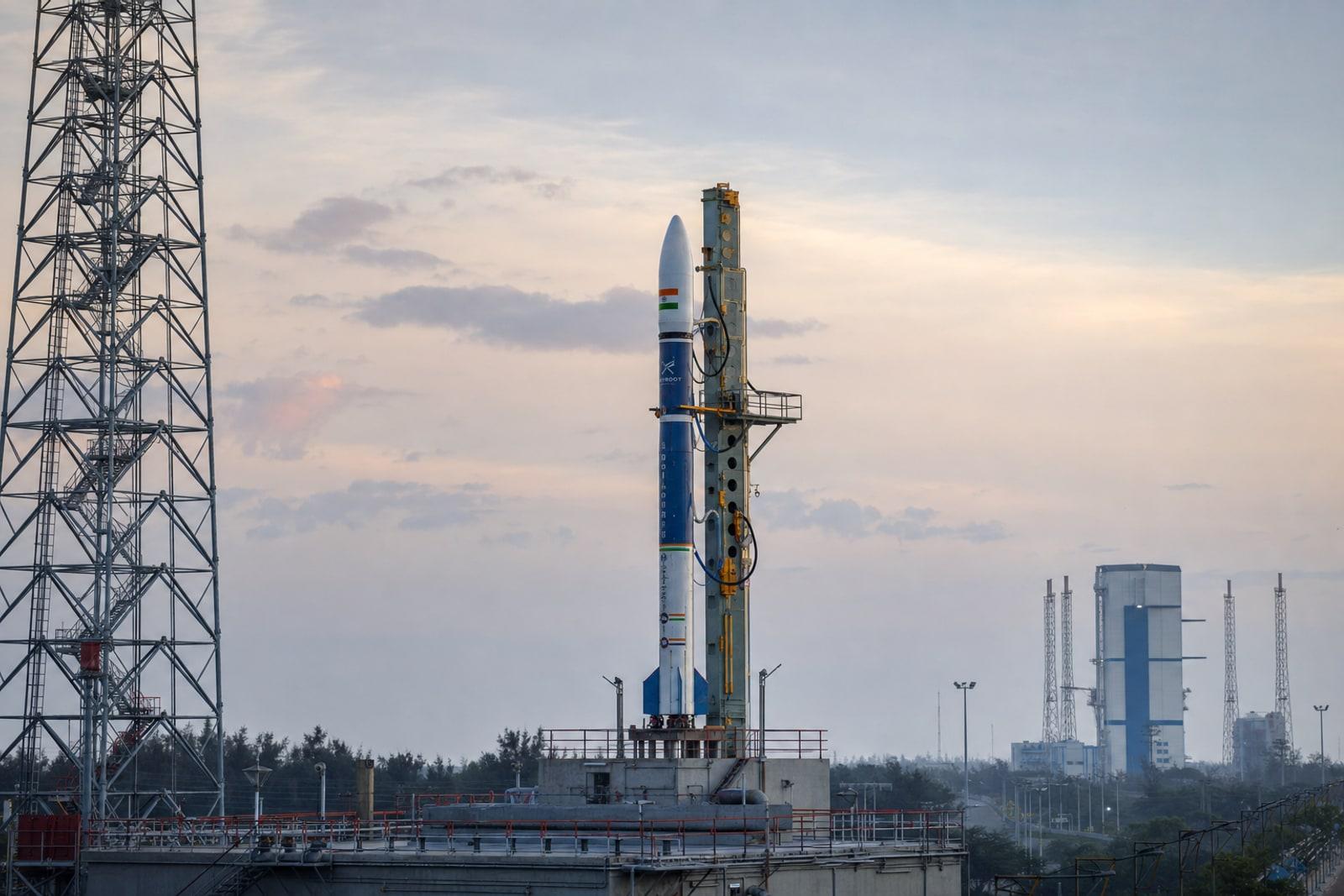
India’s first privately developed orbital rocket successfully placed payloads into low-Earth orbit on Saturday, giving the country’s emerging commercial space industry a technical milestone that had previously belonged only to the state programme.
Skyroot Aerospace’s Vikram-1 lifted off from the Indian Space Research Organisation’s Satish Dhawan Space Centre at Sriharikota at 12:05:30 p.m. local time on 18 July. Reuters reported that the rocket injected its payload into an orbit about 450 kilometres above Earth roughly 15 minutes later. ISRO separately confirmed that two satellites, identified as SCOPE and Grahaa, reached low-Earth orbit, while Space.com reported that the vehicle completed its planned sequence and payload deployment within 17 minutes.
The concordant reports establish that orbit—not merely space—was achieved. That distinction is central to what Skyroot accomplished: remaining in orbit requires far greater speed and a more complex sequence of propulsion, guidance and stage-separation events than a suborbital flight.
What makes Vikram-1 a national first
The precise first is that Vikram-1 is the first orbital launch vehicle developed by a private Indian company and Skyroot is the first private Indian company to place payloads in orbit from Indian soil. Reuters and Deutsche Welle also described India as the third country, after the United States and China, to demonstrate private-enterprise orbital launch capability.
It was not India’s first privately developed rocket to reach space. Skyroot’s smaller Vikram-S vehicle flew from Sriharikota in November 2022, but that technology demonstrator followed a suborbital path and returned to Earth rather than accelerating into orbit. Aagaman—Sanskrit for “arrival”—was the company’s first orbital attempt.
The “private” label also needs qualification. Skyroot designed and built the launch vehicle, but the mission relied heavily on public infrastructure. It flew from an ISRO launch pad, while ISRO said it had provided solid-motor casting and test facilities, testing for the Raman-I liquid upper-stage engine, trajectory analysis, integration assistance and round-the-clock safety support. IN-SPACe, the government’s private-space regulator and promoter, supplied technical reviews and launch clearances.
The milestone is therefore private vehicle development and operation within a state-enabled system—not a launch conducted independently of India’s public space programme.
A small launcher and an experimental manifest
Vikram-1 stands about 22 metres tall and has four stages. Its first three stages burn solid fuel; a liquid-fuel orbital-adjustment module performs the final insertion work. Skyroot describes the vehicle as having an all-carbon-composite structure and a 3D-printed liquid engine. Its advertised capacity is up to 350 kilograms to low-Earth orbit.
That 350-kilogram figure is the rocket’s rated capacity, not the confirmed mass carried on Aagaman. The authoritative sources reviewed for this article did not disclose a combined payload mass. They identified the principal payloads as:
- SCOPE, Skyroot’s experimental satellite for collecting mission and technology data;
- SOLARAS S3, a nanosatellite pathfinder from Indian company Grahaa Space;
- DCUBED demonstrations, German-built hardware intended for testing in orbit; and
- Embrace, a robotic-arm experiment from India’s Cosmoserve Space designed around the capture of orbital debris.
ISRO said SCOPE and Grahaa were injected into orbit, while the remaining experiments were carried on the upper stage. The mission also included symbolic objects, among them a miniature gold rocket and an artwork made with a lab-grown diamond.
Skyroot had published a target orbit of 450 kilometres at an inclination of 60 degrees. Post-launch reporting confirmed the 450-kilometre insertion, but the sources reviewed did not publish final orbital elements independently confirming the achieved inclination. The verified conclusion is therefore successful low-Earth-orbit insertion at the reported altitude, without claiming more precision than the available data supports.
From technical success to commercial test
Aagaman matters because small-satellite operators do not always want to wait for space on a larger rocket travelling to an approximately suitable orbit. A dedicated small launcher can, in principle, offer more control over schedule and destination, although it must compete with relatively inexpensive rideshare capacity on larger vehicles.
The 'cab' market is what we want to put our mark on with the Vikram series.
Skyroot chief executive Pawan Kumar Chandana used that comparison in an interview with Space.com before the flight, contrasting a dedicated “cab” with the “train” of a rideshare mission. Reuters reported that Skyroot called Aagaman “a grand success” but stressed that it was a test flight and that more test missions would precede routine commercial service.
That caution is significant. Reaching orbit once proves a difficult set of technologies; it does not yet demonstrate production cadence, repeat reliability, competitive pricing or sustained customer demand. Those will determine whether Vikram-1 becomes an enduring launch business rather than a singular engineering achievement.
India’s government has deliberately created the policy environment for that test. Reforms beginning in 2020 and the Indian Space Policy 2023 allow non-government entities to build and operate launch vehicles and infrastructure under IN-SPACe authorisation. The government told parliament in April 2026 that India’s space economy was worth about $8.4 billion in 2023—roughly 2% of the global market—and projected it could reach $44 billion by 2033. The Press Information Bureau counted 399 space start-ups in January.
Those projections remain policy ambitions, not assured revenue. Vikram-1 nevertheless supplies something more tangible: evidence that an Indian start-up can design an orbital-class rocket, navigate the country’s regulatory system and deliver satellites to orbit on its first attempt. The next measure of success will be whether Skyroot can do it repeatedly and sell the service in a crowded global market.
Frequently asked
- Did Vikram-1 successfully reach orbit?
- Yes. Reuters reported injection into a 450-kilometre orbit, ISRO confirmed that two satellites reached low-Earth orbit, and Space.com reported scheduled payload deployment after a nominal flight.
- What exactly was India’s national first?
- Vikram-1 was the first privately developed Indian orbital rocket, and Skyroot became the first private Indian company to place payloads in orbit from Indian soil. Vikram-S had reached space in 2022 but only on a suborbital flight.
- Was the launch entirely independent of ISRO?
- No. Skyroot developed the vehicle, but it launched from an ISRO spaceport and used state facilities and technical support for testing, integration, trajectory work and safety. IN-SPACe handled reviews and authorisation.
- How much can Vikram-1 carry?
- Skyroot advertises capacity of up to 350 kilograms to low-Earth orbit. That is the rocket’s rated capacity; the reviewed sources did not disclose the combined mass flown on Mission Aagaman.
Sources(10)
- 1India's Skyroot launches Vikram-1 in first private orbital rocket missionReuters · in.marketscreener.com
- 2First private orbital launch lifts off from SriharikotaIndian Space Research Organisation · isro.gov.in
- 3'The dawn of a new space era': Vikram-1, India's 1st private orbital rocket, aces debut launchSpace.com · space.com
- 4Getting Vikram-1 to orbit: Inside Skyroot Aerospace's coming bid to make spaceflight historySpace.com · space.com
- 5Skyroot | On-Demand Space Launch VehiclesSkyroot Aerospace · skyroot.in
- 6Vikram-1, India’s first private rocket, successfully reaches orbitThePrint · theprint.in
- 7India launches first private rocket into spaceDeutsche Welle · amp.dw.com
- 8Indian Space Policy 2023Government of India, Department of Space · isro.gov.in
- 9Share in Space Economy — Rajya Sabha Unstarred Question No. 4461Parliament of India · sansad.in
- 10India’s space economy at $8.4 billion, nearly 400 start-ups active after sector opened to private playersPress Information Bureau, Government of India · pib.gov.in
Related by topic