Climate finance
World Bank drops portfolio climate targets but keeps project-level climate screens
The lender removed its 45% and 35% financing benchmarks, while retaining climate reporting, a separate target for its poorest-country fund and Paris-alignment assessments.
By Marc Weber · · 4 min read
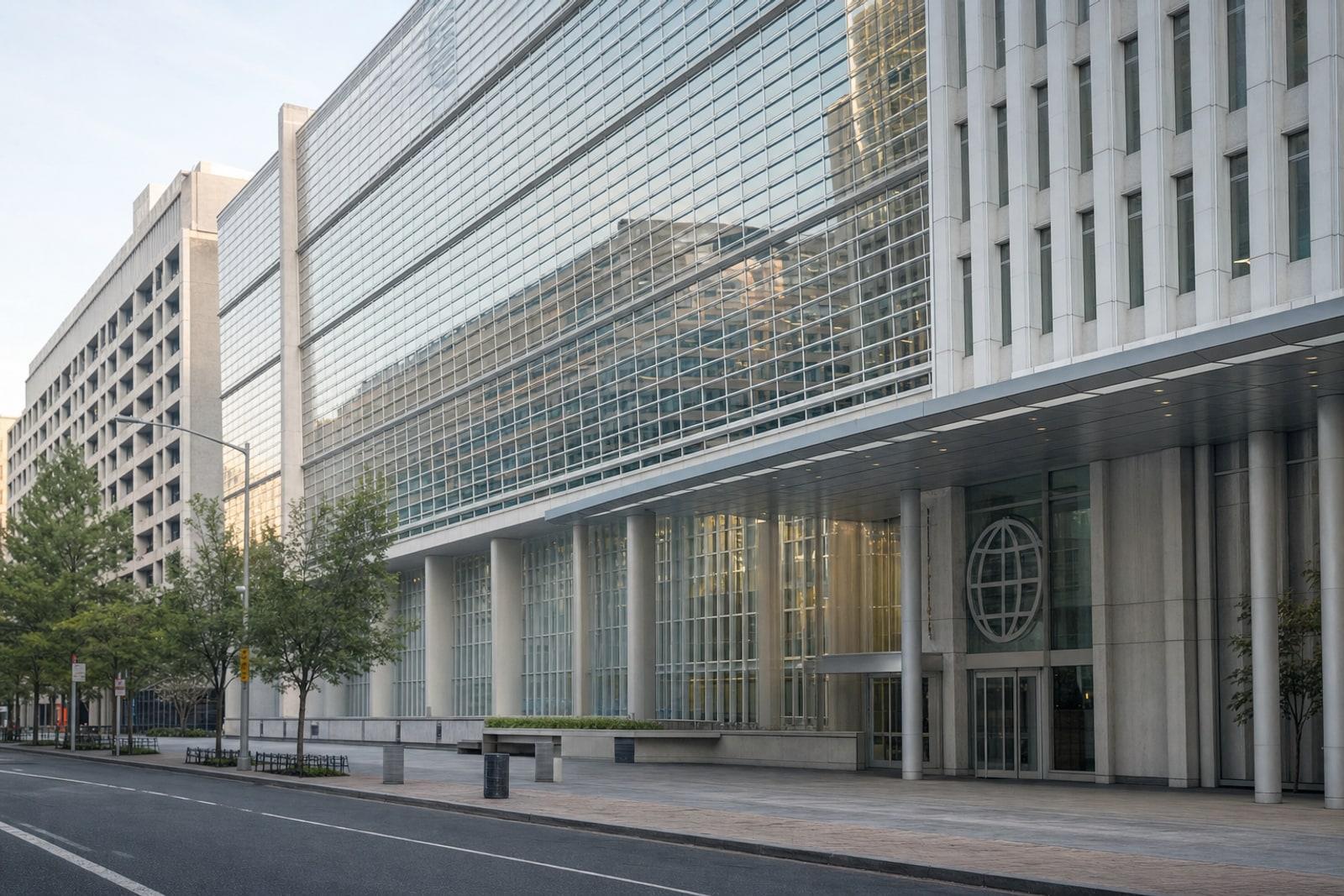
The World Bank has removed its headline requirement for climate benefits to account for 45% of annual financing, ending a portfolio-wide benchmark that had become a prominent signal of the lender’s climate ambition.
The decision is significant, but narrower than a wholesale abandonment of climate policy. In its June 29 statement, the bank extended its Climate Change Action Plan, retained two outcome indicators and promised to keep reporting climate finance. It did not cancel individual loans, withdraw its separate framework for testing new operations against the Paris Agreement or remove a climate-finance commitment governing its poorest-country fund.
What has disappeared is the group-wide minimum share of financing that management was expected to classify as producing climate co-benefits. That change can still influence which future projects are selected and how they are structured, even if it is not itself a new lending ban or permission.
Two corporate percentages were retired
The bank explicitly named two targets. The first was the 35% climate-finance share established by its 2021–2025 Climate Change Action Plan, calculated as an average across the plan’s period. The second was the more ambitious 45% annual climate co-benefits goal announced at COP28 in December 2023 for the fiscal year ending June 2025.
We will retire the 45% climate co-benefits target
The distinction matters because the older 35% target was already tied to a completed planning period. The forward-looking consequence is that the bank extended the wider action plan without replacing the 45% corporate benchmark with another group-wide percentage floor. Reuters, AFP and POLITICO’s E&E News all reported the removal.
The bank had exceeded the benchmark before retiring it. Its fiscal 2025 data show that 48% of World Bank Group financing had climate co-benefits, compared with 44% a year earlier. AFP put the corresponding group-wide amount at about $50.8 billion. The World Bank’s public-sector arms, IBRD and IDA, supplied $39.2 billion of that total.
Climate co-benefits are an input measure rather than a verdict that an entire project is green. Under the multilateral banks’ methodology, assessors identify the portion of committed finance attributable to eligible emissions-reduction or adaptation activities. The World Bank’s own methodology notes that the measure captures climate-positive components but is limited in describing a project’s overall climate impact.
What the bank kept
The June announcement preserved more of the institutional framework than the word “retreat” might suggest. The bank said the action plan would continue, with climate work driven by borrowing countries’ national plans and nationally determined contributions. Its Independent Evaluation Group will review the plan.
- The bank will continue reporting climate co-benefits for individual projects and for the portfolio.
- Its corporate scorecard will continue tracking net greenhouse-gas emissions.
- It will also track beneficiaries whose resilience to climate risks has improved.
- A separate climate-finance commitment for the International Development Association remains in place.
That IDA21 commitment requires at least 45% of IDA financing on average over fiscal 2026–2028 to have climate co-benefits, with at least half of gross climate finance supporting adaptation. IDA provides concessional loans and grants to the poorest countries. The commitment appears in the official IDA21 policy package, and E&E News reported after the June decision that climate targets embedded in separate agreements, including IDA’s, would remain.
Nor did the announcement say that Paris-alignment assessments had been withdrawn. The bank’s current public guidance says new financing is screened for consistency with low-emissions and climate-resilient development, including whether lower-carbon options are technically and economically feasible and whether material climate risks have been managed. The evidence therefore supports describing the June decision as removal of a portfolio allocation target, not elimination of project-level climate scrutiny.
Pressure from Washington, consequences abroad
The policy shift followed an explicit campaign by the United States, the bank’s largest shareholder. In an April statement, Treasury Secretary Scott Bessent demanded that the 45% target be jettisoned, arguing that it distorted economic decisions and diverted the institution from poverty reduction. Reuters and POLITICO reported that U.S. pressure continued during the board negotiations.
The bank offered a different public rationale: it said the institution was completing a move from measuring inputs to measuring development outcomes, while making its climate work responsive to client demand. Those positions are not mutually exclusive. A financing-share target measures allocation and creates an internal incentive; an emissions or resilience indicator measures intended or delivered results. Removing the former gives management and borrowers more flexibility, but also removes a clear, easily audited floor.
The scale explains why the decision reaches beyond Washington. The World Bank Group committed $118.5 billion in loans, grants, equity investments and guarantees in fiscal 2025. Reuters reported in July that it supplied almost half of the $102.6 billion in climate finance that multilateral development banks directed to developing economies during 2025. The European Investment Bank’s joint figures put total MDB climate finance at about $163 billion.
The immediate lending pipeline may remain strong because many borrowing countries want renewable power, resilient agriculture, flood protection and other investments with climate benefits. But without a corporate percentage target, future volumes will depend more heavily on country demand, project economics, management priorities and the outcome of the independent review. The bank has preserved its climate machinery; it has removed one of the clearest constraints governing how much finance must pass through it.
Frequently asked
- Which World Bank climate targets were dropped?
- The bank retired the group-wide 45% climate co-benefits target and the 35% climate-finance target contained in its 2021–2025 Climate Change Action Plan.
- Does this mean the World Bank stopped financing climate projects?
- No. The bank retained its Climate Change Action Plan, climate-finance reporting, greenhouse-gas and resilience indicators, and project-level Paris-alignment framework. Borrowers can continue seeking renewable-energy, adaptation and resilience finance.
- Were individual lending decisions reversed?
- The announcement did not cancel approved loans or identify projects for reversal. It removed an aggregate portfolio allocation floor, which may affect future project selection and structuring.
- Does any 45% target remain?
- Yes. The separate IDA21 agreement requires at least 45% of IDA commitments on average over fiscal 2026–2028 to have climate co-benefits, with at least half of gross climate finance allocated to adaptation.
Sources(19)
- 1Update on the World Bank Group Climate Change Action PlanWorld Bank Group · worldbank.org
- 2World Bank to abandon goal to devote 45% of lending resources to climate change projectsReuters via The Straits Times · straitstimes.com
- 3World Bank drops climate finance target amid US pressureE&E News by POLITICO · eenews.net
- 4World Bank drops climate finance targets in renewed action planAFP via Digital Journal · digitaljournal.com
- 5Secretary Bessent IMFC-DC StatementU.S. Department of the Treasury · home.treasury.gov
- 6World Bank Group Doubles Down on Financial Ambition to Drive Climate Action and Build ResilienceWorld Bank Group · worldbank.org
- 7What You Need to Know About the World Bank Group's 2nd Climate Change Action PlanWorld Bank Group · worldbank.org
- 8World Bank Climate Finance 2025World Bank Group · thedocs.worldbank.org
- 9IDA Results Measurement System Indicator Methodology CodebookInternational Development Association · thedocs.worldbank.org
- 10The World Bank Group and Paris AlignmentWorld Bank Group · worldbank.org
- 11IDA21 Replenishment: Final ReportInternational Development Association · documents1.worldbank.org
- 12Development banks’ climate funding hits record, but World Bank pullback loomsReuters via Investing.com · investing.com
- 13Multilateral development banks increase climate finance to record $163 billion in 2025European Investment Bank · eib.org
- 14World Bank Extends Climate Change Action Plan, But Drops Key Climate Finance TargetWorld Resources Institute · wri.org
- 15BIC’s Statement on the World Bank Group’s Extension of the CCAPBank Information Center · bankinformationcenter.org
- 16Financial Summary: World Bank Group Annual Report 2025World Bank Group · worldbank.org
- 17Multilateral banks are key to financing the fight against global warming. Here is how they workAssociated Press · apnews.com
- 18World Bank Headquarters: The Town Square for an International CommunityKohn Pedersen Fox · kpf.com
- 19About the World BankWorld Bank Group · worldbank.org
Related by topic

Skyroot reaches orbit with India’s first privately developed orbital rocket