Technology and power
Xi’s bid to write the world’s AI rules tests China’s reach — and its limits
A new Shanghai-based body gives Beijing a platform to court developing states, but censorship and chip constraints complicate its leadership claim.
By Marc Weber · · 5 min read
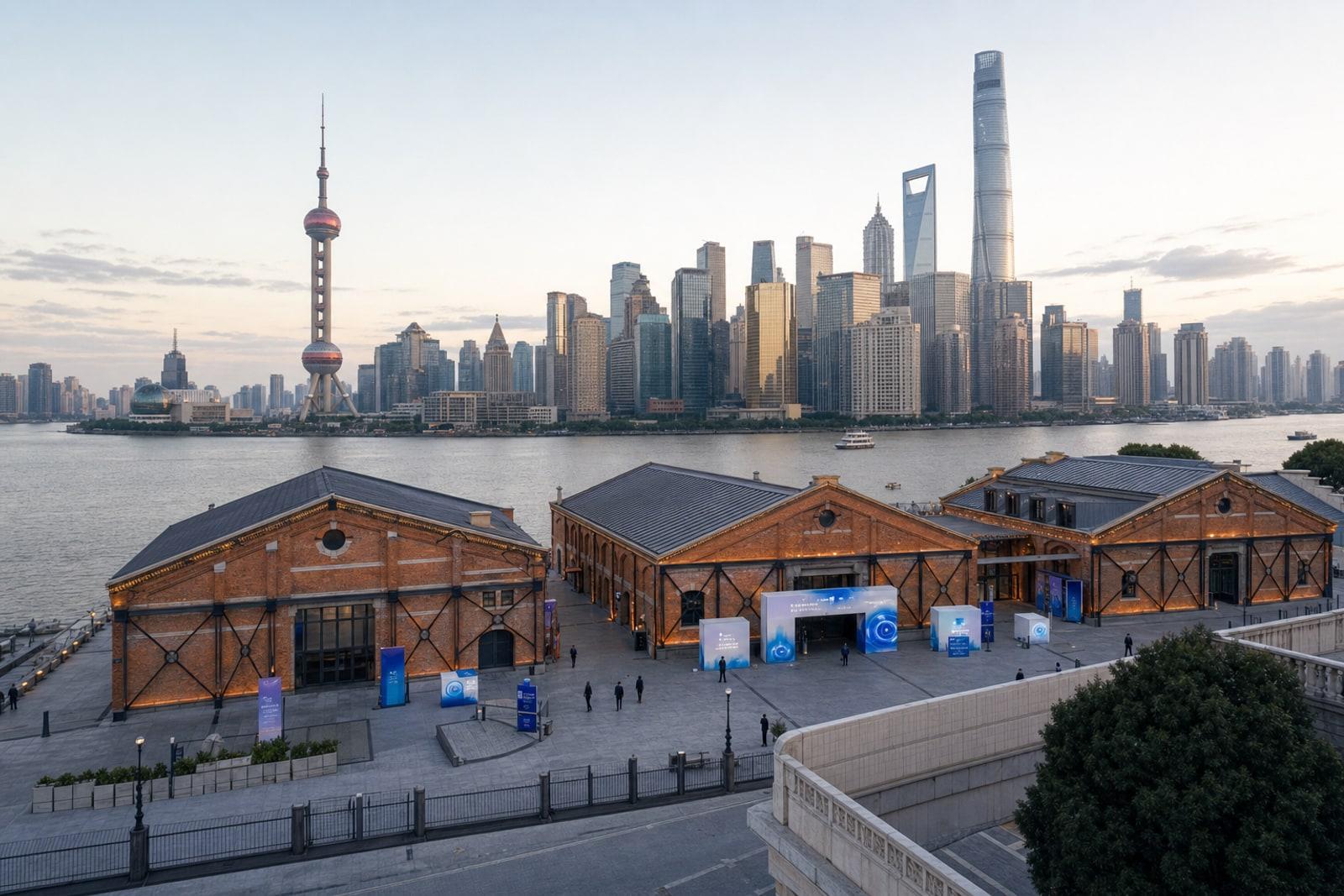
SHANGHAI — Xi Jinping has turned China’s campaign to influence artificial-intelligence rules into an institutional challenge to American technological power, presenting Beijing as the champion of countries that fear being locked out of the most consequential technology of the age.
At the World Artificial Intelligence Conference in Shanghai on Friday, the Chinese president celebrated the creation of the World Artificial Intelligence Cooperation Organization, or WAICO. Representatives of 29 countries had signed its founding agreement a day earlier. The body will be headquartered in Shanghai, according to Reuters and the Associated Press.
The development of artificial intelligence should not be a solo performance by any single country but rather a symphony of global cooperation.
Xi’s language was inclusive, but the geopolitical purpose was plain. China is offering developing states access to models, training and infrastructure while contesting the US claim to lead on technology, supply chains and standards. AI rule-setting is becoming a means of determining whose chips, platforms and political assumptions other countries will depend on.
A rulebook built around access and sovereignty
Xi organised his proposal around four themes: open innovation and sharing; tighter safeguards and human control over AI; respect for different cultures; and multilateral governance with the United Nations playing a central role. He called for coordination on development strategies, technical standards and governance rules, while opposing the use of national security restrictions that place one country’s interests above another’s.
The speech builds on China’s 2025 Global AI Governance Action Plan. That document promotes cross-border open-source communities, shared infrastructure and data, safety testing, risk-based management and standards work through bodies including the International Telecommunication Union, ISO and IEC. It also stresses national sovereignty and different development conditions—a formula that gives governments wide latitude over how AI is controlled domestically.
The package is aimed directly at states with limited computing power, specialist talent or access to frontier models. Founding members reported independently include Russia, Brazil and Pakistan. Xi said China would deepen cooperation with ASEAN, the League of Arab States, the African Union, the Community of Latin American and Caribbean States, the Shanghai Cooperation Organization and BRICS.
- China will offer 5,000 AI training opportunities to developing countries over five years.
- It plans international AI application centres with regional organisations.
- Thirty countries are to receive access to China’s MAZU AI meteorological-warning system.
These are tangible incentives, not merely diplomatic language. Yet the published proposals provide principles and projects rather than a common inspection or enforcement regime. Their immediate power is therefore likely to come from adoption: countries using Chinese models, infrastructure and standards may gradually align with Beijing’s preferences.
A direct answer to Washington
The competition is unusually explicit. The White House’s own strategy calls for exporting “full-stack” American packages combining hardware, data systems, models, cybersecurity and sector-specific applications. Its stated objective is to spread US standards and governance models while reducing dependence on systems from adversarial countries. An analyst cited by AP described WAICO as China’s response to the US-led Pax Silica supply-chain initiative.
China nevertheless has a stronger technological case than it did two years ago. DeepSeek and other Chinese developers have popularised capable, lower-cost open models, an attractive proposition for governments and businesses unable to build frontier systems themselves. Stanford’s 2026 AI Index said the performance difference between the top American and Chinese models had narrowed to 2.7% by March.
But the same research shows the remaining imbalance. US institutions produced 59 notable models in 2025, compared with China’s 35—a count also cited by the UN’s independent scientific panel. American private AI investment remained far higher. China led in publication volume, citations and patent grants, but the United States retained advantages in frontier-model production, investment and advanced computing infrastructure.
Censorship and chips expose the contradictions
Beijing’s international emphasis on openness sits uneasily with its domestic information controls. Chinese rules require generative-AI services offered to the public to uphold “core socialist values” and prohibit outputs deemed to subvert state power, harm national security or damage the country’s image. AP testing found that DeepSeek declined to discuss the 1989 Tiananmen crackdown, while Reuters reported that Chinese chatbots routinely avoid sensitive domestic politics.
Those controls do not prevent China from exporting useful software. They do, however, complicate a claim to offer universally open systems. Governments attracted by Beijing’s promise of sovereignty may welcome the freedom to apply their own controls; civil-society groups and democratic states may see a model in which political authority defines acceptable output.
Hardware is the second constraint. Washington now reviews exports of Nvidia’s H200 and similar processors to approved Chinese customers case by case, a partial easing from earlier restrictions. But Jeffrey Kessler, the senior US export-control official, told Congress on 14 July that shipments so far were “very few”. China remains barred from Nvidia’s most advanced processors and from ASML’s extreme-ultraviolet lithography machines, AP reported.
Huawei has gained ground with domestic chips and large computing clusters, reducing the leverage of US restrictions. Its best systems still lag at parts of the frontier, however, and Chinese demand for advanced processors exceeds available supply. That limits how quickly Beijing can provide the scale of computing it is promising abroad.
China does not need to displace the United States outright for Xi’s strategy to matter. If it becomes the preferred supplier of open models and training to a large group of emerging economies, it will gain a durable voice in standards and procurement. The contest is therefore not between one global order and none, but between rival ecosystems—each coupling technological access with strategic dependence.
Frequently asked
- What is the World Artificial Intelligence Cooperation Organization?
- WAICO is a new intergovernmental body headquartered in Shanghai. China and 28 other founding states say it will coordinate international cooperation and governance in artificial intelligence.
- Which countries is China trying to attract?
- The campaign focuses heavily on the Global South and works through ASEAN, the African Union, the League of Arab States, CELAC, the Shanghai Cooperation Organization and BRICS. Reported founding members include Russia, Brazil and Pakistan.
- How does China’s proposal differ from the US approach?
- China emphasises open models, capacity building, sovereignty and UN-centred governance. The United States is promoting exports of integrated American hardware, models and applications alongside US standards and security controls.
- What limits China’s claim to AI leadership?
- Public-facing Chinese AI systems operate under political-content controls, while restrictions on advanced chips and chipmaking equipment continue to constrain computing capacity despite Huawei’s progress.
Sources(18)
- 1China’s Xi calls for more global efforts to guide AI, chides US for its curbs on tech sharingAssociated Press · apnews.com
- 2President Xi Jinping Attends the Opening Ceremony of the 2026 World AI Conference and High-Level Meeting on Global AI Governance and Delivers Keynote AddressMinistry of Foreign Affairs of the People’s Republic of China · fmprc.gov.cn
- 3Twenty-nine countries sign agreement to establish global AI cooperation bodyReuters · investing.com
- 4China busca encabezar un nuevo orden mundial de la Inteligencia ArtificialEl País · elpais.com
- 5Global AI Governance Action PlanMinistry of Foreign Affairs of the People’s Republic of China · fmprc.gov.cn
- 6China Announces Action Plan for Global AI GovernanceAmerican National Standards Institute · ansi.org
- 7Fact Sheet: President Donald J. Trump Promotes the Export of American AI TechnologiesThe White House · whitehouse.gov
- 8Inside Trump’s Long-Awaited AI StrategyTime · time.com
- 9Research and Development | The 2026 AI Index ReportStanford Institute for Human-Centered Artificial Intelligence · hai.stanford.edu
- 10The 2026 AI Index ReportStanford Institute for Human-Centered Artificial Intelligence · hai.stanford.edu
- 11Launch of the preliminary report by the Independent International Scientific Panel on Artificial IntelligenceUnited Nations · transcripts.un.org
- 12DeepSeek’s new AI chatbot and ChatGPT answer sensitive questions about China differentlyAssociated Press · apnews.com
- 13China’s Huawei co-develops DeepSeek model, improves censoringReuters · investing.com
- 14国家互联网信息办公室有关负责人就《生成式人工智能服务管理暂行办法》答记者问Cyberspace Administration of China · cac.gov.cn
- 15Department of Commerce Revises License Review Policy for Semiconductors Exported to ChinaUS Bureau of Industry and Security · media.bis.gov
- 16US official says Nvidia has begun shipping powerful H200 AI chips to ChinaReuters · investing.com
- 17Nvidia loses its AI chip edge in China as US export controls boost local chipmakersAssociated Press · apnews.com
- 18The Grand HallsShanghai Municipal Government · english.shanghai.gov.cn
Related by topic