Global economy
IMF's departing chief economist says globalisation is being reshaped, not reversed
As he leaves the IMF, Pierre-Olivier Gourinchas argues tariffs and rival trade blocs are rewiring world commerce rather than ending it — a distinction with outsized stakes for Luxembourg.
By Jonas Thill · · 5 min read
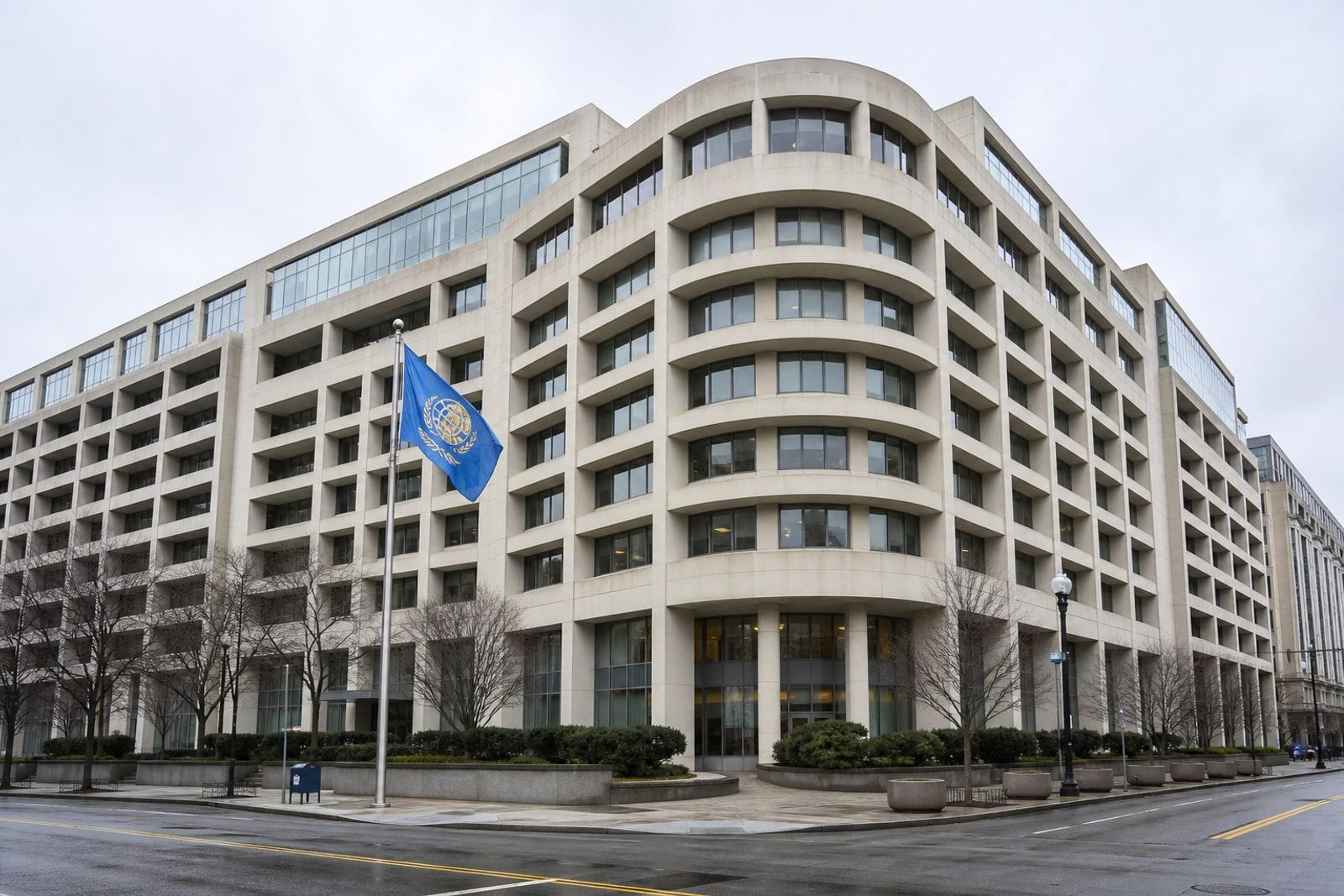
Globalisation is not dying. It is being rewired. That was the message from Pierre-Olivier Gourinchas, the International Monetary Fund's chief economist, as he prepared to leave the Fund after four years at the centre of an unusually turbulent era for the world economy.
In interviews on 26 June at the IMF's Washington headquarters, Gourinchas pushed back on the idea that tariffs and trade wars are unwinding decades of integration. "Well, it's certainly not dead," he said of globalisation, according to AFP. "We haven't experienced de-globalization. We have experienced (that) it's being transformed."
The distinction matters far beyond the seminar room. For an ultra-open economy such as Luxembourg's — where cross-border finance, services and trade dwarf domestic output — whether the world fragments into walled-off blocs or simply reroutes around obstacles shapes the prospects of its funds industry, its exporters and the tens of thousands who commute across its borders to work.
'Transformed', not retired
Gourinchas's argument is that trade is adapting rather than collapsing. When Washington raised tariffs and sought to cut bilateral trade with China, he noted, commerce found new channels. "Other actors have stepped in. The supply chains have adapted, the Mexico's, the Vietnam's of the world have stepped in," he told AFP.
He is sceptical that tariffs deliver durable leverage. "You do have leverage in the short term, and then actors on the other side respond," he told Reuters, adding that affected countries "find ways to either circumvent, accelerate their own innovation, develop new trade ties." Over a longer horizon, he said, such tools "almost never work."
The clearest evidence, in his telling, is the speed at which other powers are pairing off. The European Union signed a partnership agreement with the South American Mercosur bloc on 17 January 2026 — after a political deal struck in December 2024 — and concluded a long-stalled free-trade agreement with India ten days later, on 27 January. Both deals exclude the United States.
"All of a sudden, in less than one year, they're both signed. This is not a coincidence."
That realignment is the core of Gourinchas's thesis, one he has developed throughout his tenure: the post-war trading system is being reset into a more multipolar, bloc-tinted shape, not abolished. The IMF's flagship outlook in April 2025 was pointedly titled "Globalization Reconfigured."
A darker near-term backdrop
The reshaping is happening against a weakening cyclical picture. In its April 2026 World Economic Outlook, subtitled "Global Economy in the Shadow of War," the IMF projected global growth slowing to 3.1% in 2026 and 3.2% in 2027, with headline inflation running near 4.4% this year. That was a downgrade from the 3.3% growth the Fund had forecast in January, driven largely by the eruption of conflict in the Middle East and the threat of an energy-price spike.
The Fund was blunt that the damage is policy-driven and contingent. Absent the war, it said, it would have nudged its 2026 growth forecast up to 3.4%, helped by a technology-investment boom, lower interest rates and US tariffs that landed below their announced levels. Gourinchas warned that the risks were skewing downward: "I would say that we are somewhere in between the reference scenario and the adverse scenario," he said in April, cautioning that "every day that passes... we are drifting closer towards the adverse scenario." In that adverse case the IMF sees growth at 2.5% and inflation at 5.4%; a severe one would cut growth to around 2%.
One pillar, he insisted, has not moved: the dollar. "We are very firmly in the dollar-centered world," Gourinchas told reporters, saying the IMF saw "very, very little" to suggest the currency's grip on trade, banking and reserves was loosening — even as trade routes shift around it.
Why Luxembourg has more at stake than most
Few economies are as exposed to these currents as Luxembourg. On the standard measure of trade openness — exports plus imports as a share of GDP — the Grand Duchy is the most open economy in the world, at roughly 394% in 2023 on World Bank data, against a global average below 100%. Its prosperity is built on moving capital, services and people across borders rather than goods through ports.
The financial centre concentrates that exposure. Luxembourg is the second-largest investment-fund domicile on earth after the United States, with fund assets of about €7.6 trillion as of August 2025 and close to half of the world's cross-border fund distribution, according to industry bodies. Those funds are sold into dozens of jurisdictions; a more fragmented, bloc-based world — with divergent rules, payment rails and market access — is a direct threat to a business model premised on frictionless cross-border reach. A still-dollar-centred system, by contrast, is broadly reassuring for a centre that intermediates global savings.
The human exposure is just as stark. Around 229,000 cross-border workers commuted into Luxembourg in the first quarter of 2025 — roughly 54% from France, 23% from Belgium and 23% from Germany — close to half of all salaried jobs, according to the national statistics office STATEC. That labour market depends on open borders and a healthy Greater Region economy, both sensitive to how trade and investment flows are reorganised across Europe.
Gourinchas hands over to a successor not yet named when he returns to the University of California, Berkeley, on 1 July. His parting framing — rewired, not retired — is, for Luxembourg, less a reassurance than a brief: the question is not whether globalisation survives, but on whose terms it is rebuilt.
Frequently asked
- Is globalisation ending, according to the IMF?
- No. Outgoing IMF chief economist Pierre-Olivier Gourinchas argues the world has not experienced de-globalisation but a transformation: tariffs prompt trade to reroute through countries such as Mexico and Vietnam and to form new ties, reshaping rather than reversing integration.
- What does the IMF forecast for global growth in 2026?
- In its April 2026 World Economic Outlook, the IMF projected global growth slowing to 3.1% in 2026 and 3.2% in 2027, with inflation near 4.4% — a downgrade from January's 3.3%, mainly because of the Middle East war and energy-price risks.
- Why does this matter for Luxembourg?
- Luxembourg is the world's most trade-open economy and its second-largest investment-fund domicile, with about €7.6 trillion in fund assets, plus roughly 229,000 cross-border commuters. A restructuring of global trade directly conditions its funds industry, exports and cross-border jobs.
- Is the US dollar losing its dominance?
- Gourinchas says no. He told reporters the global economy remains 'very firmly' dollar-centred for trade, banking and reserves, with little sign of a move away — even as trade routes shift around the currency.
Sources(13)
- 1Outgoing IMF chief economist sees risks, shifting trade ties and continued uncertainty on global outlookReuters / Investing.com · investing.com
- 2Globalization isn't dead, just 'transformed,' says IMF chief economistAFP / Digital Journal · digitaljournal.com
- 3IMF chief economist Gourinchas says global economy remains firmly 'dollar-centered'Reuters / Yahoo Finance · ca.finance.yahoo.com
- 4World Economic Outlook, April 2026: Global Economy in the Shadow of WarInternational Monetary Fund · imf.org
- 5IMF cuts the outlook for global growth in the fallout from the Iran warPBS NewsHour / AP · pbs.org
- 6Pierre-Olivier Gourinchas to Step Down as IMF Economic Counsellor and Director of the Research DepartmentInternational Monetary Fund · imf.org
- 7Gourinchas to step down as IMF chief economistCentral Banking · centralbanking.com
- 8EU-Mercosur: Council greenlights signature of the comprehensive partnership and trade agreementCouncil of the European Union · consilium.europa.eu
- 9EU and India conclude landmark Free Trade AgreementEuropean Commission · ec.europa.eu
- 10Luxembourg financial centre records strong growth across sectors in 2025Luxembourg for Finance · luxembourgforfinance.com
- 11Investment Funds 2025 – LuxembourgChambers and Partners · practiceguides.chambers.com
- 12Luxembourg Trade openness – data, chartTheGlobalEconomy.com (World Bank data) · theglobaleconomy.com
- 13Domestic payroll employment: Q1 2025STATEC (Luxembourg Statistics Portal) · statistiques.public.lu
Related by topic