European Union
Bardella sets out how the RN would defy the EU from within, with implications for Luxembourg
France's far-right frontrunner would halve Paris's EU budget payments and put national law above European rules — a blueprint that strikes at the open market and free movement Luxembourg lives on.
By Camille Reuter · · 5 min read
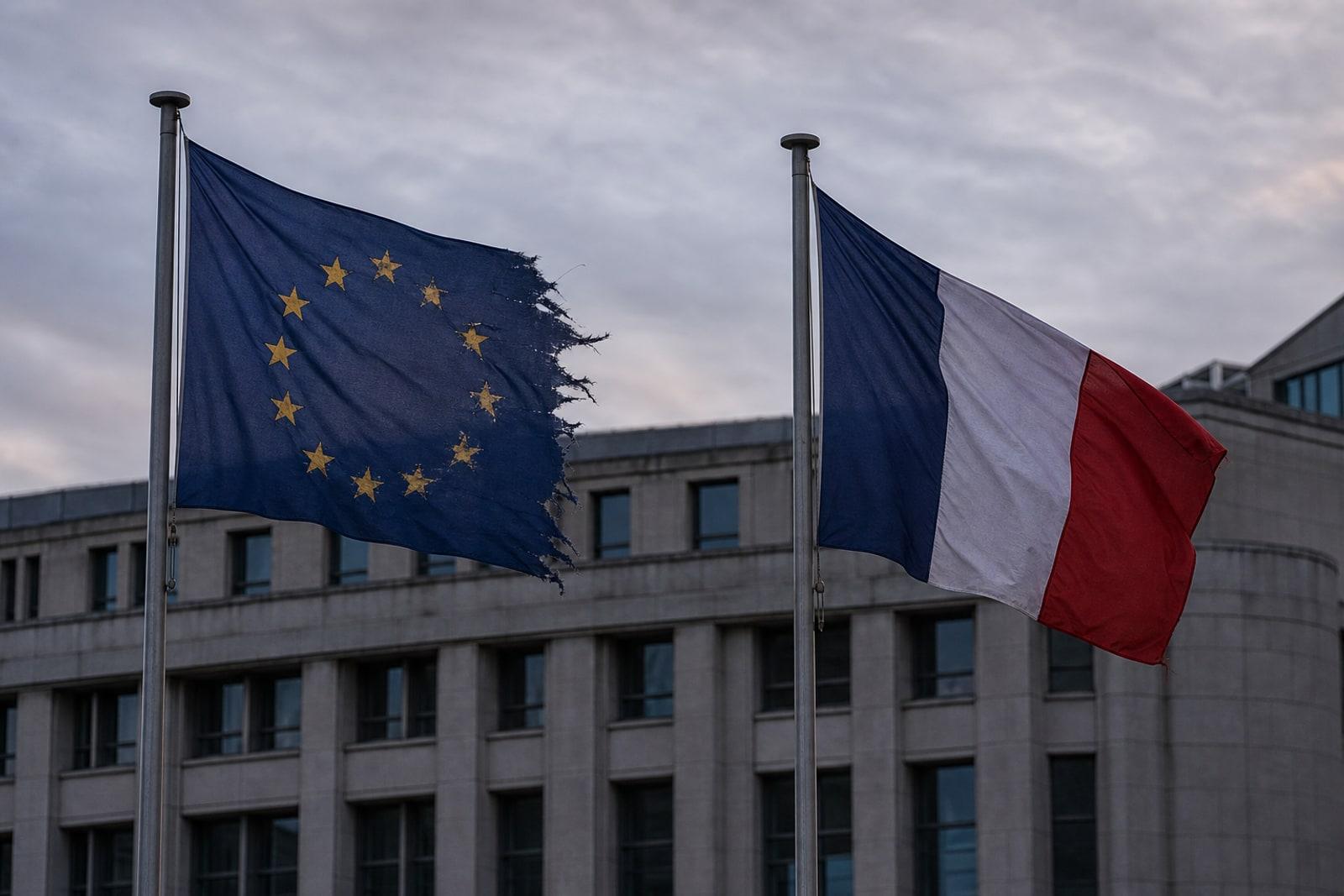
Jordan Bardella has stopped talking about leaving the European Union. Instead, the president of France's Rassemblement National (RN) is describing in increasing detail how a government led by his party would remain a member while systematically defying the rules that bind one — a strategy that one critic has summarised as telling Brussels you want to leave without saying so.
In an interview with Politico published on 15 June 2026, Bardella set out the most concrete element yet: France would slash what it pays into the EU budget. "Instead of voting a contribution to the EU budget of 12 or 15 billion, well, it will be halved," he said, calling the current sum "excessive" and adding that Paris would press the European Commission to cut its own running costs.
The remarks matter because the RN is the clear frontrunner for the 2027 presidential election, polling around 35–37.5% in the first round. Bardella is the party's designated candidate should Marine Le Pen — barred from office in March 2025 over the embezzlement of EU parliamentary funds — fail to overturn her ban; the Paris Court of Appeal is due to rule on 7 July 2026. For a small, deeply integrated member state such as Luxembourg, whose economy is wired into the single market and whose workforce pours across open borders every morning, the blueprint is not an abstraction.
What the RN actually proposes
Since around 2018 the party has dropped both "Frexit" and an explicit pledge to leave the euro, recasting itself as a force that would, in Bardella's framing, "change everything without destroying anything." The substance, drawn from his statements and from analyses by the European Council on Foreign Relations, UnHerd and Brussels Signal, includes:
- Budget: halving France's contribution and demanding a rebate of the kind Germany and the Netherlands enjoy.
- Primacy of national law: a constitutional referendum to assert the supremacy of the French Constitution over EU law, especially on migration.
- Institutions: shrinking the Commission toward a "secretariat" and handing legislative initiative to national governments via the Council.
- Free movement: renegotiating Schengen, introducing "national preference" for French citizens in jobs and housing, leaving the EU Migration Pact and ending birthright citizenship.
- Single market and energy: reopening single-market terms and opting out of EU electricity pricing in favour of a national nuclear-based rate.
On the most sovereignty-defining question, Bardella has been explicit. "I am a staunch republican and, as such, committed to the supremacy of the French Constitution," he told Brussels Signal — a direct challenge to the EU principle that European law takes precedence over national law.
Instead of voting a contribution to the EU budget of 12 or 15 billion, well, it will be halved.
How far could it go without changing the treaties?
The answer determines everything, and it is uncomfortable for both sides. Some moves need no treaty change at all. France could wield its veto over decisions requiring unanimity — aid to Ukraine, sanctions on Russia, the post-2028 budget framework, enlargement and institutional reform. It already votes its EU contribution inside its national budget, a practice tolerated even though it sits awkwardly with EU law. And asserting constitutional primacy, as Poland's courts did, requires only a domestic decision — though it would invite infringement proceedings and what analysts call "massive legal uncertainty."
The harder ambitions run into the treaties themselves. Rewriting free movement, reshaping the single market or unwinding the euro would require treaty change and the unanimous consent of all 27 members — consent the others would not give. That is why commentators from Wolfgang Münchau to the ECFR argue the RN programme, pursued in full, would not produce a clean "Frexit" so much as a slow collision: France breaking enough rules that it ends up functionally outside the club it formally remains in. France's real numbers complicate the budget pitch, too. Eurostat-based data put France's 2024 gross contribution near €22.3 billion and its net contribution at about €5.8 billion — well below Germany's €19.5 billion net.
Why Luxembourg cannot look away
No member state is more exposed to this experiment than the Grand Duchy. A founding member of the EU and host to the Court of Justice and the European Investment Bank, Luxembourg has built prosperity on exactly the freedoms the RN would contest.
The clearest pressure point is labour. In 2025 some 233,260 cross-border workers commuted into Luxembourg — about 47% of its salaried workforce, according to figures compiled from Luxembourg's IGSS by the cross-border observatories AGURAM and IBA·OIE. Of those, roughly 126,600 live in France, alongside about 53,360 in Germany and 53,300 in Belgium. Just over half, in other words, cross the French border each day under EU free-movement rules. A French government that reordered Schengen or pursued "national preference" would reach directly into the engine room of Luxembourg's economy.
Trade is the second exposure. Roughly 85% of Luxembourg's trade is with other EU states, and about 90% of its foreign trade is with EU partners, more than half of it with France, Germany and Belgium. The financial sector that generates around a quarter of GDP depends on the single market's passporting and the stability of the euro. A protracted Franco-Brussels standoff over budgets, law and borders would unsettle precisely the rules Luxembourg treats as the floor beneath its open model.
None of this is yet policy; it is a manifesto from a party that does not hold the Élysée and faces a presidential gatekeeper in Emmanuel Macron, whose assent any constitutional referendum would need. But with the RN ascendant and Le Pen's fate due within weeks, the question for Luxembourg is no longer whether to take the blueprint seriously, but how to prepare for a France that may decide the EU's rules are negotiable from the inside.
Frequently asked
- What exactly does Bardella want to do to France's EU budget contribution?
- In a Politico interview published on 15 June 2026, Bardella said France would halve its contribution, which he put at 12 to 15 billion euros and called 'excessive,' while asking the Commission to cut its operating costs. EU-based data put France's 2024 gross contribution near €22.3 billion and its net contribution at about €5.8 billion.
- Which of the RN's plans would require changing the EU treaties?
- Asserting national-law primacy, using vetoes and adjusting budget votes can be attempted without treaty change, though they would invite EU infringement proceedings. Rewriting free movement, the single market or leaving the euro would require treaty change and unanimous agreement from all 27 members — which analysts say is politically unattainable.
- Why is this an existential issue for Luxembourg?
- Luxembourg's economy runs on EU rules: in 2025 about 233,260 cross-border workers (47% of salaried jobs) commuted in — over half from France — and roughly 85% of its trade is with the EU. Curbing free movement or single-market rules would strike at the foundations of its open, EU-anchored model.
- Is Bardella likely to win power?
- The RN leads first-round polling for the 2027 presidential election at around 35–37.5%. Bardella is the party's candidate if Marine Le Pen's 2025 ineligibility ruling is upheld; the appeal verdict is expected on 7 July 2026.
Sources(15)
- 1Bardella veut réduire de moitié la contribution de la France à l'Union européenneBoursorama · boursorama.com
- 2Union européenne : Jordan Bardella veut «réduire de moitié» la contribution de la FranceLe JDD · lejdd.fr
- 3Stay in Europe, ignore some rules: Bardella explicit RN's new EU doctrine ahead of 2027Brussels Signal · brusselssignal.eu
- 4How Bardella would break the EU: He won't soften like MeloniUnHerd · unherd.com
- 5If Bardella wins: Scenarios for a far-right presidency in FranceEuropean Council on Foreign Relations (ECFR) · ecfr.eu
- 6What a far-right government in France would mean for the EUDer (europäische) Föderalist · foederalist.eu
- 7Bardella Says EU 'Completely Obsolete,' Vows Nationalist ReformsThe European Conservative · europeanconservative.com
- 8EU budget: Who pays the most into the EU, and who gains the most?Euronews · euronews.com
- 9Observatoire territorial transfrontalier / Chiffres-clés : frontaliers français au Luxembourg en 2025AGURAM · aguram.org
- 10Emploi frontalier et évolutionIBA·OIE · iba-oie.eu
- 11Luxembourg - Intra-EU trade: Exports (Eurostat data)Eurostat / Trading Economics · tradingeconomics.com
- 12France's far-right Le Pen appeals graft conviction with 2027 presidential bid on the lineFrance 24 · france24.com
- 13Fact check: Has Marine Le Pen's appeal against her presidential ban been denied?Euronews · euronews.com
- 14French far-right well ahead in new poll for 2027 presidential electionThe Connexion · connexionfrance.com
- 15Le nombre d'agents publics devenus frontaliers a doublé depuis 2019L'essentiel · lessentiel.lu
Related by topic