Environment
Barely one in five of Luxembourg's trees is healthy, forest surveys find
About 80% of the Grand Duchy's trees show signs of damage after years of drought, heat stress and bark-beetle outbreaks — and officials warn the decline is set to continue.
By Léa Hoffmann · · 5 min read
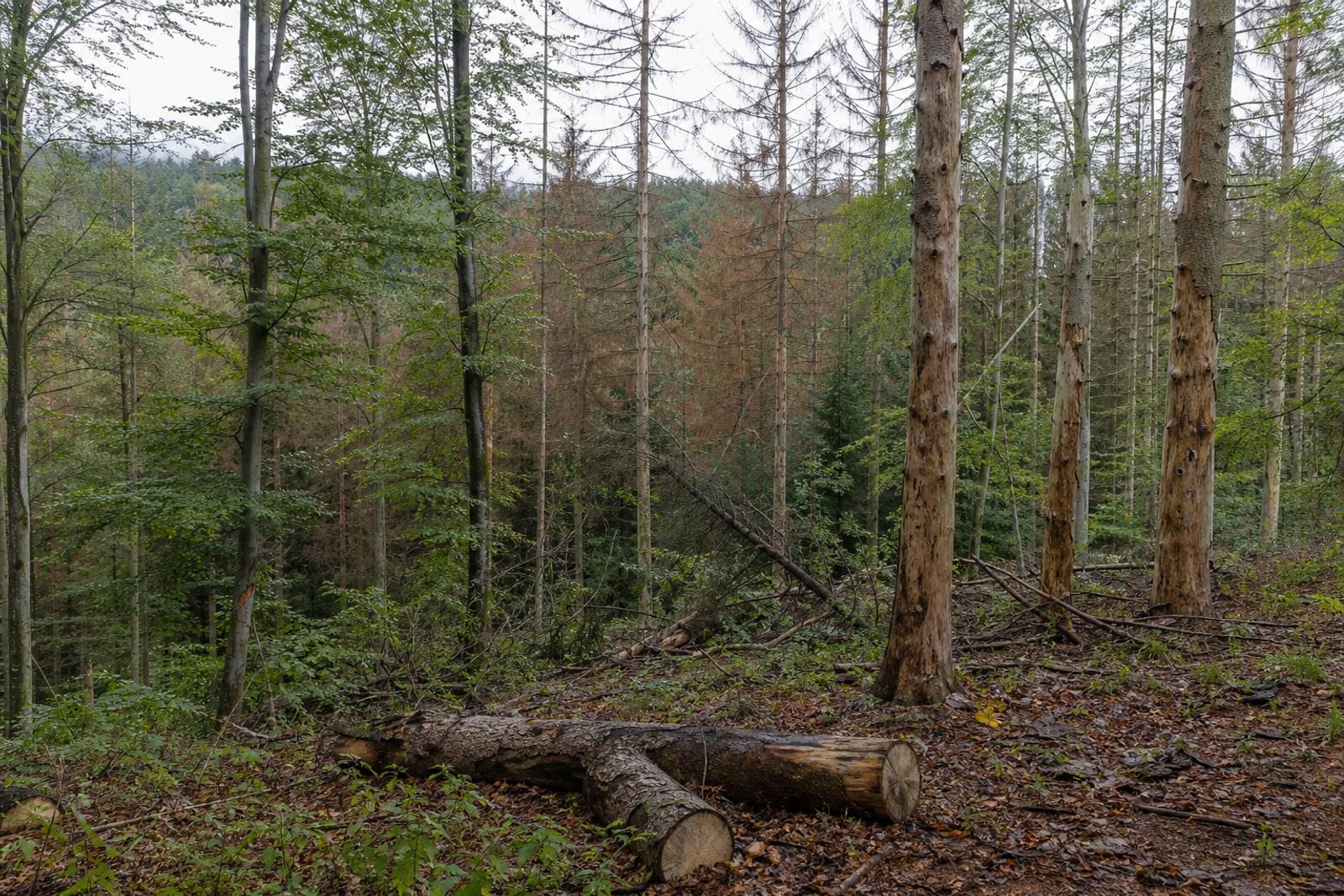
Barely one in five of the trees in Luxembourg's forests is still healthy. The country's latest forest surveys found that around 80% of trees show visible signs of damage — the accumulated toll of repeated drought years, summer heat stress and spreading bark-beetle outbreaks that have left the Grand Duchy's woodlands weakened and, in places, dying.
The figures come from two official sources: the annual phytosanitary inventory run by the Administration de la nature et des forêts (ANF), which inspects the crowns of sample trees every summer, and the third National Forest Inventory (IFN3), presented in November 2025. Together they describe a landscape in trouble. After more than five years of accelerating decline, only a minority of Luxembourg's trees are what foresters classify as undamaged, and the state itself has been blunt that the situation is likely to worsen.
A forest under permanent stress
ANF grades each surveyed tree by how far its crown has thinned. In the summer 2023 inventory — 1,176 trees on 51 plots, assessed between 20 July and 15 August — just 14.5% fell into class 0, meaning no visible damage. More than half, 55%, showed moderate to severe deterioration, and 12.3% were in advanced decline or already dead. The share of undamaged trees, which stood above 80% in the mid-1980s, has collapsed over four decades of monitoring.
A wetter summer in 2024 brought a slight reprieve, nudging the proportion of undamaged trees back towards one in five. But officials stress the improvement is fragile: around four in five trees still carry the scars of the hot, dry years between 2018 and 2022, and a single dry season can undo the gains.
Four out of every five trees show signs of damage. The numerous droughts of recent years have left their mark on many trees and weakened their vitality and resilience.
That assessment, from Environment Minister Serge Wilmes, captures why foresters increasingly speak of woodland under permanent stress rather than reacting to any single bad year. Trees weakened by water shortage become easy targets for pests and disease they would otherwise shrug off.
Beech and spruce bear the brunt
The damage is not spread evenly. The species that define Luxembourg's forests are among the hardest hit:
- Beech, the country's signature broadleaf, has deteriorated sharply: the share of dead beech more than doubled between 2019 and 2024, rising from 7% to 15%. In the 2023 survey, for the first time, not a single examined beech could be placed in the undamaged category.
- Spruce, widely planted as a timber conifer, has been devastated by the European bark beetle, whose outbreaks thrive in warm, dry conditions. Around 1,200 hectares of spruce have been felled over the past decade to contain infestations.
- Oaks and other broadleaves are also under pressure, with only about a tenth judged undamaged; conifers, oaks and the hedgerow woods of the northern Éislek uplands are described as especially affected.
Foresters attribute the pattern to a compounding set of causes — repeated drought and heat, bark-beetle proliferation helped along by milder winters, ill-adapted single-species plantations, emerging pathogens and excess nitrogen in forest soils. No single factor is to blame; it is their simultaneity that overwhelms the trees.
From carbon sink to carbon source
The broader IFN3 inventory, based on 1,845 sampling points surveyed between January 2023 and July 2024, set the health data in a longer arc. Luxembourg's forests cover about 92,250 hectares, roughly 35% of the national territory, split almost evenly between public and private ownership. Broadleaves now make up 75% of the woodland, up from 66% in 2010, as damaged conifer plantations are cleared and replaced.
Yet the forest is growing far more slowly than before. Wood-volume growth between 2010 and 2023 fell steeply against the previous decade — down 21% in broadleaf stands and 32% in conifers — while the area of spruce clear-cuts more than doubled, from 850 to 2,050 hectares. The most striking finding: over that same period Luxembourg's forests flipped from a carbon sink to a net source of CO2, as climate damage and pest-driven harvests released more carbon than the trees absorbed. Deadwood volumes, a marker of dying stands, rose from 6 to 27 cubic metres per hectare.
A Europe-wide reckoning — and Luxembourg's response
Luxembourg is not an outlier. Across central Europe, climate-stressed forests are showing the same signs: Germany's federal forest condition survey likewise finds only about one in five trees fully healthy, with woodlands failing to recover in 2025 amid drought, heat and bark beetles. The Grand Duchy's decline is a local reading of a continental trend.
The government's answer is adaptation. In 2024 some 340 hectares were replanted, and state reforestation subsidies have climbed from about €254,000 in 2015 to roughly €1.5 million, with support steered towards diverse, climate-resilient species rather than the vulnerable monocultures of the past. A new Forest Code adopted in August 2023 and an ecosystem-services subsidy scheme aim to encourage private owners — who hold half the forest — to convert damaged stands. A national forest programme is in preparation.
Ministers frame the effort as a long-term rescue of a shared asset rather than a quick fix. Presenting the national inventory, Wilmes said the challenges were considerable, but that through collective mobilisation Luxembourg could still preserve its forests for future generations and safeguard their role in biodiversity, climate protection and sustainable timber. His predecessor, Joëlle Welfring, had put it more starkly when the 2023 figures landed: "Eise Bësch brauch eis Hëllef" — our forest needs our help — "virun allem an Zäite vum Klimawandel", above all in times of climate change.
Frequently asked
- How many of Luxembourg's trees are still healthy?
- According to the latest surveys by the Administration de la nature et des forêts, around 80% of trees show visible damage, leaving only about one in five (roughly 20%) undamaged. In the 2023 phytosanitary inventory just 14.5% were classed as damage-free; a wetter summer in 2024 brought a slight improvement.
- Which tree species are worst affected?
- Beech and spruce. The share of dead beech more than doubled from 7% in 2019 to 15% in 2024, and in 2023 no examined beech qualified as undamaged. Spruce has been hit hardest by bark beetles, with about 1,200 hectares felled over ten years. Oaks and Ardennes hedgerow woods are also badly affected.
- Why are the forests declining?
- Repeated droughts and heat between 2018 and 2022 weakened trees, opening the way to bark-beetle outbreaks and disease. Ill-adapted monoculture plantations, emerging pathogens and excess soil nitrogen compound the stress. Officials say climate change means the negative trend is likely to continue.
- What is the government doing about it?
- The state is replanting damaged areas (about 340 hectares in 2024), has raised reforestation subsidies to roughly €1.5 million and is steering support towards diverse, climate-resilient species. A new Forest Code (2023) and an ecosystem-services scheme aim to help private owners convert vulnerable stands, with a national forest programme in preparation.
Sources(8)
- 1Eighty percent of Luxembourg's trees show signs of damageDelano · delano.lu
- 2Pression climatique: les forêts luxembourgeoises continuent de mourir à petit feu (80% des arbres endommagés)L'essentiel · lessentiel.lu
- 3Présentation du troisième Inventaire forestier national: des forêts luxembourgeoises face au défi climatiqueLe gouvernement luxembourgeois (Ministère de l'Environnement, du Climat et de la Biodiversité) · gouvernement.lu
- 4Les résultats de l'inventaire phytosanitaire 2023 des forêts du LuxembourgLe gouvernement luxembourgeois / Administration de la nature et des forêts · gouvernement.lu
- 5L'Inventaire phytosanitaire des forêtsPortail de l'environnement (emwelt.lu) — Administration de la nature et des forêts · environnement.public.lu
- 6Situation actuelle et avenir de nos forêtsscience.lu (Fonds National de la Recherche) · science.lu
- 7Wie steht es um den Wald in Luxemburg?science.lu (Fonds National de la Recherche) · science.lu
- 8Waldzustandsbericht: Nur jeder fünfte Baum ist gesundLAND & FORST · landundforst.de
Related by topic