European defence
Germany passes military-service law that could revive conscription if volunteers fall short
A law in force since January keeps military service voluntary but builds in a legal trigger to make it compulsory if recruitment falls short, with screening of 18-year-olds due to begin in mid-2027.
By Camille Reuter · · 4 min read
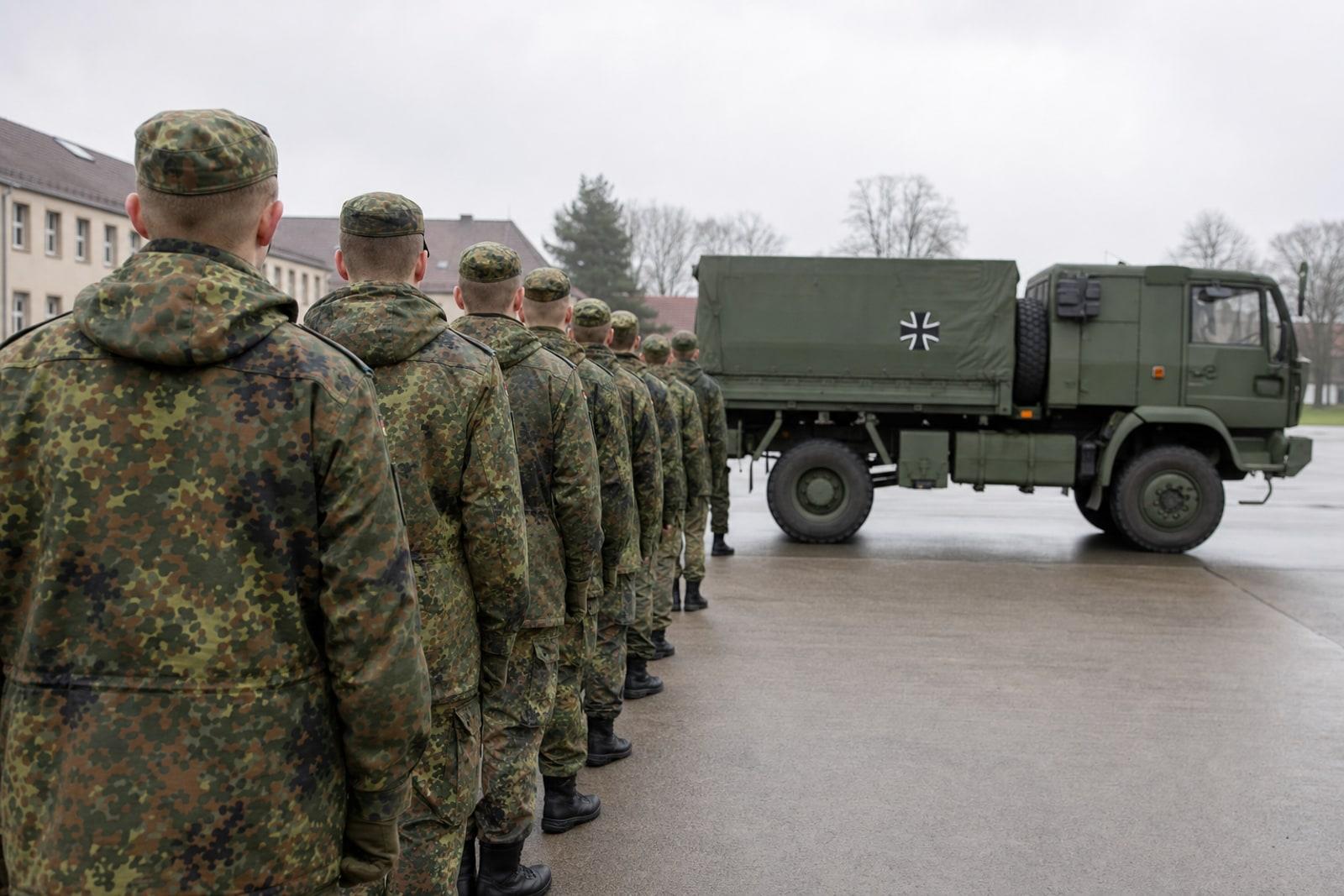
BERLIN — Germany has assembled the legal machinery to bring back compulsory military service, fifteen years after it suspended the draft, as Europe's largest economy scrambles to rebuild armed forces it now regards as dangerously undermanned against the threat from Russia.
A new law, the Military Service Modernisation Act (Wehrdienstmodernisierungsgesetz), took effect on 1 January 2026 after the Bundestag approved it on 5 December 2025. For now it keeps service voluntary. But it also writes into law a mechanism that would let parliament switch on what officials call "needs-based" conscription if too few young Germans volunteer — turning a scheme ministers present as an incentive-led recruitment drive into a potential draft.
The first concrete obligations are already landing. Since January, every man turning 18 — beginning with those born in 2008 — must complete an official questionnaire on his health, education and willingness to serve; women may respond but are not required to. From 1 July 2027, those same cohorts will face a mandatory medical examination, the Musterung, at one of 24 assessment centres the defence ministry is standing up. Officials expect the system to be fully operational by the middle of 2027.
"If that is not enough, we will have no choice but to introduce partial conscription," said Defence Minister Boris Pistorius, whose voluntary model is meant to attract about 30,000 recruits a year.
A draft in all but name?
The government insists the new system is built to lean on volunteers "for as long as possible." To make enlistment more attractive, recruits will serve between six and eleven months and earn roughly €2,600 a month before tax, with the option to stay on. Civilian alternatives remain available, and women can join but cannot be obliged to.
What makes the law different from a simple recruitment campaign is the trigger embedded in it. If volunteer numbers lag behind NATO requirements, lawmakers can activate compulsory service — but only through a fresh act of the Bundestag, a deliberate political brake rather than an automatic switch. Conservative figures in the governing coalition, including CDU/CSU parliamentary leader Jens Spahn, pushed for a binding "growth path" with regular reporting so that any shortfall is flagged early. Should Germany come under attack, the statute allows full conscription to be reinstated at once.
Critics on both flanks are uneasy: some warn the half-measure will not deliver soldiers fast enough, while others object to compelling a generation that has known only an all-volunteer force. Germany ended peacetime conscription in 2011, and an entire cohort of young adults has grown up with no expectation of a barracks summons.
The numbers behind the rush
The arithmetic is stark. Germany's active force stood at roughly 184,000 soldiers at the end of 2025, well short of what commanders say the alliance now demands of them.
- Berlin aims to grow the Bundeswehr to about 260,000 active personnel plus around 200,000 reservists by the mid-2030s, with some plans pointing higher.
- Pistorius has said Germany needs an estimated 60,000 to 100,000 additional soldiers to meet NATO capability targets and make the force fit for war.
- The voluntary scheme is designed to bring in roughly 30,000 recruits a year — the threshold that, if missed, brings the conscription trigger into play.
Driving the timeline is a hardening assessment of Russia. German and allied planners have repeatedly warned that Moscow could be capable of a large-scale attack on NATO territory within a few years, and have set 2029 as the date by which the Bundeswehr must be ready to fight if deterrence fails.
Europe rearms — and Luxembourg feels the strain
Germany's move is the most consequential piece of a continent-wide pivot. At their summit in The Hague on 25 June 2025, NATO leaders agreed to a sweeping new spending benchmark, citing "the long-term threat posed by Russia to Euro-Atlantic security."
Under that declaration, "Allies commit to invest 5% of GDP annually on core defence requirements as well as defence- and security-related spending by 2035" — at least 3.5% on core military needs such as troops, equipment and readiness, and up to a further 1.5% on infrastructure, cyber defence and resilience. The trajectory is to be reviewed in 2029.
For Luxembourg, a founding NATO member with no army of Germany's scale, the target is daunting. The Grand Duchy measures its contribution against Gross National Income rather than GDP, reflecting the outsized weight of its financial sector, and spent roughly €728 million on defence in 2024. The government's roadmap, the defence ministry confirms, still aims for 2% of GNI by 2030 — close to €1.5 billion — even as the new alliance-wide goal of 5% by 2035 implies one of the steepest proportional climbs of any member.
"Currently, the roadmap set by the government in June 2024 is still in force: 2% of gross national income (GNI) in 2030," the office of Defence Minister Yuriko Backes said, while signalling that Luxembourg is weighing whether to accelerate. The message from Berlin is that the bill for European security is rising fast — and that even the alliance's smallest members will be asked to pay a share they have not had to contemplate in a generation.
Frequently asked
- Has Germany reinstated the draft?
- Not yet. Military service is currently voluntary under the law that took effect on 1 January 2026, but the statute lets the Bundestag activate 'needs-based' conscription through a separate vote if volunteer numbers fall short or the security situation worsens. Germany suspended compulsory conscription in 2011.
- What happens in mid-2027?
- From 1 July 2027, men born in 2008 or later must undergo a mandatory medical examination (Musterung) at one of 24 assessment centres, and the wider registration and screening system is meant to be fully operational by the middle of 2027.
- How many soldiers does Germany want?
- Berlin is targeting roughly 260,000 active personnel plus about 200,000 reservists by the mid-2030s. Defence Minister Boris Pistorius has said Germany needs an estimated 60,000 to 100,000 additional soldiers to meet NATO requirements, against a current active force of around 184,000.
- How does this affect Luxembourg?
- Luxembourg is bound by NATO's June 2025 Hague pledge to spend 5% of GDP on defence by 2035. It calculates its commitment on Gross National Income, spent about €728 million in 2024, and aims for 2% of GNI by 2030 — facing one of the steepest proportional increases of any ally.
Sources(10)
- 1German parliament approves conscription scheme to boost the BundeswehrDefense News · defensenews.com
- 2German Parliament Backs Controversial Military Service Law Amid Russian ThreatU.S. News & World Report / Reuters · usnews.com
- 3Germany inches closer to bringing back mandatory military serviceEuronews · euronews.com
- 4Germany: Act to Modernize Military Service Enters into ForceLibrary of Congress (Global Legal Monitor) · loc.gov
- 5New draft military service law / Federal Cabinet: Military service modernisedFederal Government of Germany (bundesregierung.de) · bundesregierung.de
- 6Military service returns to Germany: the most important rulesDeutschland.de · deutschland.de
- 7The Hague Summit Declaration (official text)NATO · nato.int
- 8Defence expenditures and NATO's 5% commitmentNATO · nato.int
- 9Defence: Luxembourg does not want to spend for spending's sakePaperjam · en.paperjam.lu
- 10Luxembourg Details Plans to Raise Defence Spending to 2% of GNI by 2030Chronicle.lu · chronicle.lu
Related by topic