Defence finance
Canada's defence chief visits Luxembourg as allies build the plumbing for rearmament
David McGuinty's historic trip caps a fast-deepening partnership — and spotlights where the Grand Duchy fits in a new architecture of allied defence money.
By Jonas Thill · · 5 min read
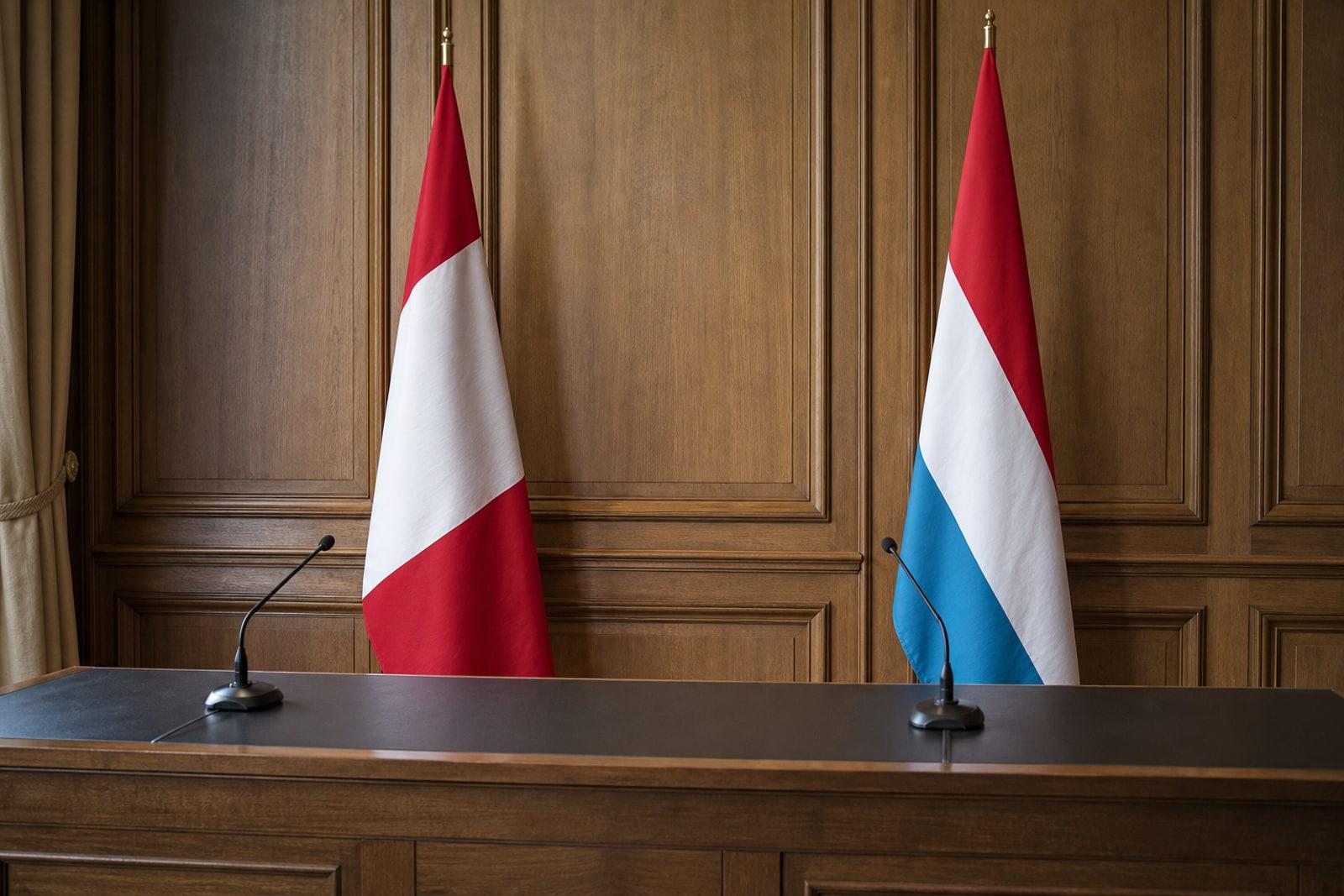
Canada's defence minister, David McGuinty, arrived in Luxembourg on Friday for what both governments billed as a milestone: the first visit by a member of Canada's federal government to the Grand Duchy in 81 years of diplomatic relations. Received with military honours at Bourglinster Castle, he met lawmakers and held a joint press conference with his Luxembourg counterpart, Yuriko Backes, in the capital.
The choreography was warm, but the subtext was money — specifically, how a rattled transatlantic alliance intends to pay for rearmament. McGuinty's stop came as Ottawa pivots toward Europe and as allies assemble a new layer of institutions designed to pool capital for defence at a speed and scale that national budgets alone cannot match.
Backes called the visit a "historic moment" and described Canada as a "reliable NATO ally, even more so in these geopolitical, very unstable times." Both ministers cast themselves as "profound believers in multilateralism" and reaffirmed support for Ukraine. McGuinty, returning the compliment, praised his hosts in unusually personal terms.
We are going to diversify, we are going to expand, we are going to branch out.
A first in 81 years
The visit followed the 2025 opening of Luxembourg's embassy in Ottawa and a rapid run of high-level contacts. In February, Canadian Prime Minister Mark Carney and Luxembourg Prime Minister Luc Frieden agreed a package of economic, security and talent partnerships, including a financial-sector policy dialogue; the two leaders spoke again in April.
For McGuinty, the trip was also a chance to bank a recent diplomatic win. Canada has become the first — and so far only — non-EU country admitted to Security Action for Europe (SAFE), the bloc's €150 billion loans-for-weapons instrument, a step Ottawa called "a very big breakthrough." Canada also participates in the EU's PERLE defence-industry programme. "Luxembourg has a stellar reputation," McGuinty said, "one that is represented by leadership that means what it says and says what it means."
Notably, the press conference did not dwell on the marquee project in allied defence finance — the proposed Defence, Security and Resilience Bank. That initiative has been driven on the Canadian side chiefly by Finance Minister François-Philippe Champagne and by the leaders' February statement, rather than by the defence portfolio.
A bank for rearmament
The Defence, Security and Resilience Bank (DSR Bank) was first floated in 2025 by Rob Murray, a former NATO innovation chief who now heads the bank's development group. The pitch: a treaty-based, member-owned institution that would mobilise private capital and offer long-term, low-cost financing across defence supply chains — from governments down to the small and medium-sized firms that struggle to borrow against military orders.
Momentum has built quickly. A high-level meeting in London in September 2025 drew representatives from 37 nations, including all G7 members, alongside the European Commission and NATO. Charter negotiations concluded in Montréal this spring, and participating countries agreed that, once the charter is ratified, Canada would serve as the bank's host — with the headquarters slated for Montréal, not Luxembourg.
That distinction matters. The Grand Duchy is a natural candidate for any new financial institution, but the DSR Bank's seat is heading across the Atlantic. "We are very pleased with the progress made during recent negotiations in Montréal to establish the Defence, Security, and Resilience Bank," Champagne said. Canada's big banks — RBC, TD, CIBC, Scotiabank and BMO — have signalled support, as have large European lenders.
The case for such a bank, set out by analysts including the Atlantic Council, is that allied rearmament needs cheaper, more predictable capital than today's patchwork of national programmes provides — and a shared balance sheet to spread risk as the United States presses partners to carry more of the burden.
Where Luxembourg fits
If the bank itself is going to Canada, Luxembourg's leverage in the new architecture lies elsewhere: as one of Europe's principal financial centres and as the home of the European Investment Bank (EIB), the EU's lending arm, on the Kirchberg plateau.
The EIB has moved aggressively into defence. The group quadrupled its security and defence financing to more than €4 billion in 2025 and, under its 2026–2028 plan, will keep total annual lending at a record €100 billion while raising defence-related financing to around €4.5 billion next year — roughly 5% of its EU activity. It has also widened eligibility rules to back purely military projects and dedicated funds, a sharp break from past caution.
Luxembourg is lifting its own contribution, too. Defence spending is projected at about 0.89% of GDP — roughly €814 million — in 2026 and is expected to top €1 billion for the first time. In May, Backes presented a roadmap raising spending by about 0.1 percentage point of GDP a year through 2029, in line with the NATO Hague Summit pledge of June 2025 to reach 5% of GDP — measured against gross national income in Luxembourg's case — by 2035, split between 3.5% for core defence and 1.5% for broader security.
A pivot, not a pivot point
Friday's visit will not by itself reshape allied finance. The DSR Bank still needs ratification; SAFE's procurement rules are still being written; and Luxembourg's defence build-up, while accelerating, starts from a low base. But the trip is a concrete marker of how quickly the map is being redrawn — with Ottawa wiring itself into European instruments, Brussels and the EIB opening the taps, and small, capital-rich states like Luxembourg angling to matter in the plumbing of a rearming West.
"We have so much more growth to achieve between the two countries," McGuinty told reporters. On the evidence of the past six months, that growth is increasingly being measured in defence euros.
Frequently asked
- Will the Defence, Security and Resilience Bank be based in Luxembourg?
- No. Participating countries agreed that, once its charter is ratified, Canada will host the bank, with the headquarters slated for Montréal. Luxembourg's role in allied defence finance comes through its financial centre and as host of the European Investment Bank.
- What is the DSR Bank meant to do?
- It is a proposed treaty-based, member-owned institution that would mobilise private capital and provide long-term, low-cost financing for allied defence and security supply chains, including for smaller suppliers and member governments.
- Why did Canada's defence minister visit Luxembourg?
- To deepen bilateral defence cooperation. Both governments called it the first visit by a member of Canada's federal government in 81 years of diplomatic relations, following Luxembourg's 2025 embassy opening in Ottawa and a February 2026 leaders' partnership.
- What is SAFE and how is Canada involved?
- SAFE (Security Action for Europe) is the EU's €150 billion defence-loans instrument for joint procurement. Canada is the first — and so far only — non-EU country admitted, with a bilateral procurement agreement concluded in 2026.
Sources(16)
- 1Canadian Defence Minister Expresses 'Deep Gratitude' For Relationship With LuxembourgChronicle.lu · chronicle.lu
- 2Minister McGuinty Heads to LuxembourgMirage News · miragenews.com
- 3Minister McGuinty to travel to LuxembourgGovernment of Canada (National Defence) · canada.ca
- 4Canada welcomes progress towards the establishment of the Defence, Security and Resilience Bank and hosting its headquartersGovernment of Canada (Finance) · canada.ca
- 5Canada to establish Defence, Security and Resilience BankDefence Industry Europe · defence-industry.eu
- 6Canada chosen as host country of multinational defence bankThe Globe and Mail · theglobeandmail.com
- 7Canada selected to headquarter new multinational defence bank, sources sayCBC News · cbc.ca
- 8Defence, Security and Resilience BankWikipedia · en.wikipedia.org
- 9How a new global defense bank can solve US and allied funding problemsAtlantic Council · atlanticcouncil.org
- 10SAFE: Council clears path for financial assistance to eight member states and concluding the Canada agreementCouncil of the EU (Consilium) · consilium.europa.eu
- 11Canada has officially joined the EU's loans-for-weapons programCBC News · cbc.ca
- 12EU Finance Ministers back EIB Group strategy for a stronger, more secure EuropeEuropean Investment Bank · eib.org
- 13EIB Group powers up flagship investment instruments to boost Europe's tech leadership and defence capabilitiesEuropean Investment Bank · eib.org
- 14Yuriko Backes presents Luxembourg's defence spending roadmap to 2029Government of Luxembourg · gouvernement.lu
- 15Prime Minister Carney secures new economic, security, and talent partnerships with LuxembourgPrime Minister of Canada · pm.gc.ca
- 16Prime Minister Carney speaks with Prime Minister of Luxembourg Luc FriedenPrime Minister of Canada · pm.gc.ca
Related by topic