Turkey & NATO
Turkey detains scores of critics as it prepares to host NATO summit
Ankara has banned protests and jailed activists, lawyers and journalists before the July alliance meeting, testing the West's reliance on a strategically vital but increasingly authoritarian ally.
By Camille Reuter · · 4 min read
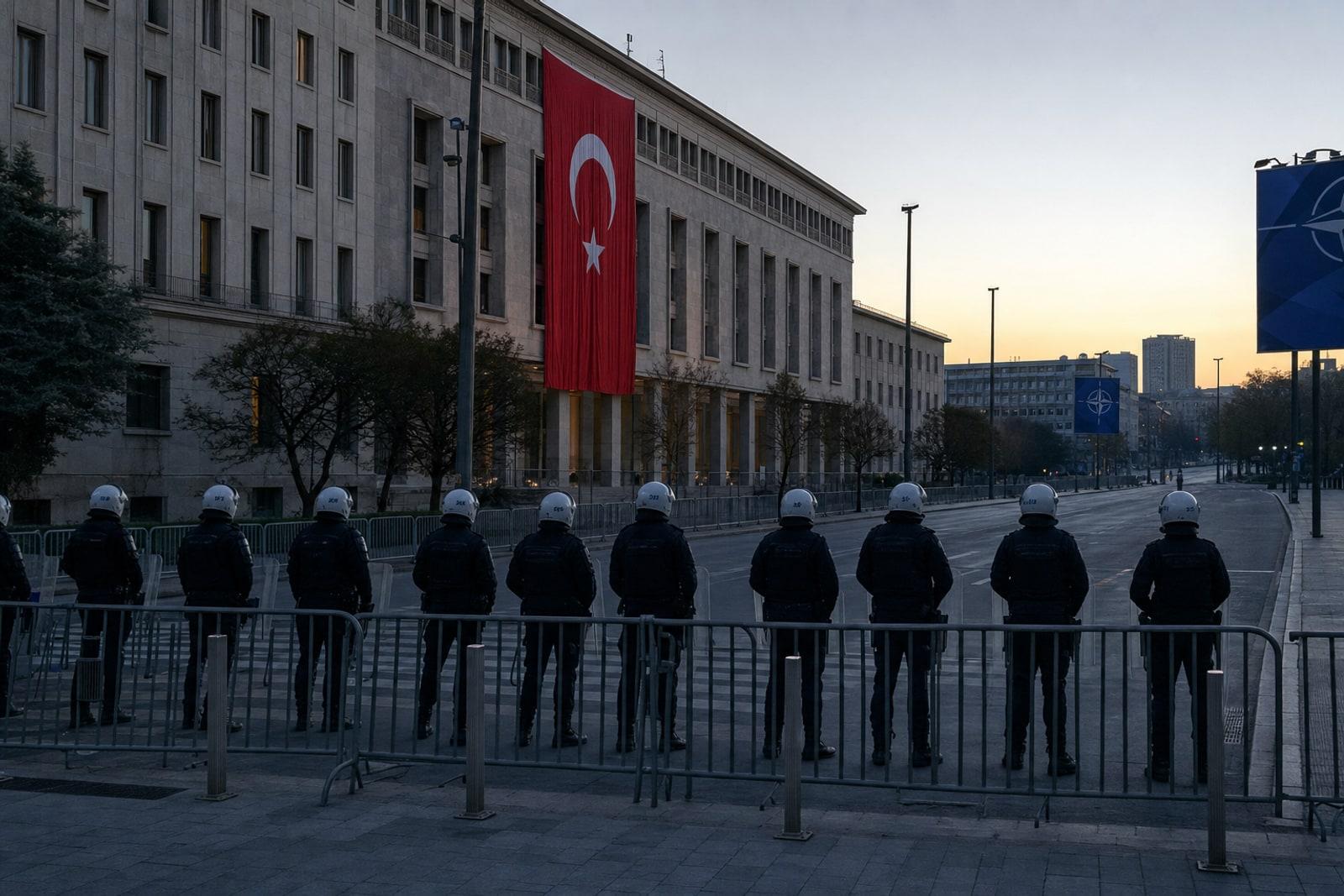
Two weeks before NATO's leaders gather in Ankara, Turkey is rounding up its critics. In pre-dawn raids on 23 June, police and gendarmerie detained more than 200 people across the capital, and the city's governor banned every public assembly for nearly a fortnight. Human rights groups say the sweep is less about security than about silencing dissent on the eve of the alliance's most prominent gathering on Turkish soil in more than two decades.
The 36th NATO summit is scheduled for 7-8 July 2026 at the Presidential Complex in Ankara, the second hosted by Turkey after the 2004 Istanbul meeting. All 32 member states are due to attend, alongside Secretary General Mark Rutte and invited partners including the European Union and Ukraine. The agenda centres on defence spending and sustaining support for Kyiv. The optics, however, are increasingly dominated by what is happening on the streets outside.
A crackdown timed to the summit
Turkish prosecutors issued detention orders for 241 suspects; 209 were taken into custody, according to the chief prosecutor's office cited by the Associated Press, while Amnesty International and the independent outlet Bianet put the figure at 225 detained in the dawn raids. Officials said those held included 56 alleged Islamic State members and 35 members of the far-left Revolutionary People's Liberation Party/Front. Courts later remanded 103 people in pretrial custody and placed 26 under house arrest.
But rights monitors and Turkish reporters say the net swept up government critics with no plausible link to terrorism. Among those arrested were:
- Emel Memiş, an associate professor of economics at Ankara University;
- Yıldız Tar, a journalist and prominent LGBTI+ rights activist;
- a representative of the environmental TEMA Foundation, a trade-union spokesperson, and members of the Progressive Lawyers Association.
The Ankara Chief Public Prosecutor's office said the operation was intended to "decipher the action and activities of terrorist organizations," linking detainees to ISIS and revolutionary leftist groups without detailing specific alleged crimes. The Ankara Governorate separately banned all demonstrations, leafleting and banners province-wide from 28 June until 10 July, citing national security around the summit.
The misuse of terrorism laws to conduct mass arrests and silence people in the run-up to a NATO summit flies in the face of the founding values of the alliance.
That assessment came from Benjamin Ward, deputy Europe and Central Asia director at Human Rights Watch, which documented the raids. Amnesty International's Esther Major, its deputy research director for Europe, was equally blunt: "The blanket ban on all protests in Ankara must be lifted and everyone arbitrarily detained in prison or under house arrest in connection with the NATO summit must be released."
Part of a longer pattern
The arrests fit a trajectory that has hardened since March 2025, when authorities detained Istanbul Mayor Ekrem İmamoğlu — President Recep Tayyip Erdoğan's most formidable rival and the opposition's presidential candidate — and put him on trial, effectively removing him from political life. His detention triggered the largest street protests Turkey had seen in over a decade.
Press freedom has narrowed in parallel. Human Rights Watch says at least 21 reporters and media workers are currently imprisoned in Turkey. The squeeze has extended to the summit itself: NATO declined to accredit a number of Turkish journalists and outlets, among them the dailies Cumhuriyet and Sözcü and the digital newsrooms ANKA, T24 and Medyascope — a move Amnesty called "a blow to media freedom."
The Western bargain
The crackdown lays bare an uncomfortable dependency. Turkey fields NATO's second-largest army, controls the Bosphorus and Dardanelles straits under the Montreux Convention, and sits astride the alliance's southern flank facing Syria, Iraq and the Black Sea. That strategic weight has long blunted Western criticism of Ankara's domestic record.
For the European Union, the dilemma is sharper still. Turkey remains a formal EU candidate, though accession talks have been effectively frozen since 2018. After İmamoğlu's arrest, EU High Representative Kaja Kallas and Enlargement Commissioner Marta Kos warned in a joint statement that the detentions raised "questions regarding Türkiye's adherence to its long-established democratic tradition," adding:
"As an EU candidate country and long-standing member of the Council of Europe, Türkiye is expected to apply the highest democratic standards and practices." In June 2026, members of the European Parliament pressed for tougher language on Ankara's rights record in the bloc's annual report.
Yet Brussels also needs Ankara. Under the March 2016 EU-Turkey Statement, the bloc pledged €6 billion in exchange for Turkey curbing irregular migration; the European Commission says it has channelled close to €12.4 billion to refugees and host communities in Turkey since 2011. Turkey hosts roughly three million refugees, the largest such population in the world. That leverage has repeatedly tempered the EU's response to Erdoğan's domestic conduct.
As leaders prepare to descend on a capital under what critics describe as a de facto state of emergency, the summit will test whether an alliance built on democratic values can reconcile them with its reliance on the host. For now, the streets of Ankara have been cleared — and the answer deferred.
Frequently asked
- When and where is the 2026 NATO summit?
- The 36th NATO summit is scheduled for 7-8 July 2026 at the Presidential Complex in Ankara, Turkey — the second NATO summit Turkey has hosted, after the 2004 Istanbul meeting. All 32 member states are due to attend.
- How many people were detained and why?
- In raids on 23 June 2026, more than 200 people were detained in Ankara; officials said the figure was around 209-225. Prosecutors cited a terrorism investigation, but rights groups say government critics with no terrorism link — including an academic, a journalist and lawyers — were swept up. Courts remanded 103 and placed 26 under house arrest.
- How are the EU and rights groups responding?
- Human Rights Watch and Amnesty International condemned the crackdown and protest ban. The EU, which still treats Turkey as a candidate country, has warned about its democratic standards, but its leverage is tempered by reliance on Turkey for security and the 2016 migration deal.
Sources(10)
- 1Türkiye: Crackdown Ahead of NATO SummitHuman Rights Watch · hrw.org
- 2Türkiye: Authorities must lift blanket protest ban ahead of NATO Summit and release scores of arbitrarily detained peopleAmnesty International · amnesty.org
- 3Ankara court remands over 100 including academic, journalist ahead of NATO summitBianet · bianet.org
- 4Rights groups criticise Turkey protest ban ahead of Nato summitMiddle East Eye · middleeasteye.net
- 5Turkey detains 209 in raids in the capital ahead of July's NATO summitThe Washington Times / Associated Press · washingtontimes.com
- 6Overview - 2026 NATO Summit in AnkaraNATO · nato.int
- 72026 Ankara NATO summitWikipedia · en.wikipedia.org
- 8Joint Statement by High Representative Kallas with Commissioner Kos on the recent events concerning Istanbul Mayor Ekrem İmamoğluEuropean External Action Service (EEAS) · eeas.europa.eu
- 9Towards NATO's 2026 Ankara SummitEuropean Parliament Research Service · europarl.europa.eu
- 10The EU-Turkey Deal, Five Years On: A Frayed and Controversial but Enduring BlueprintMigration Policy Institute · migrationpolicy.org
Related by topic
Cargolux’s wildfire fleet is commercial — its EU emergency role remains unproven