Migration
Spain opens legal status to undocumented migrants as much of Europe tightens
A one-off royal decree drew nearly 1.2 million applications before it closed on 30 June, as Madrid frames legalisation as labour-market policy against the EU's restrictionist tide.
By Léa Hoffmann · · 4 min read
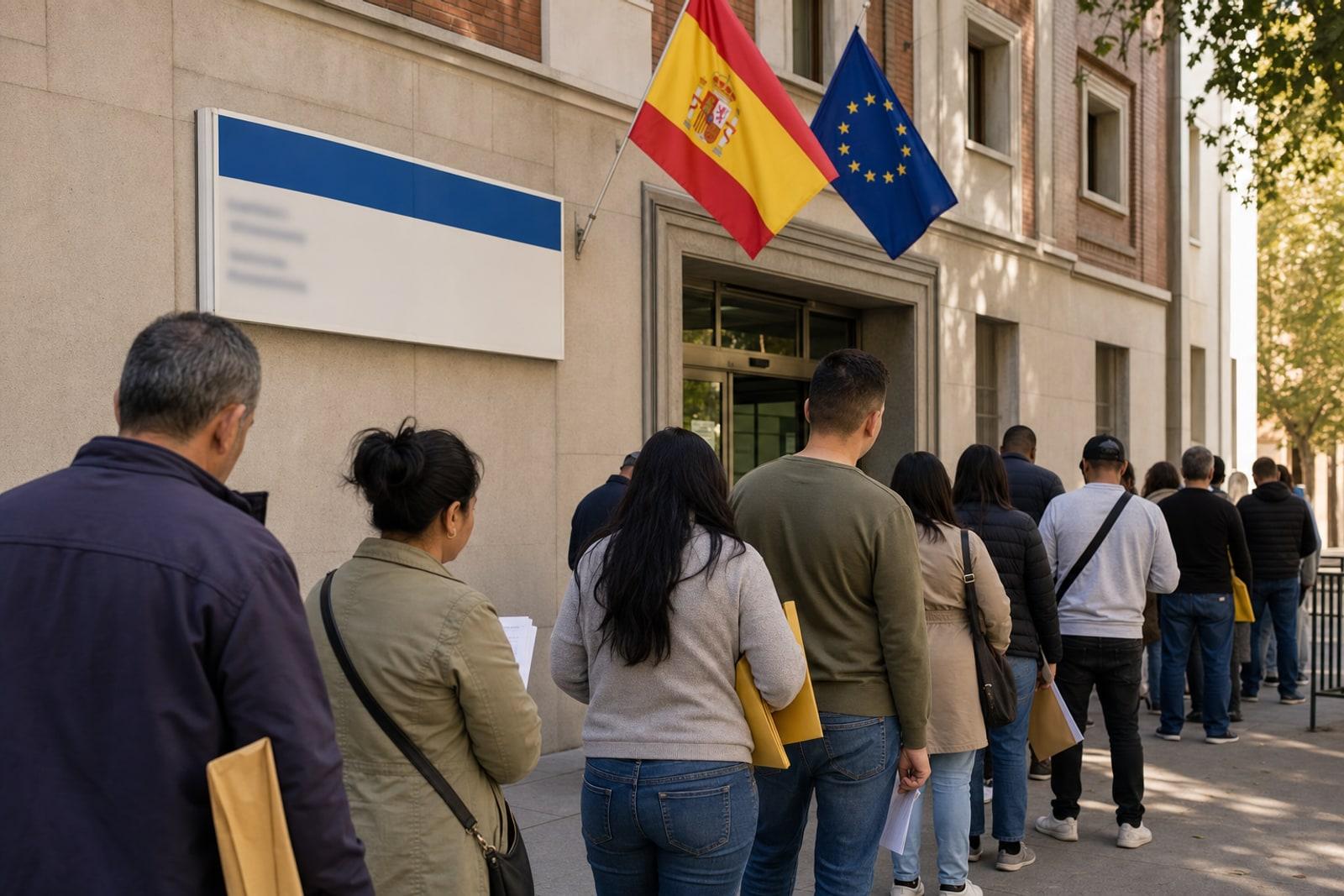
MADRID — When Spain's one-off migrant regularisation closed on 30 June, the government was left with a number few had predicted. Nearly 1.2 million people had applied for legal status in barely eleven weeks — more than double the roughly 500,000 the scheme had been designed to reach.
The extraordinary regularisation, enacted by royal decree, offered undocumented residents a rare chance to step out of the informal economy and into legal work. Prime Minister Pedro Sánchez's Socialist-led coalition casts it not as an act of leniency but as economic strategy — a wager that legalising the people already living and working in Spain will help sustain the workforce and the pension system as the population ages. It is a bet placed against the grain of a continent moving the other way.
What the decree does
The measure was approved by the Council of Ministers on 14 April and took effect on 16 April, according to the government's official record. It grants a combined residence-and-work permit valid for one year, along with access to social security and a regional health card. Applications were accepted between 16 April and 30 June. To qualify, an applicant had to:
- have been present in Spain before 1 January 2026;
- show at least five months of continuous residence;
- hold no criminal record and pose no threat to public order.
After the first year, those regularised must move into one of Spain's ordinary residence categories. Minor children already in the country could be regularised alongside their parents, receiving five-year permits. By the migration ministry's count, the scheme drew 1,174,978 applications, of which more than 600,000 had already been admitted for processing when the window shut. Colombians formed the largest group at about 26%, followed by Moroccans (13.3%), Venezuelans (11.8%) and Peruvians (8.8%); two-thirds of applicants came from Latin America, and four in five were under 45.
It is the seventh such process since 1986, when Spain first began regularising undocumented residents; the previous six benefited some 1.3 million people. A separate 2024 overhaul of Spain's ordinary immigration rules is expected to legalise a further 300,000 people a year through reformed "rooted-residence" channels.
A labour-market bet
Sánchez's case is demographic. Spain's workforce is ageing, and the government estimates the country needs around 250,000 new workers a year until 2050 to keep funding its welfare state. Foreign workers reached 3.4 million in June 2026, up more than 350,000 on the year and growing far faster than the native labour force. The government says 43% of the jobs created since its labour reform have gone to foreign workers. Unveiling a €500-million-a-year Integration and Citizenship Plan on 30 June as the regularisation wound down, Sánchez put the stakes bluntly.
Without migration, Spain would lose 19% of its GDP by 2050.
Deputy Prime Minister Yolanda Díaz linked the scheme to Spain's record employment, arguing it allowed undeclared work to "surface" into the legal economy, where migrants gain rights and pay into social security. Nearly 160,000 of those admitted had already registered with the system, the ministry said, though it did not specify how many jobs existed solely because of the scheme.
Against Europe's tightening tide
Spain's move lands just as the European Union's New Pact on Migration and Asylum begins to apply — a framework built around faster deportations, "safe third country" rules and tighter access to asylum. Brussels has been visibly uneasy. EU officials told Euronews in February that a mass regularisation was "not in line with the European Union's spirit on migration," warning it risked undercutting the bloc's message to deter irregular arrivals and could let newly legalised migrants travel freely across the Schengen area.
The centre-right European People's Party has sharpened the attack as it drifts rightward on migration. "We need qualified people who can really contribute to our system. And that is not happening in Spain," its president, Manfred Weber, said on 1 July, adding that regularised migrants "can go to France, they can go to Belgium, they can go to Poland."
At home, the opposition has been fiercer still. Santiago Abascal, leader of the far-right Vox party, denounced the decree as importing "more than a million strangers now competing with Spaniards for jobs." Sánchez, for his part, framed the choice in moral as well as economic terms, telling critics that Spain "has never moved forward by building walls."
Whether the gamble pays off will not be clear for years. The one-year permits must still be converted into durable status, and the sheer volume of applications — well beyond forecasts — will test an administration already straining to process them. But the political signal is unambiguous: as capital after European capital reaches for restriction, Madrid has staked its argument on the opposite proposition, that the migrants already inside its borders are less a burden to be managed than a workforce to be counted.
Frequently asked
- How many migrants did Spain's 2026 regularisation cover?
- The scheme received 1,174,978 applications by its 30 June close, more than 600,000 of which had been admitted for processing. The government had projected roughly 500,000 beneficiaries. Reports of '12 million' are inaccurate.
- Who was eligible and what did applicants receive?
- Undocumented residents present in Spain before 1 January 2026, with at least five months of continuous residence, no criminal record and no threat to public order. Successful applicants receive a one-year residence-and-work permit plus social security and health-card access, then must move to an ordinary residence status.
- Why is Spain regularising migrants when much of Europe is tightening?
- Madrid argues it is economic necessity: an ageing population means Spain needs about 250,000 new workers a year until 2050 to fund its welfare state. Prime Minister Pedro Sánchez says Spain would lose 19% of its GDP by 2050 without migration.
- How does it clash with EU migration policy?
- It runs against the EU's New Pact on Migration and Asylum, which emphasises deportations and tighter asylum rules. EU officials called the plan out of step with the bloc's approach, and the EPP's Manfred Weber and Spain's Vox have criticised it.
Sources(9)
- 1The Government of Spain approves the extraordinary regularisation of migrants already residing in Spain (14/04/2026)La Moncloa (Government of Spain) · lamoncloa.gob.es
- 2Spain immigration scheme sees 1.2 million apply for legal statusAl Jazeera · aljazeera.com
- 3Spain grants 600,000 temporary work permits to migrants as plan endsThe Olive Press · theolivepress.es
- 4Exclusive: EU Commission balks at Sánchez's regularisation of undocumented migrantsEuronews · euronews.com
- 5Manfred Weber attacks Pedro Sánchez on migration as EPP takes a tougher stanceEuronews · euronews.com
- 6Sánchez: 'Without migration, Spain would lose 19% of its GDP in 2050'ARA (English) · en.ara.cat
- 7Pedro Sánchez announces the new Integration and Citizenship Plan (30/06/2026)La Moncloa (Government of Spain) · lamoncloa.gob.es
- 8As Western powers crack down on migrants, Spain embraces 500,000Al Jazeera · aljazeera.com
- 9Spain approves plan to grant legal status to thousands of migrants lacking right to stayEuronews · euronews.com
Related by topic