China
Small plane crashes into Beijing's tallest tower, killing pilot and injuring 13
Chinese authorities confirmed a light aircraft struck the 528-metre CITIC Tower on Friday evening. The cause is unknown, and footage of the crash was swiftly scrubbed from China's internet.
By Léa Hoffmann · · 4 min read
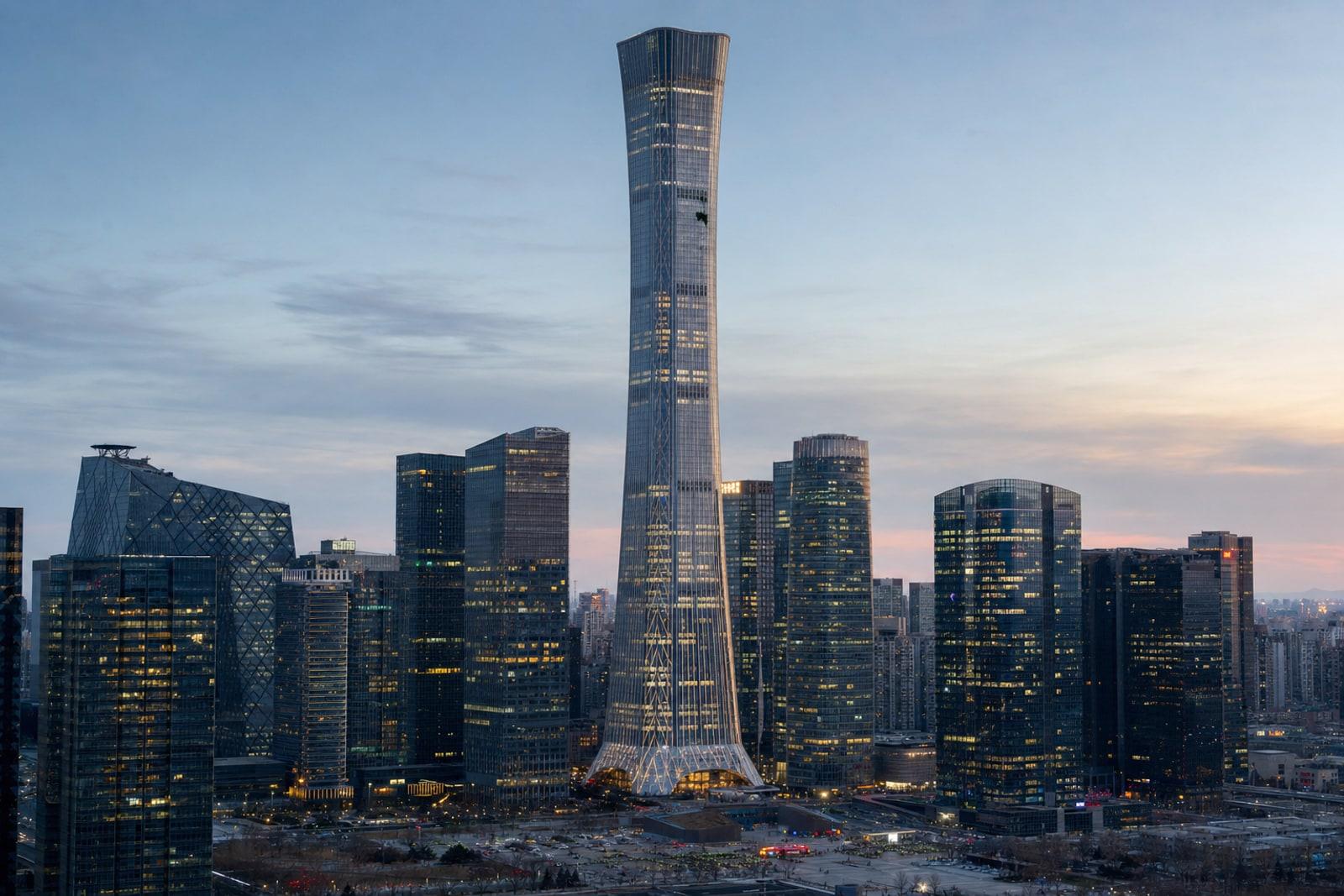
A small aircraft crashed into the CITIC Tower, the tallest building in Beijing, on Friday evening, killing the pilot and injuring 13 people in one of the most striking breaches of the Chinese capital's heavily guarded airspace in years.
The single-engine, two-seat light aircraft struck the 528-metre skyscraper — known to many residents as China Zun — at about 5:55pm local time on 26 June, according to a statement issued by the government of Chaoyang district, where the tower stands. Videos verified by international news organisations and circulated outside China appeared to show the plane hitting a high floor before spinning to the ground near the building's entrance, scattering debris across the street as crowds fled.
What the authorities have confirmed
In a short statement posted on the messaging platform WeChat on Saturday, the Chaoyang district government said a single-engine, two-seat light aircraft had crashed into a high-rise building and that the pilot had been the only person on board.
The only person on board was the pilot, who died, and 13 people were injured at the scene.
The statement, reported by the South China Morning Post and confirmed by The Associated Press and Agence France-Presse, did not name the building or the pilot, gave no cause, and said an investigation was continuing. Officials have not said whether they regard the crash as an accident or a deliberate act.
The CITIC Tower, completed in 2018, rises 528 metres over Beijing's central business district and is among the ten tallest buildings in the world. Shaped like an ancient Chinese ritual wine vessel, it serves as the headquarters of the CITIC Group, one of the country's largest state-owned conglomerates, and also houses offices, luxury apartments and a hotel. Photographs published after the crash showed shattered glass and an apparent hole in the upper facade.
The aircraft and the airspace question
Chinese authorities have not identified the aircraft. Based on registration markings visible in online images and on flight-tracking data, several outlets — including Newsweek, the South China Morning Post and The Times of London — reported that it appeared to be a domestically manufactured Sunward SA60L Aurora, a light sport aircraft built by Starair Aircraft Co. and operated by a local general-aviation company. Those details remain unverified by the Chinese government, and should be treated with caution.
Ian Petchenik, a spokesman for the flight-tracking service Flightradar24, told The Times that the aircraft is normally used for pilot training east of Beijing and that Friday's flight was “out of character.”
“I don't think we can rule anything out at this point,” he said.
The crash has drawn attention precisely because of where it happened. Beijing maintains some of the most tightly controlled airspace in China:
- Civilian small-aircraft flights are generally prohibited over the city's core.
- Flights typically require clearance from both the Civil Aviation Administration of China and the People's Liberation Army Air Force.
- Authorities had recently tightened restrictions on recreational flying and consumer drones.
How a light aircraft came to be over the capital's central business district — near where much of the Communist Party leadership lives and works — is among the central unanswered questions.
A crash that vanished from the internet
Almost as quickly as the footage emerged, it began to disappear. Videos, images and search results about the crash were scrubbed from Chinese social media platforms including Weibo and Xiaohongshu, also known as Red Note, according to reporting by CNN, NBC News and The Washington Post. A search of the building's name on some apps returned only posts dated before the crash. The footage survived largely because copies had been shared on platforms outside China's firewall, such as X.
Witnesses described police preventing bystanders from taking photographs and pressing some to delete images already on their phones. One resident of a nearby building, identified only by the surname Lin, told reporters of a hurried evacuation.
“I ran out without my ID card or bag,” Lin said.
By later that evening, CNN reported, the area around the tower appeared largely back to normal, with little outward sign of what had happened hours earlier.
What remains unverified
The most consequential questions are still open. The cause of the crash has not been established, and authorities have offered no explanation for how the aircraft reached the heart of the capital. The pilot has not been publicly identified, and no motive has been suggested. The precise model, registration and operator of the aircraft — and the extent of structural damage to the tower — have not been officially confirmed. The condition of the 13 injured was not detailed.
For now, what is firmly established is narrow but serious: a light aircraft struck Beijing's tallest building at rush hour, one person is dead and 13 are hurt, and the authorities are saying very little while moving quickly to control what the public can see.
Frequently asked
- What building did the plane crash into?
- The CITIC Tower, also known as China Zun, Beijing's tallest building at 528 metres, located in the Chaoyang central business district and headquarters of the state-owned CITIC Group.
- How many people were killed or injured?
- According to the Chaoyang district government, the pilot was the only person on board and was killed, and 13 people were injured at the scene. The condition of the injured has not been detailed.
- What caused the crash?
- The cause has not been established. Chinese authorities said an investigation was ongoing and have not stated whether the crash was an accident or deliberate.
- Why is footage of the crash hard to find in China?
- Videos, images and search results about the crash were quickly removed from Chinese social media platforms such as Weibo and Xiaohongshu. The footage survived mainly on platforms outside China's firewall.
Sources(10)
- 1Small plane crash at Beijing high-rise kills the pilot and injures 13, authorities sayABC News / Associated Press · abcnews.com
- 2Small aircraft crashes into Beijing's tallest building, killing pilot and injuring 13NBC News · nbcnews.com
- 3Small aircraft hits Beijing's tallest skyscraper, prompting evacuationsSouth China Morning Post · scmp.com
- 4China confirms death of pilot in Citic Tower plane crashSouth China Morning Post · scmp.com
- 5Pilot dies after small plane crashes into China high-riseRTÉ / Agence France-Presse · rte.ie
- 6Plane crashes into Beijing's tallest building; damage reportedNPR · npr.org
- 7Video Shows Plane Crash into Beijing's Tallest SkyscraperNewsweek · newsweek.com
- 8A small plane slammed into the tallest skyscraper in China's capital. Hours later, it was like nothing had happened.CNN · cnn.com
- 9Plane That Crashed Into Beijing's Tallest Building Usually Used For Pilot Training, Report SaysYahoo News / The Times · yahoo.com
- 10China Zun (CITIC Tower)Wikipedia · en.wikipedia.org
Related by topic