Health policy
Luxembourg's outpatient-care bill splits the country's doctors
A draft law letting physicians run clinics outside hospitals promises shorter waits, but hospital doctors warn it could drain the wards of their most profitable work.
By Léa Hoffmann · · · 6 min read
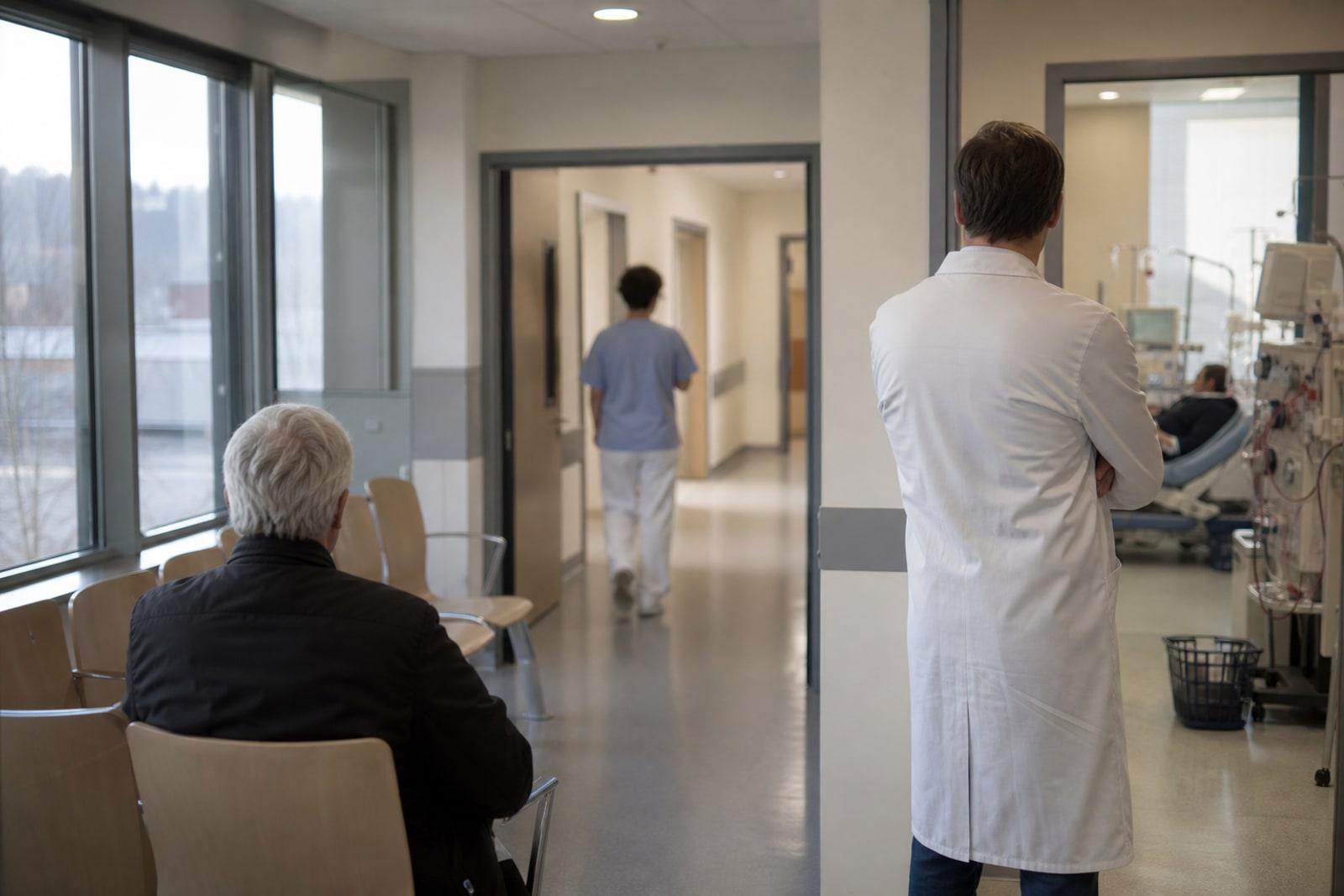
For decades, almost every scheduled operation, infusion and dialysis session in Luxembourg has run through one of the Grand Duchy's hospitals. A draft law unveiled this week would change that, and in doing so it has exposed a fault line running through the country's medical profession.
On 10 June, Health and Social Security Minister Martine Deprez presented Bill 8760 to the Chamber of Deputies' health commission, two days after it was formally deposited. The text amends the Social Security Code and the hospital law of 8 March 2018 to create a legal framework for structures de soins ambulatoires — standalone outpatient centres that physicians could own and operate outside hospital walls. Deprez summed up the ambition in three words: care that is “plus près, plus rapide et plus efficace” — closer, faster and more efficient.
What the bill proposes
The reform would let medical associations or physician-owned companies set up clinics in a defined list of fields: dialysis, oncology and non-surgical day hospitalisation, plus minor surgical procedures in ophthalmology, dermatology, urology, proctology and abdominal-wall (parietal) surgery. These are precisely the routine, high-volume interventions — cataract operations, endoscopies and the like — that many specialists argue do not require a full hospital setting.
The centres would not be free-floating. Each would need prior authorisation from the health ministry, based on an establishment project and proof of compliance, and would have to sign a convention with a partner hospital to guarantee continuity of care, patient transfers and access to medical records. Crucially, the bill specifies there would be no hierarchical tie to that hospital. The structures would also be folded into the national health map, the planning instrument that allocates capacity across the territory; the same text raises the maximum number of acute hospital sites from three to four.
Funding would be largely public. According to the ministry and reporting in Paperjam, the State would cover roughly 80 percent of a centre's investment and infrastructure costs, with the National Health Fund (CNS) carrying the remaining 20 percent; running costs would be met through the existing flat-rate financing system, and individual procedures billed under the social-security nomenclature. Deprez has been at pains to stress what the bill is not: not a “general and uncontrolled opening,” not privatisation, and explicitly closed to outside investors.
Why hospital doctors are worried
The loudest objections have come not from the reform's nominal target but from inside the hospitals. In an open letter published in the Luxemburger Wort on 12 November 2025, the presidents of the medical councils of the country's acute hospitals, together with those of the INCCI cardiac-surgery institute, the Centre François-Baclesse, the Rehazenter and the Steinfort intercommunal hospital, warned that such a shift “must be done in coherence with hospital doctors, and not in opposition to them.”
Their core fear is cherry-picking. If the simple, ambulatory and — in their words — highly profitable procedures migrate to private structures, hospitals would be left with the “heavy, complex and costly” cases that keep them financially under water. Strip out the viable segments, they argue, and the economics of the public sector deteriorate. They framed it as a recruitment problem as much as a budgetary one: “Why would a young doctor choose to work in a hospital,” with its night shifts, weekend duty and heavy responsibility, “if other structures offer simpler, more lucrative activities without the constraint of continuity of care?”
Several deputies voiced parallel reservations during the hearing, pointing to the risk of creeping privatisation and to questions over where future centres would sit.
The AMMD's more pointed quarrel
The position of the Association of Doctors and Dentists (AMMD), the profession's main body, is more nuanced than a simple rejection. The AMMD has long argued for moving routine work out of hospitals. In an October 2025 interview with Le Quotidien, its president, Dr Chris Roller, said plainly: “We want to be able to conduct routine interventions that can be safely performed outside hospitals,” citing cataract surgery, colonoscopies, gastroscopies and vasectomies under local anaesthetic.
The dispute, then, is less about whether to develop ambulatory care than about who controls it. Roller has objected to a model in which such clinics are run as appendages of hospitals, arguing that “the monopolisation of hospital medicine” obstructs doctors practising as independents. The association also contests the wider machinery of the system — an obsolete nomenclature, a fee-calculation method it says ignores medical progress and rising costs, and what it regards as contested governance.
A reform born of a financing squeeze
The bill lands in the middle of an open conflict over how Luxembourg pays for health care. The AMMD let its convention with the CNS lapse rather than sign on the terms offered, leaving fees to be set by a grand-ducal regulation — a rare breakdown in a system built on negotiated agreements.
The backdrop is a deteriorating balance sheet. Health-and-maternity insurance is projected to run a deficit of about 126.5 million euros in 2026, with spending rising faster than revenue in what CNS officials describe as a structural “scissor effect.” A quadripartite meeting of government, employers, unions and care providers in Dudelange on 6 May set a target of roughly 96 million euros in savings. Against that, the ambulatory bill is partly a bet that treating people in cheaper settings will relieve pressure on both wards and the budget.
What it means for patients
For patients, the promise is convenience: procedures closer to home, potentially shorter waits and hospitals freed to concentrate on emergencies and serious illness. Deprez has tempered expectations, conceding that Luxembourg lacks reliable data on current waiting times and that this law will not, by itself, improve access to specialist doctors.
The deeper question is whether a two-track system can be built without hollowing out the public hospitals that remain the backbone of acute care. As Bill 8760 moves to the Council of State for its opinion, the fight will be over the detail — and over who ends up running Luxembourg's clinics of the future.
Frequently asked
- What does Luxembourg's Bill 8760 actually change?
- It amends the Social Security Code and the 2018 hospital law to allow physicians, through medical associations or companies, to open and run outpatient care structures outside hospitals for a defined list of treatments, subject to ministerial authorisation and a partnership convention with a hospital.
- Which medical procedures could be performed in the new outpatient centres?
- Dialysis, oncology and non-surgical day hospitalisation, along with minor surgical interventions in ophthalmology, dermatology, urology, proctology and abdominal-wall (parietal) surgery, such as cataract operations and endoscopies.
- Why are hospital doctors opposed?
- They fear that moving simple, profitable procedures to private clinics would leave hospitals with heavy, complex and costly cases, undermining hospital finances and making it harder to recruit young doctors to demanding hospital posts.
- Does the AMMD support the reform?
- The AMMD favours performing more routine procedures outside hospitals but objects to clinics being controlled by hospitals, which its president Dr Chris Roller says hampers doctors practising as independents. It also disputes the fee nomenclature and broader governance.
- How would the new centres be funded?
- The State would cover roughly 80 percent of investment and infrastructure costs and the National Health Fund (CNS) about 20 percent; operating costs would use the flat-rate financing system and procedures would be billed under the social-security nomenclature, with no outside investors permitted.
Sources(6)
- 1Une nouvelle etape pour le developpement des soins ambulatoires au LuxembourgMinistere de la Sante et de la Securite sociale (gouvernement.lu) · m3s.gouvernement.lu
- 2Une loi pour renforcer la medecine ambulatoire (Bill 8760)Chambre des Deputes du Grand-Duche de Luxembourg · chd.lu
- 3Luxembourg: un projet de loi vise a creer des structures ambulatoires de soinL'essentiel · lessentiel.lu
- 4Les hopitaux mettent en gardeLe Quotidien · lequotidien.lu
- 5Chris Roller: 'Le metier de medecin liberal est entrave'Le Quotidien · lequotidien.lu
- 6Assurance maladie-maternite: 126,5 millions de deficit en 2026Paperjam · paperjam.lu
Related by topic