Higher education
Chamber of Employees to launch Luxembourg's first master's in AI for healthcare
A French university degree delivered locally by the Chamber of Employees will train clinicians and IT staff to deploy medical AI — as the EU tightens the rules governing it.
By Tom Schmit · · 5 min read
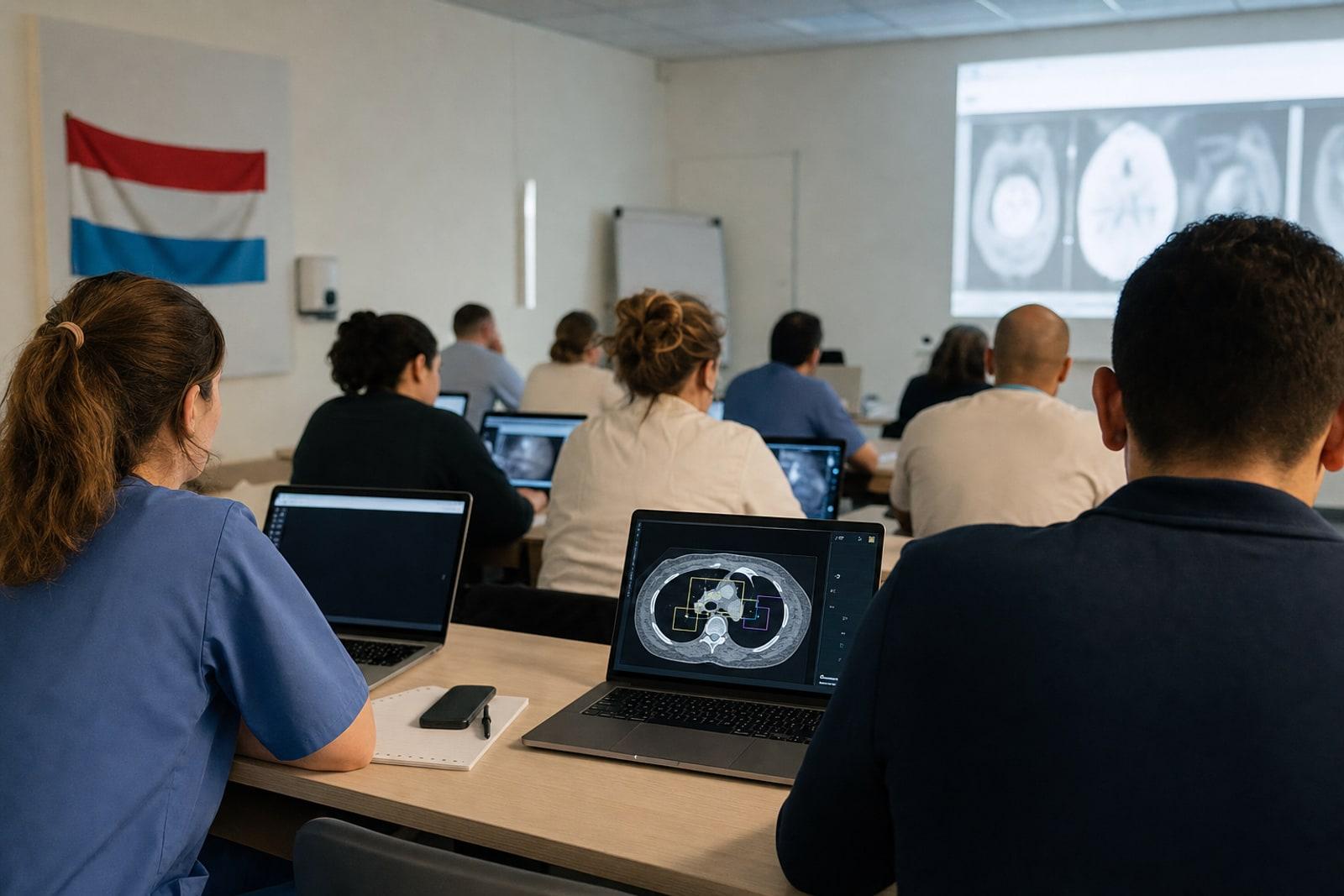
Luxembourg will gain its first master's degree dedicated to artificial intelligence in healthcare this autumn, the country's Chamber of Employees (Chambre des salariés, or CSL) has announced — a workforce-focused programme arriving just as European regulators tighten the rules governing AI in medicine.
The CSL unveiled the degree on 26 June, describing it as a national first. It is aimed not at school-leavers but at people already working: clinicians, healthcare managers and the IT specialists who build and run hospital software. Classes start in October 2026 and run for twelve months, held on weekday evenings and Saturdays so participants can keep their jobs while they study.
One detail complicates the "Luxembourg first" framing. The diploma is not awarded by the University of Luxembourg, the Grand Duchy's national university, which is not involved. Instead it is a Master 2 Informatique – Parcours : IA et Santé (a master's in computer science with an AI-and-health track) granted by the Université de Technologie de Belfort-Montbéliard (UTBM) in France, and delivered inside Luxembourg by the CSL's Luxembourg Lifelong Learning Centre (LLLC) together with the vocational training body CFPC DeWidong.
Under the arrangement, UTBM provides the academic oversight and the degree itself; the LLLC handles delivery and access for working professionals; and DeWidong bridges the academic syllabus with the day-to-day realities of the care sector.
What the degree covers
The programme carries 66 ECTS credits across seven teaching units, grouped under five themes that lean as heavily on governance as on the technology itself:
- Ethics, law and regulation
- Understanding AI and transparency, including the bias and "explainability" problems that dog clinical algorithms
- Governance and implementation in healthcare settings
- Practical applications and real-world use cases
- Methodology and project management
Teaching is in French, with B1-level English required to graduate, and the bulk of the course runs in person in Luxembourg, with about a quarter delivered remotely. Entry requires a master's-level first year or an equivalent four-year qualification, though candidates can also qualify through a recognition-of-prior-experience route. Tuition is set at 7,900 euros, according to the CSL's programme page, and applications run until September 2026.
The emphasis is deliberate. Rather than training people to write machine-learning code from scratch, the degree is pitched at those who must decide whether, and how, to let an algorithm into a clinic — and who will be accountable when it makes a call.
The challenge is not only technological: it is about ensuring a responsible transition in the service of the quality of care, patient safety and the central role of human beings in healthcare decisions.
That framing, from the CSL, mirrors the regulatory direction of travel across the European Union, where human oversight of medical AI is becoming a legal requirement rather than a slogan.
A bet on the talent pipeline
The master's is a small but pointed piece of a larger national strategy to retrofit Luxembourg's workforce for AI. The government has been running a free introductory course, "Elements of AI Luxembourg," whose fifth edition launched in March 2026; more than 5,300 residents have completed it, and the authorities have set a target of training 1% of the population by 2030. That drive is overseen by Elisabeth Margue, the minister delegate responsible for media and connectivity.
Healthcare is one of the sectors where Luxembourg, like its neighbours, expects AI to land hardest — in diagnostic imaging, patient monitoring, administrative triage and the management of care pathways. The CSL says the new degree is built around precisely those settings, with modules on clinical AI and on managing AI within care pathways, alongside the bioethics and compliance content.
The flexible format, the chamber argues, is part of the point.
"The programme offers a flexible timetable intended to facilitate, as far as possible, the balance between professional activity, personal life and further study," the CSL said.
Arriving as Europe rewrites the rules
The timing is not incidental. Under the EU's Artificial Intelligence Act, AI that is embedded in, or itself functions as, a medical device — already regulated under the bloc's Medical Device Regulation and its in-vitro diagnostics counterpart — is automatically classed as "high-risk." That designation triggers a stack of obligations: risk-management systems, high-quality and well-governed training data, transparency for users, demonstrable human oversight, and conformity assessments carried out by notified bodies, all layered on top of existing device rules.
Those requirements are phased in over the coming years. EU institutions have pushed several deadlines back, with standalone high-risk AI systems now due to comply by December 2027 and high-risk AI built into regulated products such as medical devices by August 2028. The European Commission also runs dedicated work on AI in healthcare, reflecting how central the sector has become to the bloc's digital ambitions — and to its anxieties.
For hospitals and health firms, that compliance burden translates into demand for people who can speak both languages — clinical and computational — and who understand the legal scaffolding around them. A degree that spends as much time on governance, ethics and the AI Act as on the algorithms is, in effect, a bet that the scarce skill in medical AI will not be building the models, but safely deploying them.
Whether 7,900 euros and a year of evenings proves an attractive proposition for Luxembourg's stretched healthcare workforce will become clearer when the first cohort assembles in October. What the launch signals is plainer: a small country positioning its talent pipeline at the contested intersection of medicine, data and regulation.
Frequently asked
- Is this degree run by the University of Luxembourg?
- No. Despite being billed as a Luxembourg first, the diploma is awarded by the Université de Technologie de Belfort-Montbéliard (UTBM) in France and delivered in Luxembourg by the Chamber of Employees' Lifelong Learning Centre (LLLC) with CFPC DeWidong. The University of Luxembourg is not a partner.
- Who is the master's degree for, and what does it cost?
- It targets working healthcare professionals and IT/digital specialists who deploy AI in care settings. Entry requires a master's-level first year or equivalent, or recognition of prior experience. Tuition is 7,900 euros and applications run until September 2026.
- When does it start and how is it structured?
- Classes begin in October 2026 and run for 12 months on weekday evenings and Saturdays. The degree carries 66 ECTS across seven teaching units covering ethics and law, AI transparency, healthcare governance, practical use cases, and project methodology. Teaching is in French, with B1 English required to graduate.
- How does it relate to EU rules on medical AI?
- AI embedded in or acting as a medical device is classed as high-risk under the EU AI Act, requiring data governance, transparency and human oversight. Those obligations phase in by December 2027 and August 2028, driving demand for staff who can deploy medical AI in compliance with the rules.
Sources(5)
- 1Luxembourg to Launch 1st Master's Degree in AI & HealthcareChronicle.lu · chronicle.lu
- 2Master Intelligence Artificielle et Santé (Master 2 Informatique – Parcours : IA et Santé)Chambre des salariés / LLLC (csl.lu) · csl.lu
- 3Le Luxembourg poursuit la formation de sa population à l'intelligence artificielleGouvernement du Grand-Duché de Luxembourg · gouvernement.lu
- 4Artificial Intelligence in healthcareEuropean Commission – Public Health · health.ec.europa.eu
- 5EU Commission drafts guidelines on classifying high-risk systems under the AI ActRegulatory Affairs Professionals Society (RAPS) · raps.org
Related by topic