Housing policy
Luxembourg keeps its 6,000-homes target but admits it can't measure capacity
The government has reaffirmed its annual housing goal in a parliamentary reply, yet conceded it has no consolidated estimate of how many homes the construction sector can actually deliver.
By Sophie Klein · · 4 min read
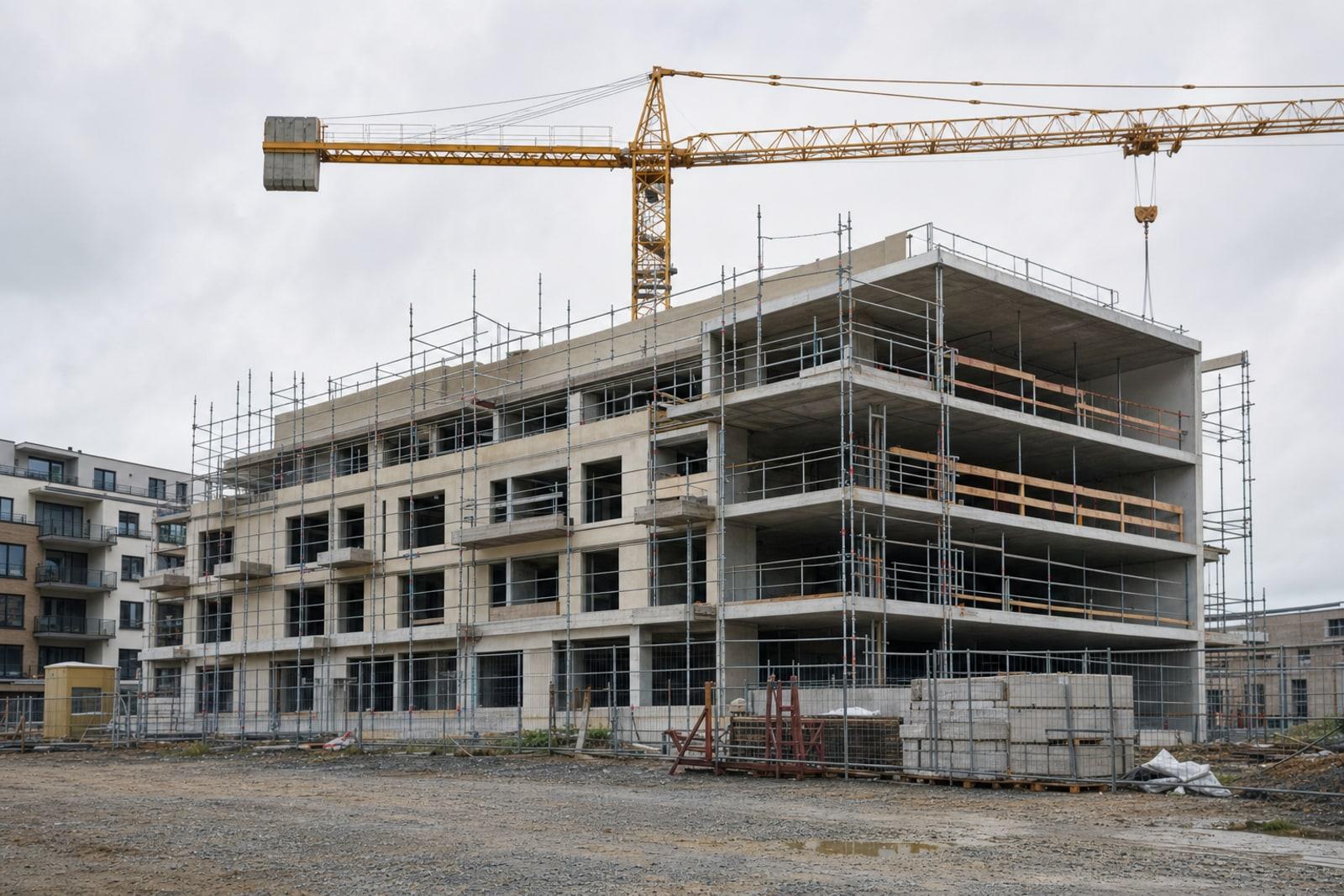
Luxembourg's government insists it is still chasing one of the most consequential numbers in domestic politics — 6,000 new homes a year — while conceding it cannot say how many homes the country is actually capable of building.
In a joint written reply to parliament dated 19 June 2026, Housing Minister Claude Meisch and Economy Minister Lex Delles, both of the Democratic Party (DP), reaffirmed the government's ambition to raise housing production to meet structural demand. But they acknowledged that, as the reply put it, the state "does not yet have a consolidated and updated estimate of the effective annual production capacity" in current conditions. The exchange was reported by L'essentiel and Paperjam.
The admission is striking because 6,000 homes a year is not a loose aspiration but a figure rooted in the governing coalition's programme. Prime Minister Luc Frieden has framed it in demographic terms, saying the country needs to build at that pace "to properly house the roughly 12,000 new residents who settle here every year."
A target the state still claims, but cannot cost
The ministers were responding to a question filed by two opposition deputies from the Luxembourg Socialist Workers' Party (LSAP), Yves Cruchten and Mars Di Bartolomeo. They asked whether the 6,000 figure remained realistic and on what assumptions it rested, noting that recent analyses judge the goal "hardly achievable, even disconnected from current market realities."
At this stage, the government does not yet have a consolidated and updated estimate of the effective annual production capacity in the current context.
That candour underlines a gap between political commitment and operational planning. The government continues to name the target while saying it lacks the data to know whether the sector can come close to it.
Building far below the goal
The historical record makes the scale of the challenge plain. Between 1970 and 2021 — the latest period for which complete figures exist — Luxembourg delivered 133,717 homes, an average of just 2,571 units a year, according to figures cited in the parliamentary reply and reported by Paperjam. That is roughly 43 percent of the 6,000-home objective. The 4,000-unit threshold has been crossed only a handful of times in more than half a century, with a record of 4,444 homes in 2008.
Recent data point the wrong way. STATEC, the national statistics office, recorded around 4,025 dwellings approved for construction in 2024, down 8.6 percent year on year, after falls of about 6 percent in 2023 and 23.4 percent in 2022. The slide accelerated into 2025: permits for new dwellings dropped 37.8 percent in the first quarter to 774 units. In Luxembourg City, permits collapsed by 95.1 percent to just 20 dwellings.
Meanwhile demand keeps building. Analysts estimate that more than 7,000 new households form in Luxembourg each year, while fewer than 4,000 homes are completed — a structural shortfall that has helped push house prices up around 135 percent between 2010 and 2021, against roughly 42 percent across the euro area.
A construction sector in retreat
Part of the problem is that the industry expected to deliver those homes has been contracting. Construction gross value added fell 7.2 percent year on year in the first half of 2024, the sharpest decline in the economy, STATEC reported. Higher interest rates chilled both buyers and developers, and a wave of insolvencies followed.
Between 2021 and 2025, some 712 construction companies failed and around 4,521 jobs were lost in the sector, according to figures compiled from official data, though bankruptcies eased somewhat in 2025. The deputies' question listed the constraints the government itself recognises:
- labour shortages and a string of company failures in construction;
- insufficient mobilisation of buildable land;
- complex and lengthy administrative and planning procedures;
- an economic climate of higher interest rates that has slowed or stalled projects.
Public construction has not filled the gap. The national affordable-housing developer SNHBM began 301 units and completed 250 in 2024, with more than 1,000 under construction — useful, but far short of the national target, and reflecting a long-run delivery capacity nearer 400 homes a year. Social housing remains around 2 percent of the total stock, among the lowest shares in Europe.
What the government is doing
Ministers point to a battery of measures intended to revive supply. The state has committed €923m to affordable public housing for 2024-2026, stepped up purchases of off-plan (VEFA) developments to keep building sites active, and is pressing ahead with the Pacte Logement 2.0, a state-municipal partnership running to 2032. It is also moving to simplify planning rules and has introduced a new land-mobilisation tax designed to discourage owners from sitting on undeveloped plots.
Whether any of this closes the distance to 6,000 homes a year remains an open question — and, by the government's own account, an unmeasured one. The Fondation IDEA, an independent think tank, warned in March 2026 that the crisis risks becoming permanent and that the target is unlikely to be met in the short to medium term. For residents and the roughly 228,000 cross-border workers who underpin the labour market, the practical stakes are immediate: as long as construction trails household formation, prices and rents face upward pressure, and the gap the government has pledged to close keeps widening.
Frequently asked
- What is Luxembourg's housing construction target?
- The government's stated objective is 6,000 new homes a year, a figure rooted in the coalition agreement and linked by Prime Minister Luc Frieden to housing the roughly 12,000 new residents who arrive annually.
- Is Luxembourg meeting the 6,000-homes target?
- No. Output has averaged about 2,571 homes a year between 1970 and 2021, and building permits have fallen sharply — to around 4,025 dwellings in 2024 and down a further 37.8% in early 2025.
- Why is the target hard to reach?
- Ministers and deputies cite labour shortages and construction-firm bankruptcies, insufficient mobilisation of buildable land, slow administrative procedures, and high interest rates that have stalled projects.
- Has the government dropped the target?
- No. In a June 2026 parliamentary reply ministers reaffirmed the ambition, but conceded they lack a consolidated, updated estimate of how many homes the sector can actually deliver.
Sources(10)
- 1Logements au Luxembourg: le gouvernement maintient-il l'objectif de 6 000 unités par an?L'essentiel · lessentiel.lu
- 2Le gouvernement vise 6.000 nouveaux logements par an… à l'aveuglePaperjam · paperjam.lu
- 3Housing Crisis in Luxembourg Becoming Permanent, IDEA Analysis SuggestsChronicle.lu · chronicle.lu
- 4Luxembourg's Housing Situation: A Double Crisis or the New Normal?Goldbridge Investment Club · goldbridge.lu
- 5Conjoncture Flash October 2024: Construction remains in critical conditionSTATEC · statistiques.public.lu
- 6Construction bankruptcies strand workers in LuxembourgIndustryRadar · industryradar.com
- 7Seulement 4.458 logements autorisés l'an passéLes Frontaliers · lesfrontaliers.lu
- 8Le logement en chiffres au quatrième trimestre 2023STATEC / gouvernement.lu · gouvernement.lu
- 9Claude Meisch at the European Conference of Ministers responsible for Housinggouvernement.lu · gouvernement.lu
- 10The State of Housing in the EU 2025 — LuxembourgHousing Europe · housingeurope.eu
Related by topic