EU presidency
Ireland begins EU Council presidency, presents priorities in Luxembourg
Dublin will chair EU decision-making until December, steering talks on the next long-term budget, enlargement, competitiveness and defence — files that reach directly into Luxembourg.
By Camille Reuter · · 4 min read
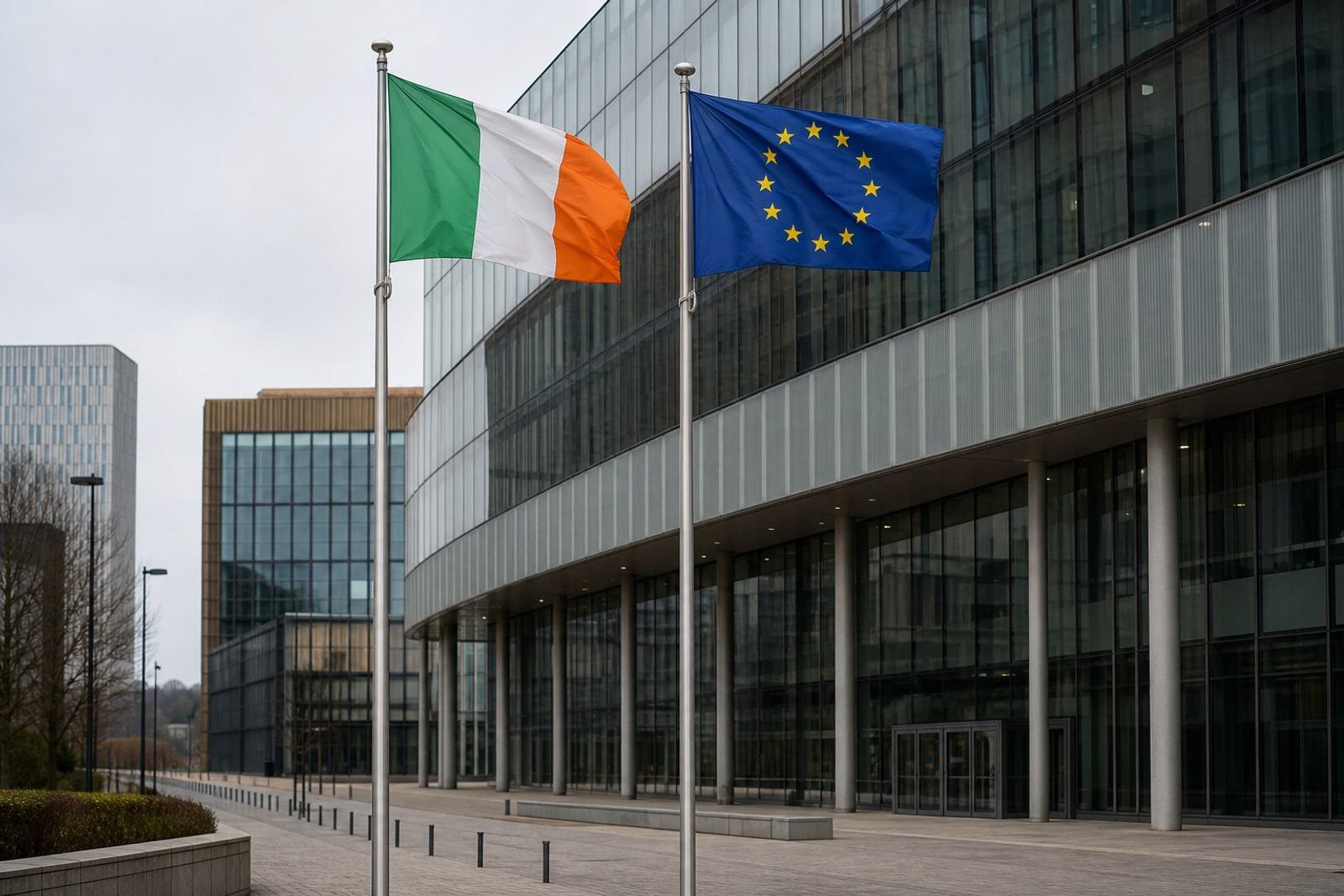
Ireland took over the rotating presidency of the Council of the European Union on 1 July, opening a six-month term that will shape the bloc's most contentious files of 2026 — from the next long-term budget to enlargement and defence. On its first day, Dublin's diplomats brought that agenda to Luxembourg, where the presidency's priorities were laid out for an audience of officials from across the EU institutions.
The presentation was held at the Foyer Européen in Luxembourg-Gare, organised jointly by the European Commission Representation in Luxembourg and the Embassy of Ireland. Around 70 diplomats and representatives of the EU institutions attended, according to Chronicle.lu. Anne Calteux, head of the Commission's Luxembourg office, explained the mechanics of the role — chairing Council meetings, brokering compromise among member states and helping to advance the EU's legislative agenda — while Ireland's ambassador to Luxembourg, Jean McDonald, presented the programme, describing a presidency that begins at what she called "a critical time for Europe."
It is Ireland's eighth turn at the helm, taking over from Cyprus and handing to Lithuania at the end of the year. Its slogan draws on an Irish proverb, "Ní neart go cur le chéile" — strength with unity — and this is the first Irish presidency in which Irish operates as a fully official EU language.
Three pillars, six months
Ireland has organised its programme around three pillars it describes as interlocking: competitiveness, European values and security. On the economy, the presidency has committed to advancing the "One Europe, One Market" roadmap agreed by the Council, Commission and Parliament, with a practical focus on cutting red tape, deepening the single market and accelerating the energy transition. Digital policy and artificial intelligence also feature, reflecting Ireland's standing among the EU's top five member states for research and innovation.
Those goals track closely with the European Commission's own agenda and the EU's Strategic Agenda for 2024–2029, meaning the presidency's job is largely one of delivery: moving files that are already on the table toward decisions. On security, Ireland says it will press cross-border cooperation against organised crime — including migrant smuggling and firearms trafficking — and the full implementation of the Pact on Migration and Asylum, alongside closer defence cooperation.
For the next six months, we will work in partnership with Member States, the European institutions and our international partners to help advance a stronger, safer and more competitive European Union.
The words are the Taoiseach's, Micheál Martin, who marked the handover in Dublin alongside European Council President António Costa. "Now that the starting whistle has blown, we are ready to give it our all," Martin said. Costa, for his part, called it "the right presidency in the right time."
The budget fight ahead
The heaviest task of the term is money. The European Commission tabled its proposal for the Multiannual Financial Framework — the EU's seven-year budget — for 2028 to 2034 in July 2025, and Ireland has said it will work to advance those negotiations and, ideally, secure agreement among member states before the year is out. That requires unpicking the most sensitive question in Brussels: how to finance the budget, and how far to lean on new EU-wide "own resources."
Enlargement runs alongside it. Ireland has reaffirmed support for candidate countries, with negotiations advancing for Montenegro, Albania, Moldova and Ukraine. Support for Kyiv threads through the whole programme; Martin pledged that the EU would "stand unswervingly by the people of Ukraine, inspired by their courage and determined to ensure that they get the peace and justice they deserve."
Why it matters for Luxembourg
For a small member state, a presidency held next door is more than protocol. Luxembourg's economy is unusually exposed to precisely the files Ireland will chair — and several of them are decided by unanimity or hard bargaining among capitals, where a small country's influence depends on the agenda being run fairly.
- The budget. As a net contributor and a financial centre, Luxembourg has a direct stake in the size and financing of the 2028–2034 framework and in any new own-resources drawn from the single market or corporate taxation.
- Cross-border work. STATEC counted nearly 494,000 employees in Luxembourg at the end of 2025, of whom roughly 47% — about 231,290 people — commute in from France, Belgium and Germany. The single-market, mobility and tax-coordination files on Ireland's desk touch that workforce directly.
- Competitiveness and finance. Simplification, capital-markets and financial-services measures bundled into the competitiveness pillar are core business for a jurisdiction built on fund management and cross-border finance.
- Security and defence. Deeper EU defence cooperation and internal-security measures shape a bloc in which Luxembourg is a small but active participant.
The Luxembourg event also carried a lighter note of the ties Dublin is cultivating: under Ireland's County Pairing Initiative, County Carlow has been twinned with Luxembourg, a nod to historical links running back through Echternach and Saint Willibrord.
Ireland's turn is estimated to cost in the region of €185 million, according to Brussels Signal. Whether it delivers a budget deal by December — the presidency's own stated ambition — will be the clearest measure of a six-month term that, for Luxembourg as for the rest of the bloc, sets the terms of the next decade of EU spending.
Frequently asked
- When does Ireland hold the EU Council presidency?
- Ireland holds the rotating presidency of the Council of the European Union from 1 July to 31 December 2026. It is Ireland's eighth presidency; it succeeds Cyprus and hands over to Lithuania at the start of 2027.
- What are Ireland's main priorities for its EU presidency?
- Ireland has framed its programme around three pillars — competitiveness, European values and security — and named as key tasks advancing the EU's 2028–2034 long-term budget, enlargement, defence cooperation and continued support for Ukraine.
- Where were the priorities presented in Luxembourg?
- On 1 July 2026, the European Commission Representation in Luxembourg and the Embassy of Ireland presented the priorities at the Foyer Européen in Luxembourg-Gare, to around 70 diplomats and EU-institution officials.
- Why does Ireland's presidency matter for Luxembourg?
- As a small member state, net contributor and financial centre, Luxembourg is directly exposed to the files Ireland will chair — the next EU budget and own resources, single-market and financial-services measures, and rules affecting the roughly 231,000 cross-border workers in its economy.
Sources(8)
- 1Priorities of the Irish Presidency of the Council of the EUIrish Presidency of the Council of the EU (consilium.europa.eu) · irish-presidency.consilium.europa.eu
- 2What are Ireland's priorities for its upcoming Presidency of the Council of the EU?European Parliamentary Research Service (EPRS) · epthinktank.eu
- 3'Ready to give our all': Ireland begins its six-month EU presidencyThe Irish Times · irishtimes.com
- 4Ireland Presents Priorities for EU Council Presidency in LuxembourgChronicle.lu · chronicle.lu
- 5The policies that will define Ireland's EU PresidencyRTÉ · rte.ie
- 6Irish Council Presidency includes a focus on security and migrationEuropean Commission — Migration and Home Affairs · home-affairs.ec.europa.eu
- 7Ireland's EU presidency set to cost around €185 millionBrussels Signal · brusselssignal.eu
- 8Regards 02/26 — Panorama of the Luxembourg labour market on 1 MaySTATEC (statistiques.public.lu) · statistiques.public.lu
Related by topic