Euro rescue fund
Europe's €500 billion crisis fund, seated in Luxembourg, searches for a new mission
With no bailout in sight, the Luxembourg-based European Stability Mechanism is weighing crisis prevention and even defence financing — while a reform to complete the banking union stays stuck in Rome.
By Jonas Thill · · 5 min read
The eurozone built a €500 billion firewall to fight financial crises. Almost a decade after its last rescue, the fund is looking for something to do.
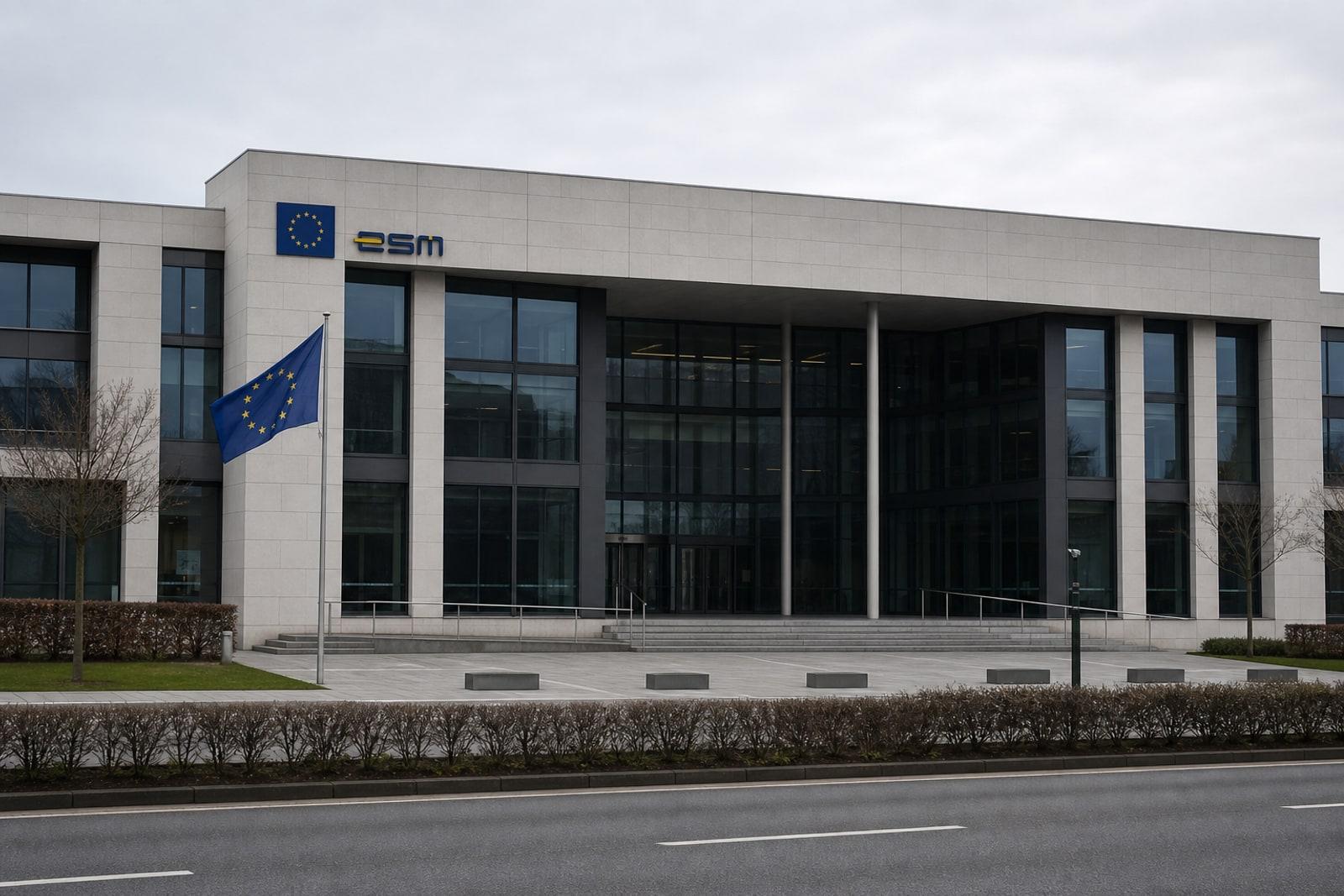
The European Stability Mechanism (ESM), the permanent bailout institution set up during the sovereign-debt crisis and headquartered in Luxembourg's Kirchberg district, has not disbursed a new loan to a member state since Greece left its programme in 2018. Bond markets are calm, no government is queuing for aid, and the reform meant to give the fund a fresh mandate has been frozen for more than two years. So its managing director, the former Luxembourg finance minister Pierre Gramegna, is publicly reimagining what a crisis fund does when there is no crisis.
A €500 billion fund without a crisis to fight
The ESM was established in 2012 as a permanent successor to the temporary rescue vehicle thrown together at the height of the euro crisis. Its statutory maximum lending capacity is €500 billion; the fund's own figures put its current lending capacity at €433 billion. Reuters, reporting on Gramegna's plans in January, described the institution as having "over 430 billion euros ($514 billion) of firepower."
That firepower is almost entirely unused. Ireland, Portugal, Spain, Cyprus and Greece all drew on the ESM or its predecessor during the crisis years, but the last of those programmes — Greece's — ended in 2018. Since then the fund has managed its legacy loans, invested its capital and watched from the sidelines. Its governance is unmistakably a club of governments: the Board of Governors is made up of the euro area's 20 finance ministers, the same people who sit as the Eurogroup.
A pitch to finance defence
Gramegna's most striking idea is to point the fund at Europe's rearmament. In an exclusive interview with Reuters published on 30 January 2026, he argued the ESM could extend so-called precautionary credit lines to countries for defence spending — without attaching the harsh economic-reform conditions that made its crisis-era loans politically toxic.
The pitch is aimed at states that are financially sound but fiscally stretched by soaring military budgets, in particular smaller members such as the Baltic countries, which have nearly quadrupled defence spending since Russia's 2022 invasion of Ukraine to roughly 5% of economic output. To spare any single borrower the stigma of asking for help, Gramegna suggested countries could make "collective requests."
It is one of our instruments. It's available. We need to rediscover the potential of that instrument.
Crucially, Gramegna has framed this as using tools the ESM already owns rather than an expansion of its purpose. He has argued that the factor justifying the fund's intervention is the risk of financial destabilisation, and that its existing seven instruments could be deployed with member states' consent — no new treaty required. But the ambition points further still, into debate about whether Europe's rescue machinery should also serve competitiveness and industrial resilience. In a February interview with the Italian agency ANSA, Gramegna said the ESM was "willing to open a discussion with all our member countries," while stressing that any new role would need the consensus of every member.
The reform stuck in Rome
Even a mission the ESM has formally agreed to take on is still on hold. Under a revised treaty signed in early 2021, the fund would become the common "backstop" to the Single Resolution Fund — the banking union's pot for winding down failing banks, which has itself built up around €80 billion. The ESM would stand ready to lend up to roughly €68 billion if that fund were ever exhausted, a safety net designed to reassure markets that no bank failure could overwhelm the system.
That backstop cannot be switched on. The reform requires ratification by all euro-area members, and Italy's Chamber of Deputies voted against it on 21 December 2023, leaving Rome the lone holdout. The Meloni government has stood its ground since, and the Eurogroup has repeatedly urged it to reconsider. In his statement after the Italian vote, Gramegna was blunt about the cost: "Without the ratification from all Member States, the ESM will not be able to provide the common backstop to the banking union's Single Resolution Fund, which would benefit all euro area countries."
Italy's government can, in principle, put ratification back to parliament after a six-month interval. Gramegna has said he keeps in "constant contact" with Italy's finance minister, Giancarlo Giorgetti, and has suggested that the very debate about modernising the ESM — including the defence discussion — could shift how Rome views the institution.
Luxembourg's institutional anchor
Whatever the fund becomes, it will remain a Luxembourg fixture. The ESM sits on the Kirchberg plateau alongside the European Investment Bank, the EU's Court of Justice and the Court of Auditors, part of the concentration of European institutions that underpins the Grand Duchy's outsized role in the bloc's financial architecture. Its managing director is a Luxembourger who ran the country's finances for eight years before taking the job in December 2022 on a five-year term.
For now, the safety net stays folded — €430 billion of unused capacity, a signed reform it cannot deploy, and a menu of proposals waiting on 20 governments to agree. As Gramegna put it to ANSA, the shared aim is to "find an intelligent way to finance this together." Whether Europe's crisis fund reinvents itself for an age of rearmament, or simply waits for the next shock, will be decided not in Luxembourg but around the table of finance ministers who own it.
Frequently asked
- What is the European Stability Mechanism?
- The ESM is the eurozone's permanent crisis-lending institution, established in 2012 and based in Luxembourg. It has a maximum lending capacity of €500 billion and is governed by the euro area's finance ministers, who form its Board of Governors.
- Why does the ESM want a new role?
- Demand for bailouts has faded — no country has drawn a new ESM programme since Greece exited in 2018. With its firepower largely unused, managing director Pierre Gramegna is proposing new missions such as crisis prevention and potentially defence financing.
- Why is the ESM's banking-union backstop blocked?
- A 2021 treaty reform would make the ESM the common backstop to the Single Resolution Fund, but it needs ratification by every euro-area member. Italy's lower house voted against it in December 2023, leaving Rome the only holdout and freezing the change.
- How could the ESM help fund defence?
- Gramegna has suggested the fund could offer precautionary credit lines to financially healthy but budget-stretched states without demanding economic reforms, and that countries could make collective requests to avoid stigma — using existing instruments rather than expanding the mandate.
Sources(12)
- 1Exclusive: European crisis fund worth over $500 billion could be used for defence, says ESM chiefReuters (via U.S. News & World Report) · usnews.com
- 2Exclusive: European crisis fund worth over $500 billion could be used for defence, says ESM chiefReuters (via ThePrint) · theprint.in
- 3Statement by ESM Managing Director Pierre Gramegna on the decision of the Italian Parliament not to ratify the revised ESM TreatyEuropean Stability Mechanism · esm.europa.eu
- 4What is the ESM's lending capacity?European Stability Mechanism · esm.europa.eu
- 5ESM ReformEuropean Stability Mechanism · esm.europa.eu
- 6Eurogroup urges ESM ratification amid worsening economic outlookEunews · eunews.it
- 7Pierre Gramegna interviewed by ANSA (Italy)European Stability Mechanism · esm.europa.eu
- 8ESM Board of Governors appoints Pierre Gramegna as new ESM Managing DirectorEuropean Stability Mechanism · esm.europa.eu
- 9Luxembourg's Pierre Gramegna Appointed ESM Managing DirectorChronicle.lu · chronicle.lu
- 10European Stability MechanismWikipedia · en.wikipedia.org
- 11European stability mechanism / State of LuxembourgFonds Kirchberg · fondskirchberg.public.lu
- 12Europe's €430b crisis fund could be repurposed for defence, says ESM chiefMalay Mail (Reuters) · malaymail.com
Related by topic