Germany
Tens of thousands rally in Erfurt as AfD re-elects its leaders and eyes power
Police put the crowd at around 31,000 as protesters blocked roads to the AfD's federal congress, where Alice Weidel and Tino Chrupalla were returned as co-leaders.
By Léa Hoffmann · · 4 min read
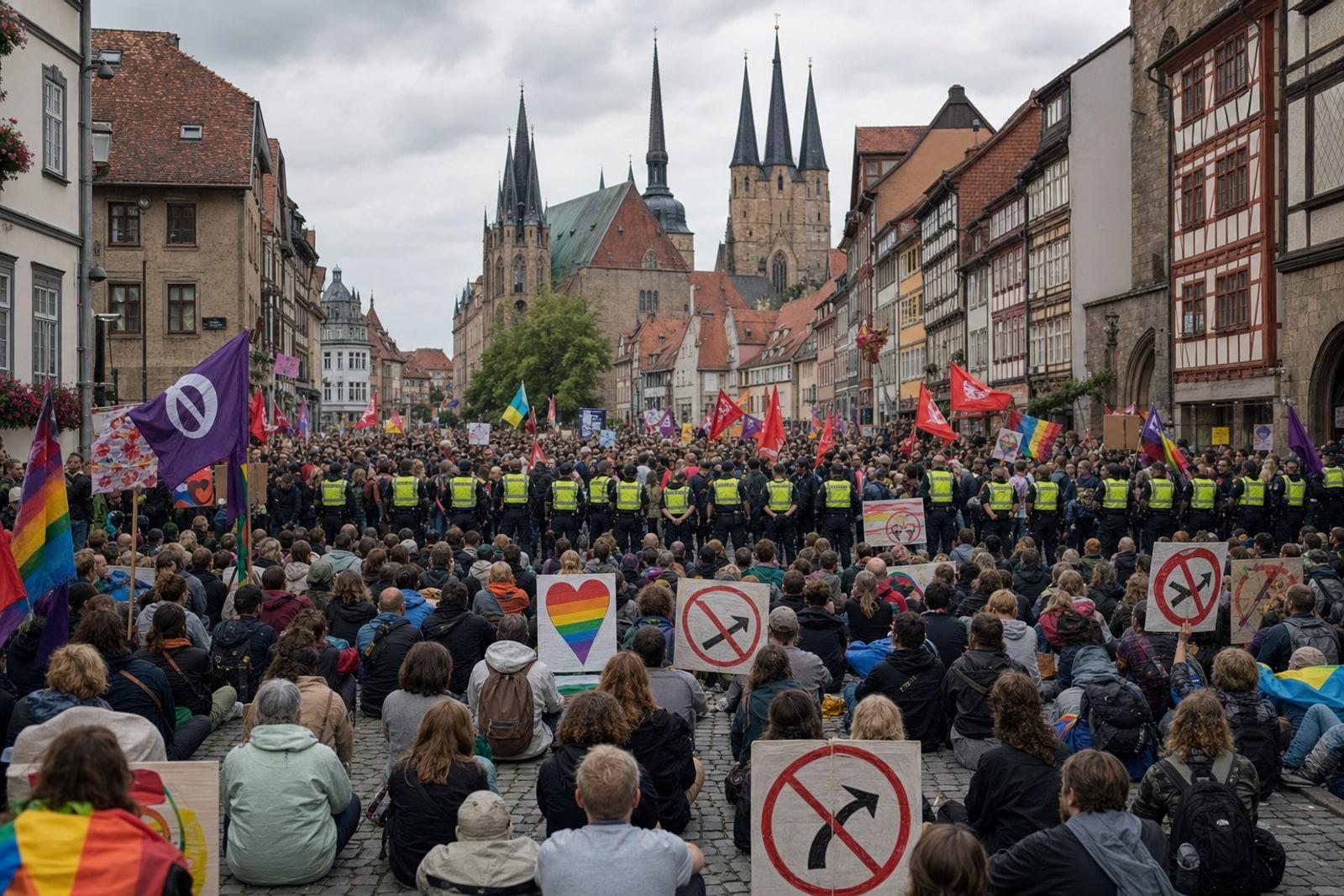
Tens of thousands of demonstrators converged on Erfurt on Saturday, blocking roads and sitting in long rows across the approaches to the convention centre where Germany's far-right Alternative for Germany (AfD) opened its federal congress. Police estimated the crowd at about 31,000 — the largest turnout yet recorded against an AfD party conference — while the organising alliances claimed roughly 50,000.
The protesters, drawn from trade unions, civil-society groups and left-wing parties, tried to choke off delegate access to the Messe Erfurt from several directions. Watched by police in riot gear, many staged sit-down blockades on highways and city streets. Thuringia police described the demonstration as legitimate and largely peaceful, recording 48 criminal offences and 11 administrative violations over the day; some reports noted paint and fireworks thrown at an AfD office and at officers. Despite the disruption, most delegates reached the hall and the two-day meeting began on schedule.
The umbrella group behind the blockades, Widersetzen ("Resist"), framed the day as a stand against what it called a normalisation of the far right.
"We want to make it clear that we simply won't tolerate this, that fascism is on the rise here in Germany," said Georg Becker, a spokesperson for Widersetzen.
A party emboldened
Inside the hall, the AfD returned its two federal co-leaders. Alice Weidel was re-elected with about 81% of the vote and Tino Chrupalla with roughly 70%, both running unopposed after four years at the head of a party that has moved from the fringe to the centre of German politics. Chrupalla's tally was down from around 81% two years earlier, a sign of internal friction even as the party's national standing has climbed.
The leaders used the congress to project confidence and to sharpen the party's hardline message on migration.
"We will govern. First at a regional level, then at national level," Chrupalla told delegates.
Weidel, who cast the coming votes in near-existential terms, told the congress: "For this remains our last chance to save our country." The rhetoric underscored how far the AfD has travelled since the February 2025 federal election, when it took 20.8% — its best post-war result and second place nationally. Several recent national polls now put the party at or near the top, cited at up to 29%, against around 22% for the CDU/CSU conservatives led by Chancellor Friedrich Merz.
Why now: the eastern test
The immediate trigger for both the congress and the counter-protests is a run of elections in Germany's east, where the AfD is strongest. Saxony-Anhalt goes to the polls on 6 September, with Mecklenburg-Vorpommern also voting in September. The party is hoping for more than 40% in Saxony-Anhalt, a result that could put it within reach of governing an entire state for the first time.
That prospect alarms the AfD's opponents, who fear a regional breakthrough would erode the "firewall" — the long-standing refusal by mainstream parties to cooperate with the far right — and pave the way to national influence. Organisers said the Erfurt mobilisation, larger than earlier set-piece protests in Gießen in 2024 and Riesa in January 2025, was meant to show that resistance is growing in step with the party.
- Turnout: police estimate about 31,000; organisers claim up to 50,000, with some 17,000 joining blockades.
- Leadership: Weidel (~81%) and Chrupalla (~70%) re-elected as co-chairs, both unopposed.
- Polling: AfD cited at up to 29% nationally, versus around 22% for Merz's CDU/CSU.
- Next test: Saxony-Anhalt votes 6 September; Mecklenburg-Vorpommern also in September.
A wider European backdrop
Germany's argument over the AfD is playing out against a broader European shift, as parties of the nationalist and radical right gain ground from France to Italy to the Nordic states. What sets the German case apart is the legal shadow over the AfD itself. In May 2025, the domestic intelligence service, the Federal Office for the Protection of the Constitution (BfV), moved to classify the party as a "confirmed right-wing extremist" organisation. The agency suspended that step after the AfD sued in Cologne; the party remains formally categorised as a "suspected" extremist organisation while the case proceeds.
That unresolved status feeds both sides of the debate. Supporters cast the intelligence label as a politically motivated attempt to criminalise a popular movement; opponents point to it as grounds for keeping the party out of power, and some campaigners renew calls for an outright ban. For now, the AfD's trajectory remains one of the defining questions for Germany — and, by extension, for a European Union watching its largest member state test the limits of its post-war consensus.
By nightfall in Erfurt, the blockades had thinned and the delegates had done their business. Both camps left claiming momentum: the party pointing to the polls and the ballots to come, its opponents to the size of the crowd that had tried to shut the congress down.
Frequently asked
- How many people protested against the AfD in Erfurt?
- Police estimated about 31,000 demonstrators on 4 July 2026, the largest turnout recorded against an AfD party congress. Organising alliances Widersetzen and Zusammenstehen claimed roughly 50,000, including around 17,000 joining blockades. Earlier same-day estimates were lower, at about 15,000 to 20,000.
- Who leads the AfD after the Erfurt congress?
- Delegates re-elected the party's two federal co-leaders. Alice Weidel won about 81% of the vote and Tino Chrupalla about 70%, both running unopposed. They have led the party for roughly four years.
- Why did the protests happen now?
- The congress came weeks before elections in eastern Germany where the AfD is strongest. Saxony-Anhalt votes on 6 September 2026, with Mecklenburg-Vorpommern also voting in September; the AfD hopes to top 40% in Saxony-Anhalt.
- Is the AfD officially considered extremist in Germany?
- Germany's domestic intelligence service moved in May 2025 to classify the AfD as a 'confirmed right-wing extremist' organisation, then suspended that step after the party sued. The AfD is currently classified as a 'suspected' extremist organisation pending the court case.
Sources(9)
- 1Thousands protest in Germany as far-right AfD party meetsAl Jazeera · aljazeera.com
- 220,000 protest against AfD party conference in GermanyEuronews · euronews.com
- 3Thousands protest in Germany as far-right AfD sets sights on powerReuters (via Investing.com) · investing.com
- 4Far-right Alternative for Germany party reelects leaders as protesters and police clashPBS NewsHour / Associated Press · pbs.org
- 5Thousands Protest in Germany as Far-Right AfD Sets Sights on PowerU.S. News / Associated Press · usnews.com
- 6Liveticker zum AfD-Parteitag und den Gegenprotestentaz · taz.de
- 7Liveblog zu den Ereignissen beim AfD-Bundesparteitag in ErfurtZDFheute · zdfheute.de
- 8Germany's intelligence agency suspends 'extremist' classification for AfD party, says courtEuronews · euronews.com
- 9German spy agency pauses extremist classification of AfD until court decisionThe Times of Israel · timesofisrael.com
Related by topic