Space
China's Tianwen-2 probe reaches quasi-moon Kamoʻoalewa to begin an asteroid sample hunt
The Chinese spacecraft has arrived at a tiny, fast-spinning asteroid that shadows Earth, aiming to return at least 100 grams of rock — the kind of prospecting science Luxembourg staked out years ago.
By Marc Weber · · 5 min read
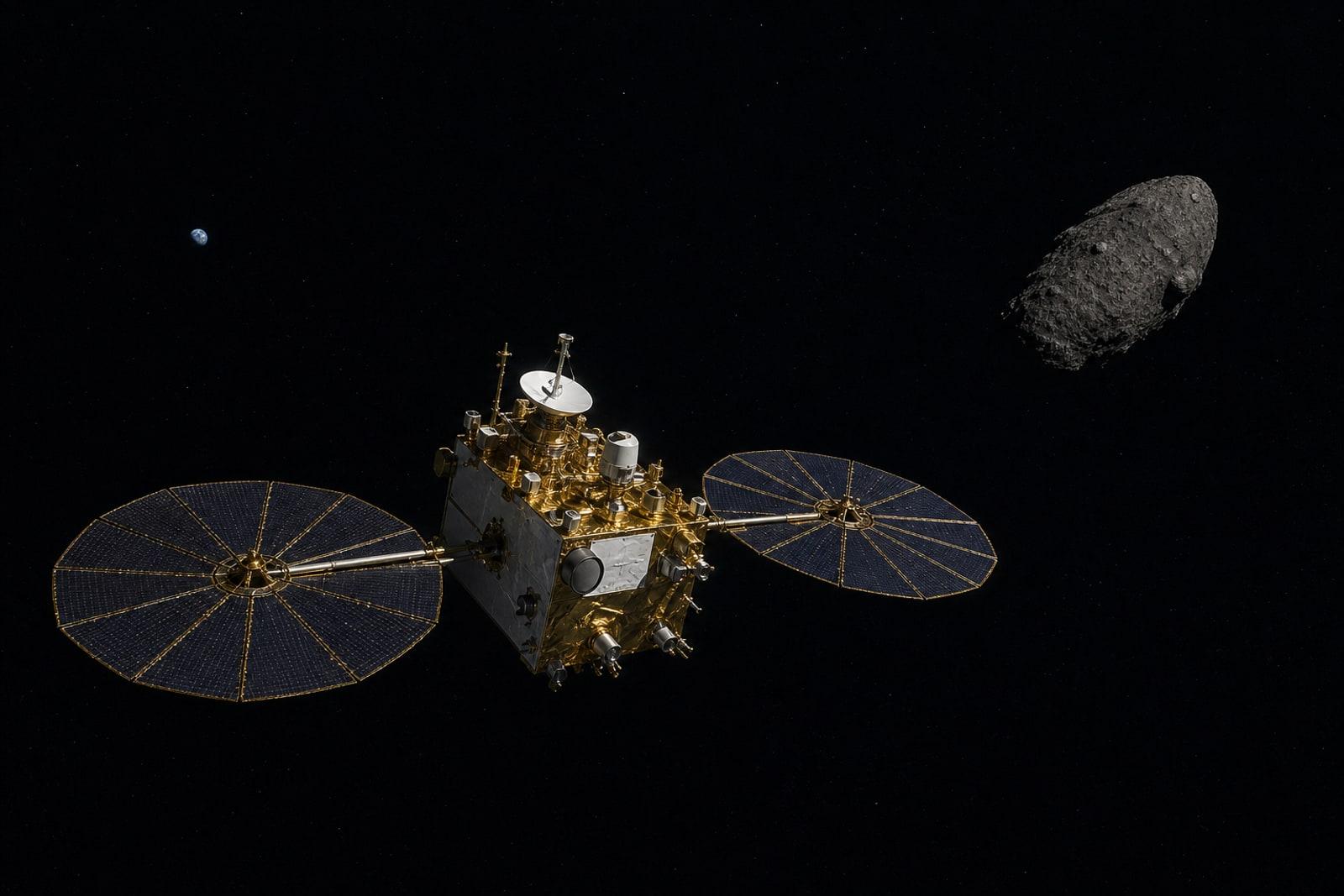
China's Tianwen-2 spacecraft has reached Kamoʻoalewa, a tiny asteroid that circles the Sun in near-lockstep with Earth, opening the most demanding phase of the country's first attempt to scoop up rock from another world and fly it home. Only Japan and the United States have pulled off an asteroid sample return; China now aims to become the third.
The probe, operated by the China National Space Administration (CNSA), fired its main engine on 7 June 2026 to settle into a controlled orbit around its target, then began closing in to within about 20 kilometres for a months-long survey. At arrival the asteroid sat roughly 39 million kilometres from Earth, according to Live Science — close by interplanetary standards, but a punishing target all the same: Kamoʻoalewa is no bigger than a city block and spins once every 28 minutes.
A five-year round trip
Tianwen-2 launched on 28 May 2025 aboard a Long March 3B rocket from the Xichang Satellite Launch Center. Its most distinctive feature is a pair of large circular solar panels — each about 4.7 metres across — that dwarf the compact spacecraft bus and will keep it powered far from the Sun.
From its survey orbit the probe will map Kamoʻoalewa with 11 instruments, among them cameras, spectrometers, radar and an Italian-built dust analyser, working down from about 20 kilometres to a few hundred metres above the surface. Only then will it try to grab material, using whichever of three techniques the terrain allows:
- Touch-and-go — a brief tag of the surface, the method NASA used at Bennu;
- Hovering — matching the asteroid's rapid spin to collect without landing;
- Anchor-and-attach — latching on to the surface, a technique never before attempted at an asteroid.
The mission is targeting at least 100 grams of regolith, with some planning documents citing a possible 200 to 1,000 grams. That would dwarf earlier hauls: Japan's Hayabusa2 brought back about 5.4 grams from the asteroid Ryugu in 2020. Tianwen-2 is due to leave Kamoʻoalewa around April 2027 and release its return capsule during an Earth flyby near 29 November 2027, aiming for a landing in Inner Mongolia. The spacecraft itself will carry on, using Earth's gravity to swing toward the main-belt comet 311P/PANSTARRS for a rendezvous around 2035.
Catching an "oscillating fragment"
Kamoʻoalewa — provisionally catalogued as 2016 HO3 — was discovered by the Pan-STARRS survey at Hawaii's Haleakalā Observatory on 27 April 2016. Its Hawaiian name translates roughly as "the oscillating fragment," a nod to the way it appears to bob back and forth across Earth's sky. It is a quasi-satellite: not gravitationally bound to Earth, but held in a loose, stable dance that keeps it as a companion for decades at a time.
The way Kamo'oalewa moves with Earth is kind of like a dog that might tag along with you for a while on a long walk through the woods, but it's not your dog.
That description came from Richard Binzel, a planetary scientist at the Massachusetts Institute of Technology, speaking to Live Science. The asteroid's peculiar orbit is only part of the intrigue.
A prize scientists cannot yet identify
What makes Kamoʻoalewa a scientific target rather than just a convenient one is that researchers still argue about what it is. Its reddish, heavily space-weathered surface resembles lunar soil, prompting a striking hypothesis: that the asteroid is a chip of the Moon, blasted into space by an ancient impact. A rival 2026 study led by Yang Li of the Chinese Academy of Sciences argues instead for a more ordinary asteroid origin, in the Flora family of the main belt.
"We therefore propose that Kamo'oalewa probably originated from the Flora family," the team wrote, while stressing they did not "completely close the door" on a lunar link. Only physical samples can settle it. As Li Chunlai, chief commander of Tianwen-2's ground application system, put it: "We'll only obtain definitive answers after completing our exploration."
Why Luxembourg is watching
The mission also speaks to an ambition nurtured far from any launch pad. Luxembourg positioned itself early as a European hub for the emerging asteroid economy. Its Law of 20 July 2017 on the exploration and use of space resources — in force since 1 August 2017 — made it the first European country to grant private companies legal title to whatever they extract in space. Its opening article declares that "space resources are capable of being appropriated," while stopping short of letting anyone own a celestial body itself.
The law anchors the SpaceResources.lu initiative, launched in 2016 with roughly €200 million in public backing, and led to the creation of the Luxembourg Space Agency in 2018. The commercial case for mining asteroids remains unproven and distant. But the science underpinning it — what these bodies are made of, how their loose surfaces behave, whether their water and metals could ever be tapped — is exactly what missions like Tianwen-2 exist to establish. Every gram Kamoʻoalewa yields is a data point for the field Luxembourg bet on.
For now, the hard part is still ahead. The probe must map a spinning, boulder-strewn rock, choose a spot, and make contact without wrecking itself — then keep its cargo safe across an 18-month journey home. If it works, a sealed capsule will streak into the skies over Inner Mongolia in late 2027, carrying the first Chinese sample of an asteroid and, perhaps, the answer to where Earth's quiet companion came from.
Frequently asked
- What is Tianwen-2 and what is it doing?
- Tianwen-2 is China's first asteroid sample-return mission, run by the China National Space Administration. It reached the near-Earth asteroid Kamoʻoalewa in June 2026 and is mapping it before attempting to collect at least 100 grams of surface material to bring back to Earth.
- When will the samples arrive on Earth?
- The spacecraft is expected to leave Kamoʻoalewa around April 2027 and release its return capsule during an Earth flyby near 29 November 2027, targeting a landing in Inner Mongolia. The spacecraft will then head for the comet 311P/PANSTARRS around 2035.
- What is asteroid Kamoʻoalewa?
- Kamoʻoalewa (2016 HO3) is a small near-Earth asteroid, 40–100 metres across, that spins every 28 minutes and orbits the Sun in step with Earth as a quasi-satellite. Discovered in 2016, its origin is debated — it may be a fragment of the Moon or an ordinary asteroid.
- What is Luxembourg's connection to the mission?
- Luxembourg has no role in Tianwen-2, but it staked out the asteroid-resources sector early: its 2017 space-resources law, the SpaceResources.lu initiative and the 2018 creation of the Luxembourg Space Agency all depend on the kind of asteroid science this mission advances.
Sources(12)
- 1China's Tianwen-2 mission has (probably) arrived at a quasi-moon of EarthThe Planetary Society · planetary.org
- 2Tianwen-2Wikipedia · en.wikipedia.org
- 3Tianwen-2 makes series of burns on approach to asteroid, according to radio trackingSpaceNews · spacenews.com
- 4China's secretive Tianwen-2 probe arrives at Earth's 'quasi-moon' ahead of historic landing attemptLive Science / Yahoo News · yahoo.com
- 5Tianwen-2 Reaches Kamoʻoalewa: China's Asteroid Sample Return Mission in FocusNew Space Economy · newspaceeconomy.ca
- 6Kamo'oalewa asteroid's lunar origin challenged ahead of Tianwen-2 arrivalPhys.org · phys.org
- 7Tianwen-2 mission target asteroid (469219) Kamoʻoalewa probably develops an Itokawa-compositional but more space-weathered surfaceNature Communications · nature.com
- 8469219 KamoʻoalewaWikipedia · en.wikipedia.org
- 9Tianwen-2 probe operating normally in orbit, image of unfolding of circular solar panels released: CNSAGlobal Times · globaltimes.cn
- 10Luxembourg becomes first European country to pass space mining lawMining.com · mining.com
- 11Luxembourg adopts space resources lawSpaceNews · spacenews.com
- 12Luxembourg Law on Space Resources Rests on Contentious Legal Grounds (Working Paper No. 189)KU Leuven Centre for Global Governance Studies · ghum.kuleuven.be
Related by topic