Space & telecoms
Luxembourg's OQ Technology connects drones to its 5G satellite network
An Airbus-backed trial linked a flying drone to OQ's low-Earth-orbit constellation, and a separate test relayed compressed video — modest throughput, but a concrete step for Luxembourg's space bet.
By Marc Weber · · 5 min read
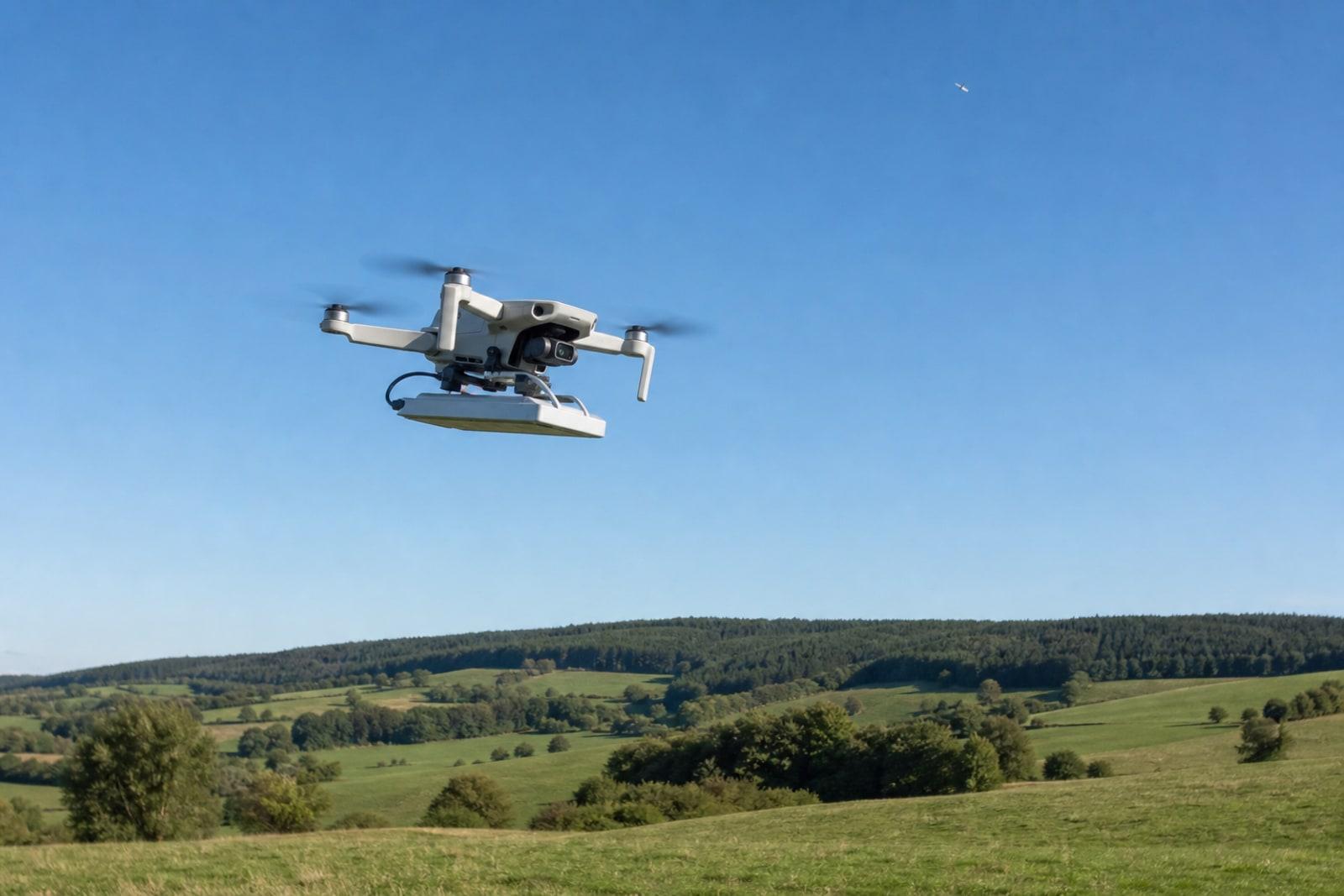
Luxembourg's long bet on space has produced a tangible new capability: a small drone flying loops and spins while staying connected not to a cell tower but to a satellite passing overhead in low-Earth orbit. The operator behind it, Luxembourg-based OQ Technology, says the link held for 99.95% of the flight — a result both more modest and, in some ways, more interesting than the phrase “drone video over satellite” implies.
Across a run of demonstrations through 2025, OQ — which describes itself as the world's first satellite operator built for 5G “Internet of Things” connectivity — connected drones directly to its constellation and, separately, pushed compressed video footage from a drone up to a satellite. The data rates were tiny by broadband standards, but the company argues that is precisely the point: a standards-based, low-power link that works where Starlink-style terminals are too large, too power-hungry, or simply unavailable.
What was actually demonstrated
The headline result came in July 2025, when OQ and Airbus Central Research & Technology said they had carried out what they billed as the world's first flight demonstration of a low-Earth-orbit 5G non-terrestrial network (NTN) connecting to terminals mounted on a flying drone. The trial used licensed S-band spectrum and narrowband-IoT (NB-IoT) — the same 3GPP cellular standard used in terrestrial networks — and, according to the two partners, held the connection through “aerobatic manoeuvres like loops and spins” and random drone orientations.
The numbers are deliberately small: roughly 5 kilobits per second of throughput, alongside the 99.95% continuity figure cited by both partners. That is orders of magnitude below the megabit-class links a consumer broadband satellite service delivers, and far too thin for live high-definition video on its own. In a separate demonstration, OQ said it transmitted video from a compact drone over the same kind of narrowband link by using edge computing on the drone to compress the footage before sending it — sidestepping the bulky, power-hungry broadband terminals such a transmission would normally require.
OQ's founder and chief executive, Omar Qaise, has been candid that full-motion, high-resolution video over satellite remains an aspiration rather than an accomplished fact.
We hope in future also with the D2D missions to demonstrate high resolution video transmission from drone to the satellite.
A third milestone, in late July 2025, saw a motion-activated camera send a still image — of a model rocket — over a LEO satellite through OQ's “OQ ONE” user terminal, in what the company called the first image relayed over a 5G NTN IoT link. “Being able to send images over satellite makes our 5G network dramatically more powerful,” Qaise said at the time. “Whether it's an oil rig, power station, or environmental sensor in the middle of nowhere, you can now see what's happening, not just measure it.”
Why narrowband, and why defence is watching
OQ's pitch rests on its choice of S-band and licensed spectrum. The band “is not affected by rain or weather conditions and can penetrate through forests,” Qaise said, advantages over the higher Ku- and Ka-band frequencies that broadband constellations rely on. Licensed spectrum, he has argued, also brings less interference and more protection than unlicensed alternatives such as the LoRa technology used in some IoT networks.
That profile — small, low-power terminals, resilient links and standards-based hardware — is what draws defence and security interest. Both OQ and Airbus described the drone work as a step toward 5G and 6G NTN for airborne platforms in aviation, defence and secure IoT. Among the intended uses the company lists:
- border cameras and tactical sensors
- pipeline and remote-facility surveillance
- disaster-zone imagery and traffic monitoring
- autonomous guidance beyond terrestrial coverage
Luxembourg has separately awarded OQ €2.28 million for a project dubbed Sentinel, researching how to protect 5G satellite uplinks against jamming and spoofing — a nod to the contested-spectrum environment such systems would face in a crisis.
Funding, backing and the sovereignty question
OQ was founded in 2016 by Qaise and has leaned on Luxembourg's deliberate space-sector industrial policy throughout. It partnered with the European Space Agency under Luxembourg's national LuxIMPULSE programme in 2018, secured a national space-activity licence in 2023, and in November 2025 was granted a Luxembourg concession to deploy and operate satellite-based 5G IoT and direct-to-device services. The company operated about ten satellites as of October 2025 and is working toward a larger constellation.
The money has followed. After a €13 million Series A in 2022 and later rounds that drew in Saudi Aramco's venture arm and a Luxembourg state fund, OQ secured €25 million in venture debt from the European Investment Bank in February 2026, backed by the EU's InvestEU programme, to help fund more than 20 of its own satellites plus hosted payloads on 14 third-party spacecraft.
“This financing from the European Investment Bank is a strong vote of confidence in our vision and technology,” Qaise said. Luxembourg's economy minister, Lex Delles, called the deal proof of “the innovative strength of Luxembourg-based space companies.”
Where OQ fits in the wider scramble for orbital connectivity is still being defined. Unlike SpaceX's Starlink, which sells broadband to consumers and enterprises, or the legacy L-band operator Iridium, OQ is betting that using the same 3GPP cellular standards as ground networks will let ordinary chips and devices reach space without bespoke hardware. It is far smaller than the EU's flagship sovereign constellation, IRIS² — a €10.6 billion, roughly 290-satellite system led by SES, Eutelsat and Hispasat that is not due in full service until around 2030 — but it is part of the same European push to cut dependence on non-EU networks for critical communications. For now, the Grand Duchy can point to a concrete result: a drone, a satellite, and a link that did not drop.
Frequently asked
- Did OQ Technology transmit real-time HD video over satellite?
- No. It relayed compressed video from a drone over a narrowband link using edge computing. CEO Omar Qaise has said high-resolution video transmission from drone to satellite remains a future ambition.
- How fast is the drone-to-satellite link?
- The Airbus/OQ trial demonstrated roughly 5 kilobits per second with 99.95% connection continuity — narrowband IoT speeds, not broadband.
- How is OQ different from Starlink and Iridium?
- Starlink sells broadband via large terminals and Iridium uses proprietary L-band; OQ uses 3GPP NB-IoT and 5G NTN standards so standard low-power chips and devices can connect directly.
- Who funds OQ Technology?
- Backers include the European Investment Bank (€25m venture debt in 2026), Luxembourg state funds, the European Innovation Council and Saudi Aramco's venture arm, with ESA and Luxembourg government programme support.
Sources(10)
- 1Airbus and OQ Technology use S-band to connect satellite to droneMobile Europe · mobileeurope.co.uk
- 2Airbus and OQ Technology conduct world's 1st demo of LEO 5G NTN connecting to a flying droneSatNews · satnews.com
- 3OQ Technology plans direct-to-smartphone demo with cellular spectrumSpaceNews · spacenews.com
- 4OQ Technology Makes History: First-Ever Image Sent via 5G NTN IoT Over LEO SatelliteIoT Business News · iotbusinessnews.com
- 5European financing for Luxembourgish satellite-to-smartphone connectivity pioneer OQ TechnologyEuropean Investment Bank · eib.org
- 6OQ TechnologyWikipedia · en.wikipedia.org
- 7OQ Tech gets Luxembourg 5G-by-Sat concessionAdvanced Television · advanced-television.com
- 8OQ Technology Granted Luxembourg Concession for Satellite-Based 5G IoT & D2D ServicesSpaceWatch.GLOBAL · spacewatch.global
- 9OBSERVER: What is IRIS²?Copernicus / European Commission · copernicus.eu
- 10A Passion for Space, A Platform for the World: The OQ Technology StoryLuxembourg Space Agency · space-agency.public.lu
Related by topic