Labour market
Luxembourg's craft-skills centres mark a decade as the trades shortage endures
Ten years on, the Centres de Compétences say they have trained more than 90,000 workers — yet Luxembourg's trades still lean heavily on cross-border and imported skills.
By Jonas Thill · · 5 min read
Luxembourg's main upskilling vehicle for the skilled trades turned ten this month, and the headline numbers are substantial: the Centres de Compétences for the building-technical and finishing trades say they have put more than 90,000 workers through more than 17,000 training sessions since 2016. The anniversary, marked by an evening event in June titled Les Maîtres du Geste that drew over 500 political, economic and union guests, was framed as a celebration of a model that has quietly become central to how Luxembourg keeps its electricians, plumbers, roofers and heating technicians current.
Behind the rounded figures, the centres' own decade accounting is more precise: 84,807 participants across 16,622 training sessions, delivered by a team of roughly 25 staff to a base of some 2,600 craft companies. Whichever number is cited, the trajectory is steep — as recently as mid-2023 the centres reported 44,000 people trained over seven years. Yet a ten-year verdict turns on a harder question than throughput: has the model begun to close Luxembourg's craft-skills shortage, or has it merely made the shortage easier to live with?
How the model works
The Centres de Compétences trace to an interprofessional agreement signed in July 2015 by the Fédération des Artisans and the trade unions OGBL and LCGB. Two centres — Génie Technique du Bâtiment (building services) and Parachèvement (finishing) — operate jointly, covering around 30 trades from electricity, heating, sanitation and lifts to roofing, tiling and painting, and since 2019 extending into management, digital and soft skills.
The funding mechanism is the part that sets Luxembourg apart. Contributing craft companies pay a mandatory levy of 0.5% of their payroll, pooled through the sectoral fund Fongeco under a Grand-Ducal regulation in force since November 2015. In return, training is free for employees of contributing firms. The arrangement turns continuing education from a discretionary cost into a collective entitlement — a design intended to reach the small workshops that rarely budget for training on their own.
The Chambre des Métiers, Luxembourg's public-law chamber for the craft sector, sits alongside rather than above the centres: it provides complementary, theory-focused continuing training, while the centres concentrate on hands-on practice. The relationship is set to deepen — a planned new building will house rooms shared with the chamber's building-inspection service, the Service de Contrôle et de Réception du Bâtiment.
A workshop built for the energy transition
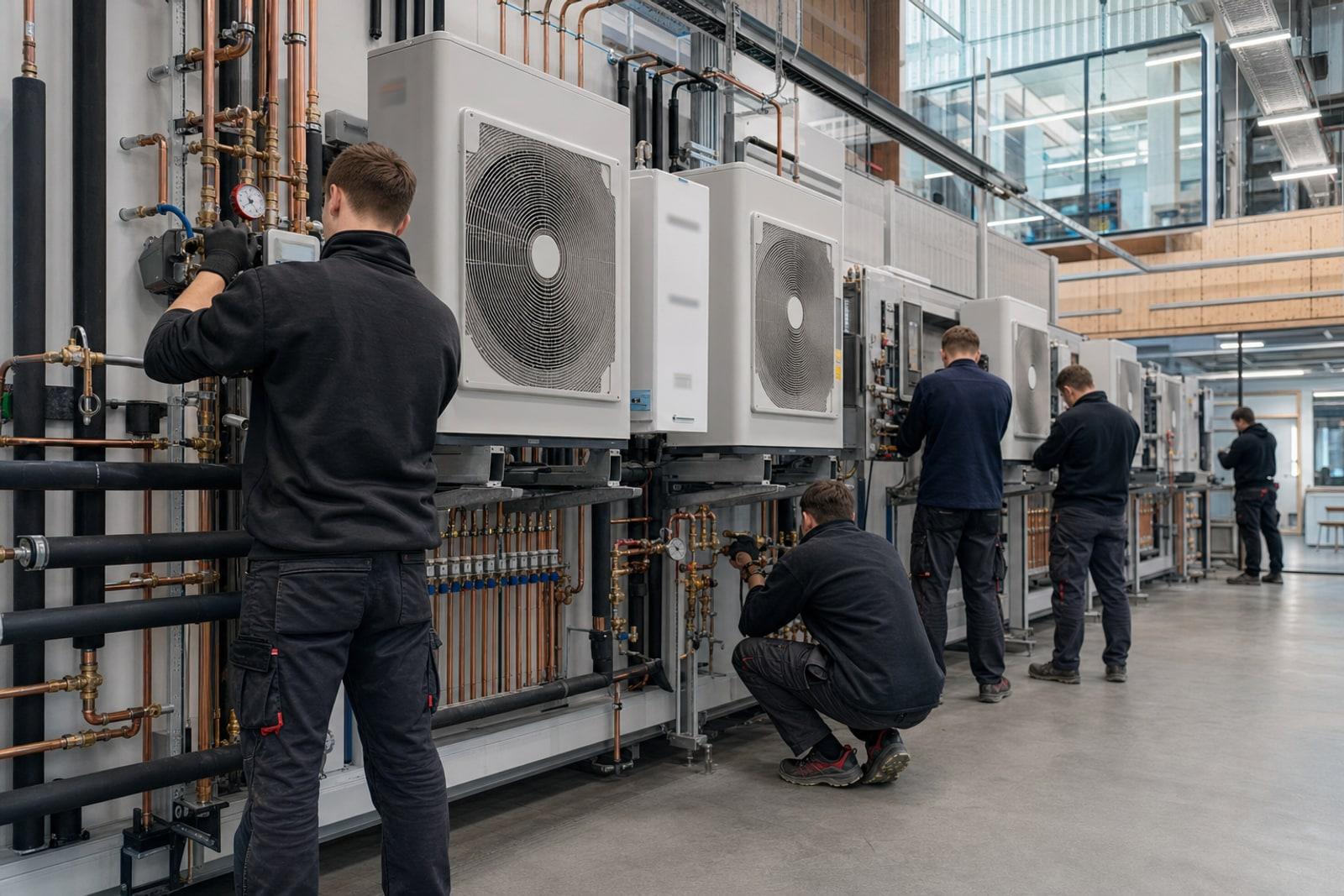
The physical heart of the operation is the Centre de Formation Krakelshaff in Bettembourg, opened in early 2021 on a 2.45-hectare site provided by the ministries of the Economy and of the Middle Classes. Its roughly 5,000 square metres — two near-identical training buildings linked by a steel footbridge, plus two large workshop halls — let apprentices and working tradespeople practise on real installed equipment rather than in a classroom.
Increasingly, that equipment is the kit of decarbonisation. The centres have built training around heat pumps, combustion boilers, ventilation systems, photovoltaics, building thermography, home energy-management systems and electromobility, with hydrogen flagged as a coming theme. At the anniversary the centres announced further expansion: a 500-square-metre equipped workshop this summer, the shared building with the Chambre des Métiers, and a planned site in the north of the country to cut travel time for firms there.
la formation reste la clé de la compétitivité, de l'innovation et de la durabilité
That assessment came from Claude Schreiber, president of the Génie Technique du Bâtiment centre. Marc Herkes, who heads the Parachèvement centre, credited the staff who built the curricula: "rien de ce qui existe ici – les programmes, les maquettes, les parcours – n'existerait sans nos équipes" — nothing here, the programmes, the models, the pathways, would exist without the teams.
Closing the gap, or masking it?
The political case for the centres is the case for upskilling generally. "Skilling up is an indispensable pillar to guarantee employability, competitiveness and social cohesion," Labour Minister Marc Spautz told the gathering, in remarks that placed continuing training at the centre of Luxembourg's response to a fast-changing job market.
The structural backdrop is unusually stark. Luxembourg counted nearly 494,000 employees at the end of 2025, and about 47% of them were cross-border workers — roughly 229,000 people commuting daily from France, Belgium and Germany. No other EU economy relies so heavily on labour it does not house, and the construction, energy and craft sectors that the centres serve are among the most exposed to shortages of qualified hands.
On that measure the decade verdict is mixed. The centres have demonstrably raised the skill level of the workforce already inside Luxembourg's trades, and the levy-funded model has given small firms access to training they would not otherwise buy. What ten years has not done is loosen the country's dependence on imported and cross-border skills: the trades still recruit across the borders because domestic supply alone cannot fill the order book, and the energy transition is adding new specialisms faster than any single training system can backfill them.
That leaves the centres in a familiar position for Luxembourg institutions — indispensable, and insufficient on their own. They have built durable capacity to keep the existing workforce competent and to absorb new green-trade requirements. Closing the shortage outright would require something the centres cannot supply by themselves: more people willing to enter the trades in the first place. For now, the model is best read not as a cure for the craft-skills gap but as the thing keeping it from widening.
Frequently asked
- What are Luxembourg's Centres de Compétences?
- They are continuing vocational-training centres for the building-technical (Génie Technique du Bâtiment) and finishing (Parachèvement) trades, created after a 2015 interprofessional agreement and operational from 2016, based at the Krakelshaff centre in Bettembourg.
- How are the centres funded?
- Contributing craft companies pay a mandatory levy of 0.5% of their payroll, pooled through the sectoral fund Fongeco under a Grand-Ducal regulation in force since November 2015. Training is then free for employees of contributing firms.
- How many people have they trained?
- Over a decade the centres report more than 90,000 people trained across more than 17,000 sessions; their detailed accounting cites 84,807 participants and 16,622 training sessions.
- What role does the Chambre des Métiers play?
- The Chambre des Métiers provides complementary, theory-focused continuing training and is set to share a new building with the centres for its building-inspection service; the centres themselves are run by the artisan federations.
Sources(9)
- 1Les Centres de Compétences de l'artisanat célèbrent une décennie à l'ouvrageCentres de Compétences GTB/PAR (cdc-gtb.lu) · cdc-gtb.lu
- 2À propos — Centres de Compétences Génie Technique & ParachèvementCentres de Compétences GTB/PAR (cdc-gtb.lu) · cdc-gtb.lu
- 3Annonce Centres de compétences (décennie : 84 807 participants, 16 622 formations)Infogreen.lu · infogreen.lu
- 4Bettembourg : l'artisanat se forme à la transition énergétiqueLe Quotidien · lequotidien.lu
- 5Quels sont les dispositifs de financement de la formation professionnelle continue pour les PME au Luxembourg ?Pixie.lu · pixie.lu
- 6Le nouveau « Centre de Formation Krakelshaff » des Centres de Compétences GTB/PARLëtzebuerger Gemengen (gemengen.lu) · gemengen.lu
- 7Cross-Border Workers Constitute 47% of Luxembourg's WorkforceChronicle.lu · chronicle.lu
- 8Domestic payroll employment: +0.2% in Q1 2025 and +0.9% over 12 monthsSTATEC / Statistics Portal Luxembourg · statistiques.public.lu
- 9La formation dans le secteur artisanalgouvernement.lu / luxembourg.public.lu · luxembourg.public.lu
Related by topic