Diplomacy
Iran and US wrap first round of talks with a 60-day road map as oil slides
Negotiators left a Swiss mountain resort with a timetable, two crisis hotlines and the enrichment question still open. Markets cheered the de-escalation regardless.
By Camille Reuter · · 4 min read
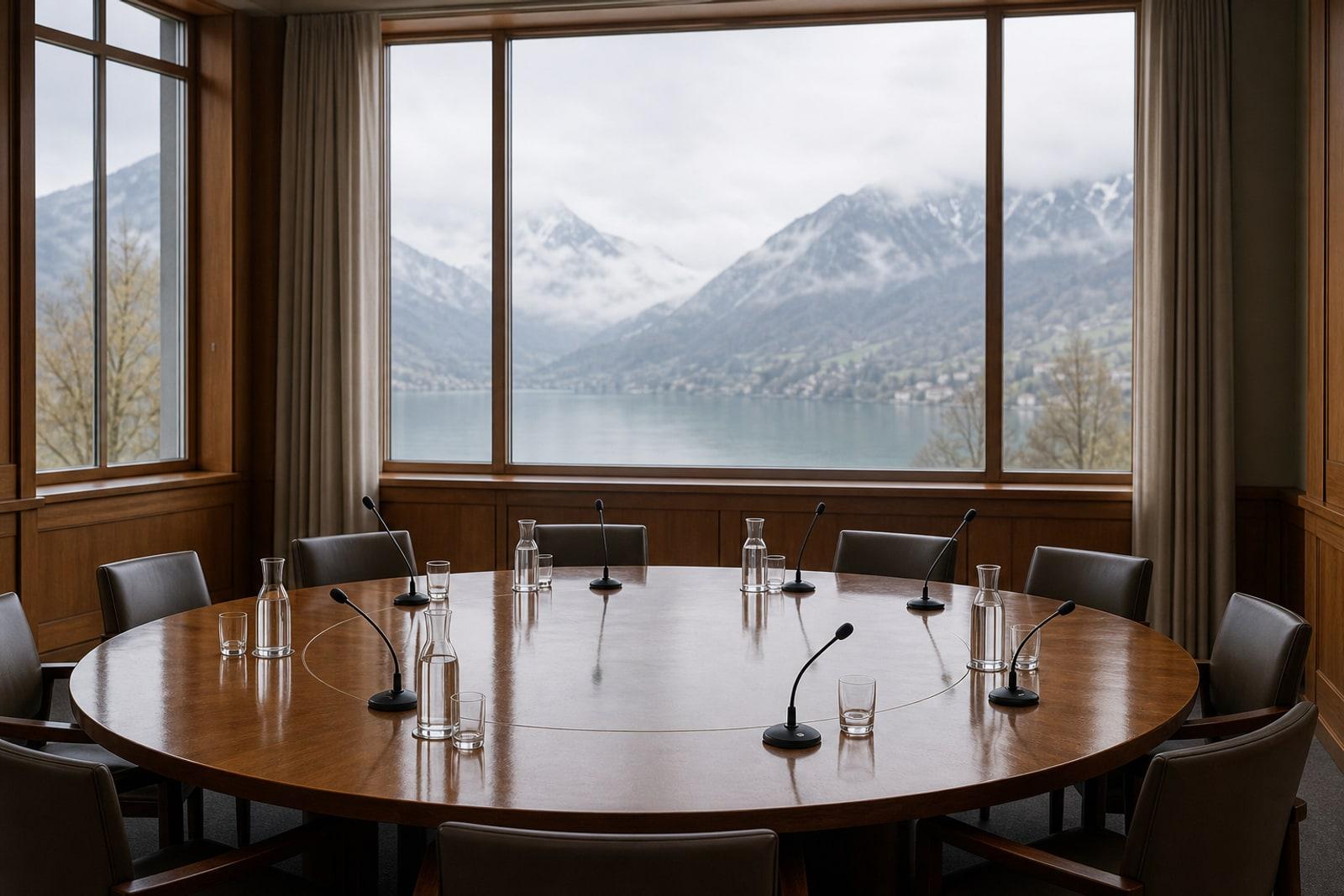
After nearly four months of war that choked off Gulf energy flows, negotiators from the United States and Iran wrapped up the first round of formal post-ceasefire talks at a Swiss mountain resort on Monday, agreeing a road map intended to deliver a final deal within 60 days. The outcome was modest in substance but powerful in signal: oil extended a steep slide and equity markets pushed higher on bets that the Middle East's most dangerous confrontation in years is cooling.
The talks at the Bürgenstock resort above Lake Lucerne brought together U.S. Vice-President JD Vance and presidential adviser Jared Kushner, Iranian Foreign Minister Abbas Araghchi and Pakistani Prime Minister Shehbaz Sharif, in a quadrilateral format mediated by Qatar and Pakistan. They built on a framework — a memorandum of understanding announced on 15 June — that had already halted fighting and reopened shipping through the Strait of Hormuz.
What was agreed
According to readouts from the parties and the mediators, the round produced a "High Level Committee" with political oversight of the negotiations, which signed off on a road map "towards reaching a final deal within 60 days" and cleared the way for technical talks on the nuclear file, sanctions and dispute resolution to run through the rest of the week.
Two confidence-building mechanisms stood out. Tehran and Washington established a communication line meant to "avoid incidents and miscommunication" and ensure "safe passage for commercial vessels" through the Strait of Hormuz, the chokepoint for roughly a fifth of the world's seaborne oil. The sides also agreed to set up a de-confliction cell with Lebanon and the mediators to police the halt to military operations there — a step Araghchi described as the first real test of the framework.
Markets price in the thaw
The market reaction was emphatic. Brent crude, which had spiked above $111 a barrel during the war, fell about 4.5% to below $83 when the framework was confirmed on 15 June and kept sliding; by mid-week Brent futures were trading near $77–$78, down roughly a quarter over the month. Equities ran the other way: Japan's Nikkei 225 and South Korea's Kospi hit record highs, while U.S. S&P 500 and Nasdaq futures climbed.
Analysts cautioned that relief was running ahead of reality. "While markets had already reacted late last week when President Trump indicated that a deal was close, actual confirmation spurred a further rally. The fall in oil prices will provide some relief for central banks," said Khoon Goh, head of Asia research at ANZ. Shipping and insurance specialists warned that vessel backlogs and mine-clearing in the Gulf could take months to resolve, and U.S. officials acknowledged energy flows would not normalise quickly.
The unfinished business
The road map papered over the dispute that has defied every previous round: uranium enrichment. Washington is pressing for Iran's enrichment to be cut to zero under intrusive verification, while Tehran frames the right to enrich as non-negotiable.
"We will never back down from the right to enrich uranium, and the other side is also forced to accept it," Iranian President Masoud Pezeshkian said.
Vance struck a triumphal note, telling supporters that "the opening of the Strait of Hormuz, the ending of the Iranian nuclear program, all of these things have already been accomplished." The gap between that claim and Pezeshkian's red line underscored how much remains unsettled. President Donald Trump kept up the pressure, warning that if Iran did not rein in its "highly paid PROXIES" in Lebanon, "we'll hit Iran very hard again." Israeli troops still in southern Lebanon and sporadic clashes with Hezbollah remain flashpoints that could unravel the truce.
Europe's diminished seat — and its stake
For Europe, the talks matter even though it is not in the room. France, Germany and the United Kingdom — the so-called E3 — triggered the 2015 nuclear deal's "snapback" in 2025, and the EU reimposed UN-mandated restrictive measures on Iran that September. Yet the current, U.S.-led process has largely sidelined the bloc, a measure of how little leverage European capitals retain over the sanctions architecture that matters most to Tehran.
The more immediate European dividend is economic. Cheaper crude eases the imported-energy bill and headline inflation across the euro area, giving the European Central Bank more room to manoeuvre — the "relief for central banks" Goh flagged. For an open, energy-importing economy and financial hub such as Luxembourg, lower oil prices and calmer markets are welcome, even though the Grand Duchy has no direct part in the diplomacy. The caveat is that none of it is locked in: the 60-day clock is short, the enrichment question is unresolved, and a single incident in the Gulf could send the whole calculation into reverse.
Frequently asked
- What did the first round of Iran-US talks actually produce?
- A road map agreed by a new 'High Level Committee' aiming for a final deal within 60 days, plus a Strait of Hormuz communication line and a Lebanon de-confliction cell. Technical talks on the nuclear file, sanctions and dispute resolution continue through the week.
- Where and in what format were the talks held?
- At the Bürgenstock resort above Lake Lucerne, Switzerland, in a quadrilateral format mediated by Qatar and Pakistan, with U.S. Vice-President JD Vance, adviser Jared Kushner, Iran's Foreign Minister Abbas Araghchi and Pakistan's Prime Minister Shehbaz Sharif.
- Why did oil prices fall and stocks rise?
- Investors priced in lower risk to Gulf energy supplies as the Strait of Hormuz reopened. Brent slid from above $111 a barrel during the war to the high-$70s, while Asian and U.S. equity indices rallied, some to record highs.
- What is the main unresolved issue?
- Uranium enrichment. The U.S. is pushing for zero enrichment under intrusive verification, while Iran insists enrichment is a non-negotiable right — leaving the hardest question for the technical talks ahead.
Sources(11)
- 1First round of U.S.-Iran negotiations end, technical talks will continue after Trump threats shake summitNBC News · nbcnews.com
- 2Key points from the first round of Iran-US talksYahoo News · yahoo.com
- 3Iran war updates: First round of Iran-US talks concludes in SwitzerlandAl Jazeera · aljazeera.com
- 4Live Updates: U.S. and Iranian negotiators meet as Trump threatens to hit Iran very hard againCBS News · cbsnews.com
- 5Oil prices fall, stocks rally as US, Iran sign framework to end warAl Jazeera · aljazeera.com
- 6Stock markets soar, oil falls as US and Iran announce framework to end warAl Jazeera · aljazeera.com
- 7Current price of oil as of June 16, 2026Fortune · fortune.com
- 8Brent rises after U.S.-Iran peace talks in Geneva are abruptly postponedCNBC · cnbc.com
- 92025–2026 Iran–United States negotiationsWikipedia · en.wikipedia.org
- 10Iran sanctions snapback: Council reimposes restrictive measuresCouncil of the European Union · consilium.europa.eu
- 11European Countries Move to Restore UN Sanctions on IranArms Control Association · armscontrol.org
Related by topic