Science
CERN shuts down the Large Hadron Collider for a four-year upgrade
Europe's flagship collider near Geneva powers down in July for its biggest overhaul yet, betting a multi-year shutdown on tenfold more data and a sharper hunt for dark matter.
By Marc Weber · · 5 min read
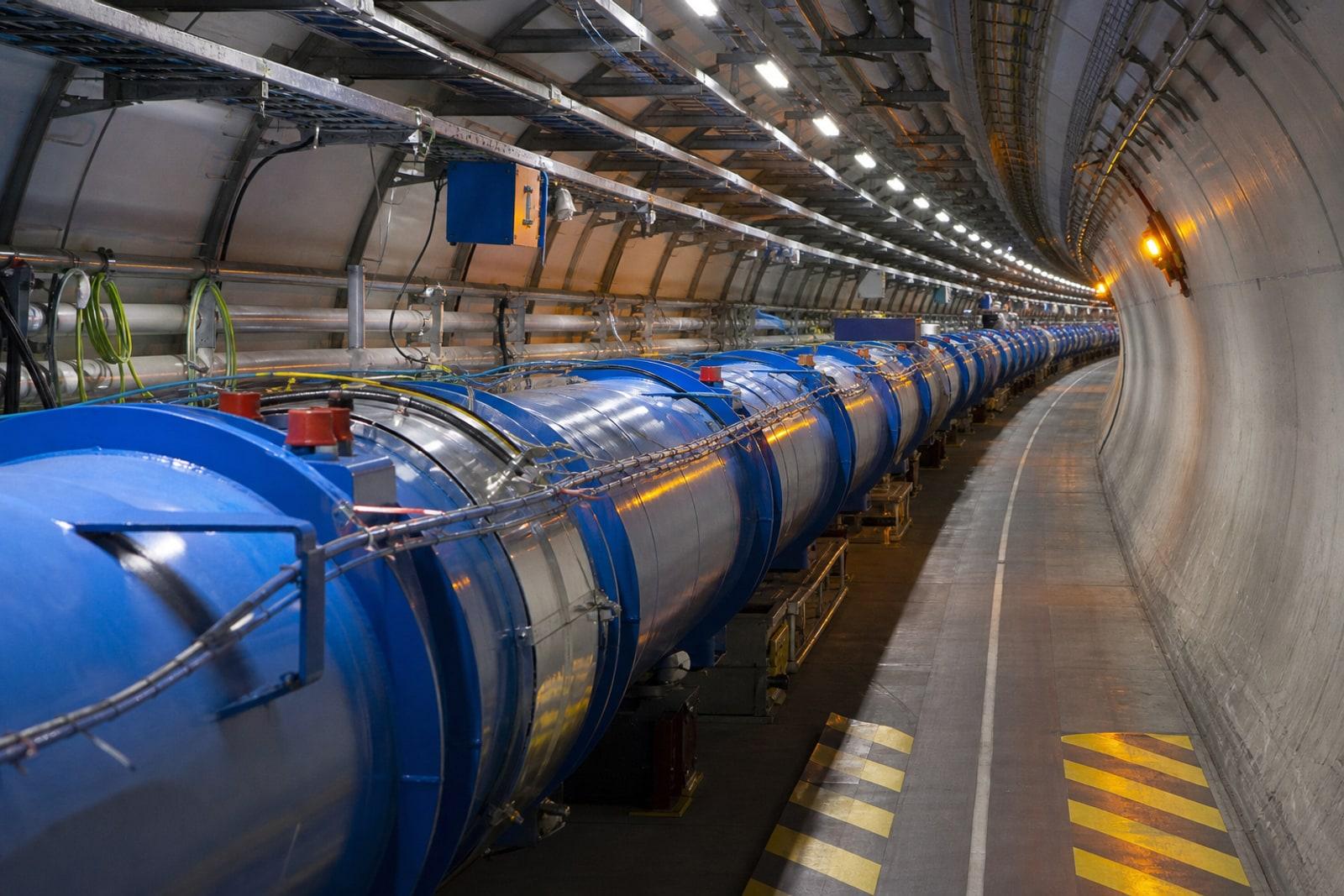
Sometime in July, engineers at CERN will bring Europe's most powerful scientific instrument to a halt. After a final, compressed run of proton collisions, the Large Hadron Collider — a 27-kilometre ring buried about 100 metres beneath the farmland on the Franco-Swiss border near Geneva — will go quiet for nearly four years. It is the most consequential pause in the machine's history, and the laboratory is betting it on one of physics' hardest questions.
The shutdown opens the door to the High-Luminosity LHC (HL-LHC), a sweeping upgrade designed to multiply the collider's data output roughly tenfold. The goal is not a more powerful beam but a far more intense one: many more collisions, recorded in finer detail, so that physicists can scrutinise the Higgs boson and chase rare phenomena that today's machine produces too seldom to study — among them possible signatures of dark matter, the unseen substance thought to make up most of the universe's mass.
"I don't think it is possible to overstate the importance and excitement of the High-Luminosity LHC, which is the largest project undertaken by CERN for the past 20 years," said CERN Director-General Mark Thomson as the laboratory began full-scale tests of the upgrade's hardware in February.
A short, intense run, then years in the dark
The current run, known as Run 3, has been extended to July 2026 to squeeze out a final tranche of data before the machine is opened up. CERN describes the season as short but intense. Once it ends, the laboratory's Third Long Shutdown (LS3) begins.
The timeline has slipped. LS3 now starts about seven and a half months later than first planned, and the shutdown itself has been extended by roughly four months. As a result, start-up of the upgraded collider — Run 4 — is now scheduled for June 2030, about a year later than the previous plan. Work on CERN's chain of injector accelerators begins in September 2026, with a gradual restart of operations in 2028.
The decision to shift the start of the HL-LHC by approximately one year and increase the length of the shutdown reflects a consensus supported by our scientific committees.
That assessment came from Mike Lamont, CERN's Director for Accelerators and Technology. The delay, CERN and the trade journal CERN Courier report, stems mainly from the difficulty of building the next-generation ATLAS and CMS detectors — vast upgrades to the experiments' trackers and calorimeters that ate into schedule contingency — compounded by the disruption of the COVID-19 pandemic, the fallout from Russia's invasion of Ukraine, and civil-engineering work to connect new underground galleries to the tunnel.
What the upgrade actually changes
Only about 1.2 kilometres of the 27-kilometre ring is being rebuilt, but the new components are the most demanding the laboratory has attempted. Around the two big general-purpose experiments, ATLAS and CMS, crews will install:
- New focusing magnets made from niobium-tin, a brittle superconductor that allows a peak magnetic field roughly 50% stronger than the LHC's current niobium-titanium magnets, squeezing the beams more tightly at the collision points.
- Crab cavities — about 16 compact superconducting radio-frequency cavities that tilt the proton bunches just before they meet, so they overlap more completely and produce more collisions.
- A reinforced protection system and innovative superconducting power lines, plus new caverns and service tunnels at the experiment sites.
The payoff is luminosity — the rate of collisions. CERN expects the upgrade to raise the integrated luminosity by a factor of about ten over the original design value, with 140 to 200 collisions packed into every bunch crossing, up from roughly 60 today. In February, the laboratory switched on a full-length mock-up of an upgraded section, the "IT String," to test that the magnets, cavities and cooling systems work together before they go into the tunnel.
"All the systems have already been tested individually," said Oliver Brüning, a leading figure on the HL-LHC project. "The goal of the IT String is to validate their integration and their collective performance under operational conditions."
The physics: more Higgs, and a shot at dark matter
More collisions mean more of the rarest events. CERN estimates the upgraded machine will generate at least 15 million Higgs bosons a year — against around three million from the LHC in 2017 — and on the order of 380 million over its lifetime, compared with roughly 55 million produced since the original collider started up. That statistical firepower lets physicists measure how the Higgs interacts with other particles with far greater precision, a test of whether the Standard Model holds or cracks.
It also sharpens the search for the unknown. CERN frames the LHC as a tool to probe some of the field's deepest open questions: whether the theory known as supersymmetry exists, whether there are extra spatial dimensions, and the nature of dark matter. None has yet revealed itself; the wager is that a far larger dataset improves the odds of catching a faint, rare signal — or of ruling possibilities out.
A continent-spanning bill
The accelerator upgrade's materials budget runs to roughly 950 million Swiss francs over 2015 to 2026, with the wider programme, including the detector overhauls, costing considerably more. About a tenth of the budget arrives as in-kind contributions from partner laboratories: the HiLumi collaboration spans nearly 50 institutions across more than 20 countries, most in Europe but reaching the United States, Japan, Canada and China.
That international division of labour is visible in the hardware itself. The US Fermilab outside Chicago built and shipped five of the niobium-tin focusing magnets, with five more assemblies due by mid-2027. For a machine that took decades and a continent to build, the coming silence underground is not an ending but a long, expensive breath before the next attempt to read the universe's fine print.
Frequently asked
- When does the LHC shut down and when does it restart?
- CERN's Third Long Shutdown begins in July 2026, immediately after the final Run 3 collisions. The upgraded High-Luminosity LHC (Run 4) is scheduled to start in June 2030, about a year later than previously planned.
- What does the High-Luminosity upgrade change?
- It increases the collision rate, not the energy. New niobium-tin focusing magnets (about 50% stronger) and around 16 superconducting 'crab' cavities will raise integrated luminosity roughly tenfold, with 140-200 collisions per bunch crossing instead of about 60.
- How does the upgrade help the search for dark matter?
- More collisions produce more of the rarest events. The larger dataset lets physicists hunt faint signatures of dark matter and other new phenomena that the current machine produces too rarely to study, while measuring the Higgs boson far more precisely.
- How much does it cost and who pays?
- The accelerator-upgrade materials budget is about 950 million Swiss francs (2015-2026). Roughly 10% comes from in-kind contributions by partner labs across nearly 50 institutions in more than 20 countries, including the US, Japan, Canada and China.
Sources(8)
- 1Updated schedule for CERN's acceleratorsCERN · home.cern
- 2Revised schedule for the High-Luminosity LHCCERN Courier · cerncourier.com
- 3Accelerator Report: The 2026 run will be short but intenseCERN · home.cern
- 4HiLumi LHCCERN · home.cern
- 5The High-Luminosity Large Hadron Collider (media kit)CERN · home.cern
- 6HiLumi LHC: full-scale tests startFermilab Newsroom · news.fnal.gov
- 7LS3 schedule changeCERN High Luminosity LHC Project · hilumilhc.web.cern.ch
- 8Updated Schedule For CERN's AcceleratorsMirage News (republishing CERN) · miragenews.com
Related by topic