Space
Kilometre-class asteroid sweeps safely past Earth this afternoon
Asteroid 1997 NC1, up to 1.6 km across, makes its closest pass in about four centuries at 13:14 Luxembourg time - at a safe 2.56 million km, with no impact risk.
By Marc Weber · · 4 min read
A near-Earth asteroid up to 1.6 kilometres across slips past our planet early this afternoon, in a close approach that astronomers have anticipated for years and that carries no risk whatsoever. Object (152637) 1997 NC1 reaches its nearest point to Earth on Saturday 27 June at 11:14 UTC - 13:14 in Luxembourg - according to the European Space Agency's Near-Earth Object Coordination Centre.
At that moment the asteroid will be 2,559,461 kilometres away, give or take a few kilometres, ESA says. That is about 6.66 times the average distance between Earth and the Moon, or roughly 1.59 million miles - far too distant to pose any threat, yet close enough to make the kilometre-scale rock a prime target for the world's planetary-defence instruments.
A record pass, but no danger
By the standards of near-Earth encounters this is a notable one. ESA and independent astronomers describe it as the asteroid's closest approach to Earth since around the year 1600, with no comparable pass expected again until 2133. Despite the milestone, the orbit is exhaustively mapped: 1997 NC1 has swung by Earth some 40 times across roughly three decades of observation, so its path is known with high precision and the chance of a collision is effectively zero.
The object is what astronomers call an Aten-type asteroid, on an orbit that keeps it mostly closer to the Sun than Earth and carries it around our star every 294 days or so. NASA's Jet Propulsion Laboratory lists it as a potentially hazardous asteroid - a formal category based on size and orbit, not on any imminent danger. ESA estimates its diameter at between 750 and 1,650 metres, a wide range that reflects how much remains unknown about how reflective its surface is; it is commonly described as roughly a kilometre wide. For scale, that is some 50 to 60 times the width of the small rock that exploded over Chelyabinsk, Russia, in 2013.
Gianluca Masi, the astrophysicist who runs the Virtual Telescope Project and photographed the asteroid as it neared, put the safety question plainly:
Of course, there are no risks at all for our planet.
For skywatchers, the asteroid is a faint quarry. Shining at around magnitude 10, it is invisible to the naked eye but can be picked up through a backyard telescope of six inches (15 centimetres) or more as a star-like point that drifts measurably against the background stars over a few minutes, best seen around 26 to 28 June.
How astronomers are tracking it
The asteroid was first spotted on 5 July 1997 by NASA's Near-Earth Asteroid Tracking programme at Haleakala in Hawaii, and it has been followed optically ever since. This week's flyby offers something new: the first radar observations in the object's recorded history.
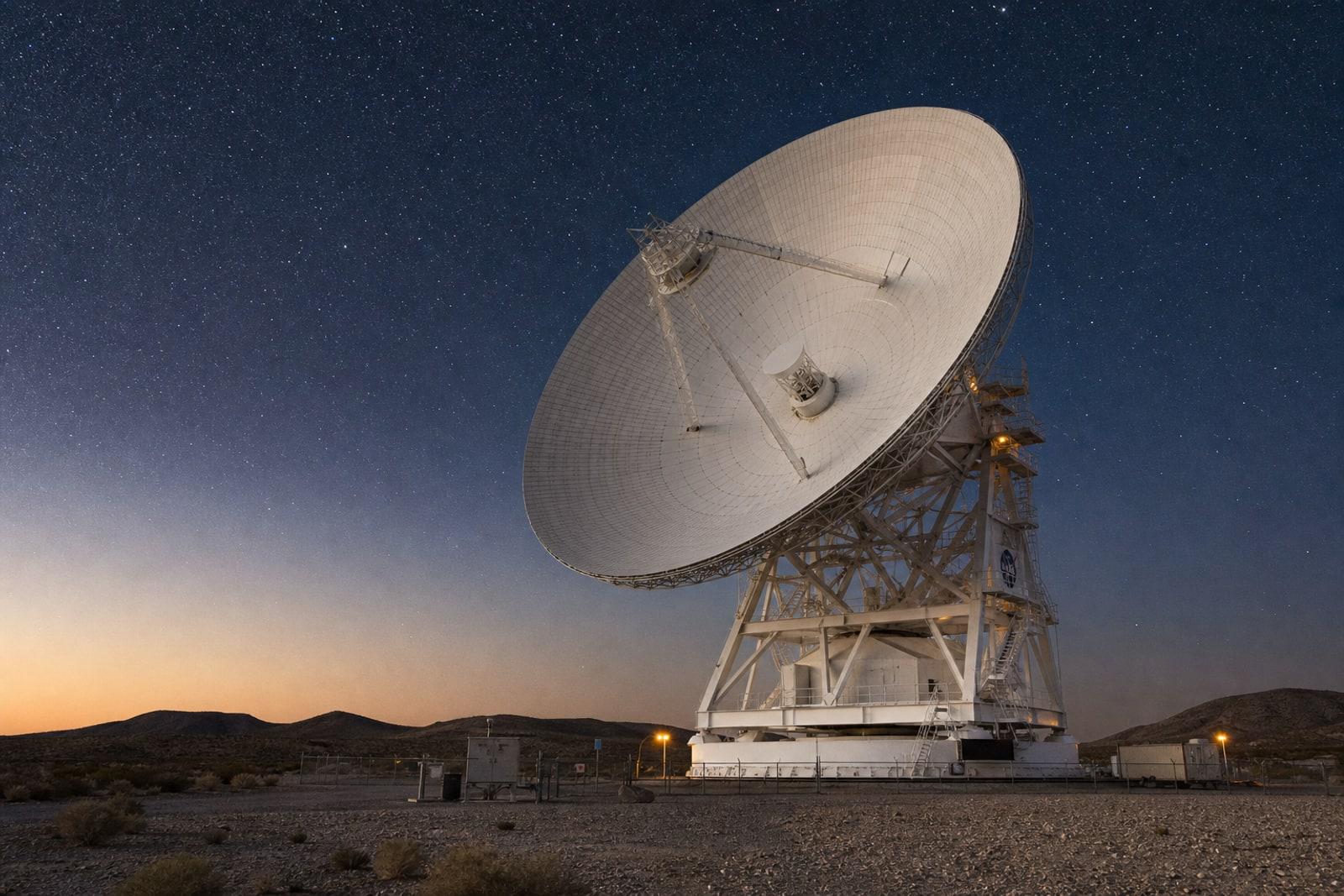
NASA's Goldstone Solar System Radar, in California's Mojave Desert, is bouncing radio waves off the asteroid on 24, 25 and 27 June. Radar echoes can sharpen estimates of an object's size, shape, rotation and exact orbit - exactly the gaps that optical observations have left open. Lance A. M. Benner, a planetary radar scientist at JPL, described the set-up:
"This object has not been observed with radar previously. We will use the 34-meter DSS-26 antenna as a transmitter (7190 MHz) and the 34-meter DSS-13 antenna as a receiver to observe this asteroid on June 24, 25, and 27."
The goal, Benner said, is to "help resolve some discrepancies regarding the diameter, spectral class and optical albedo" of the asteroid - the very uncertainties that give its size such a broad range. Alongside the radar work, robotic telescopes have been imaging the pass; the Virtual Telescope Project captured it from Chile's Atacama Desert on 24 June, when the asteroid was still about 3.5 million kilometres away and registered as a streak crossing a field of stars.
Europe's watch on the sky
The encounter is also a window onto how Europe keeps watch for the objects that share Earth's orbit. ESA's Near-Earth Object Coordination Centre, based at the agency's ESRIN site in Frascati, Italy, published a detailed close-approach fact sheet for 1997 NC1 and maintains the running risk list that underpins the continent's planetary defence. The centre sits within ESA's Space Safety programme, overseen by the agency's Planetary Defence Office, which coordinates European tracking and analysis and feeds into the international warning networks run with NASA and observatories worldwide.
That effort is a collective one across ESA's member states - Luxembourg among them, having joined the agency as a full member in 2005 and helping fund its shared programmes. No single national facility is central to this particular flyby; rather, it is the pooled network of telescopes and radars, from Hawaii to California to the data desks in Frascati, that turns a distant speck into a precisely charted visitor.
For the public, the takeaway is reassuringly mundane. A kilometre-class asteroid is passing closer than it has in four centuries, and the systems built to find such objects saw it coming decades in advance, tracked it the whole way, and confirmed there was never anything to fear. The next time 1997 NC1 comes this near, in 2133, those systems will be sharper still - in part because of the measurements being gathered this weekend.
Frequently asked
- Will asteroid 1997 NC1 hit Earth?
- No. The asteroid passes about 2.56 million kilometres away - roughly 6.6 times the distance to the Moon. Its orbit is precisely known after some 40 past flybys, and the collision probability is effectively zero.
- When and how close does it pass?
- Closest approach is 27 June 2026 at 11:14 UTC (13:14 Luxembourg time), at 2,559,461 km according to ESA. It is the asteroid's nearest pass to Earth since about the year 1600.
- How big is the asteroid?
- ESA estimates it at between 750 and 1,650 metres across, depending on how reflective its surface is; it is commonly described as roughly one kilometre wide, making it a kilometre-class near-Earth object.
- Can I see it from Luxembourg?
- Not with the naked eye. At around magnitude 10 it requires a telescope of six inches (15 cm) or larger, through which it appears as a faint star-like point drifting against the background stars, best around 26-28 June.
Sources(6)
- 1Close approach of asteroid (152637) 1997 NC1European Space Agency · esa.int
- 2Close Approach Fact Sheet for (152637) 1997 NC1ESA NEO Coordination Centre · neo.ssa.esa.int
- 3Large asteroid to pass Earth safely on June 27EarthSky · earthsky.org
- 4Reasons to Approve of the June 27 Flyby of Asteroid 1997 NC1Universe Magazine · universemagazine.com
- 5Potentially Hazardous Asteroid (152637) 1997 NC1 close encounter: new image - 24 June 2026The Virtual Telescope Project 2.0 · virtualtelescope.eu
- 6Asteroid 152637 (1997 NC1) | Space ReferenceSpace Reference · spacereference.org
Related by topic