Memory
France inducts historian and Resistance fighter Marc Bloch into the Panthéon
Eighty-two years after the Gestapo shot him, the co-founder of the Annales school becomes the first historian honoured in France's mausoleum under the Fifth Republic.
By Tom Schmit · · 4 min read
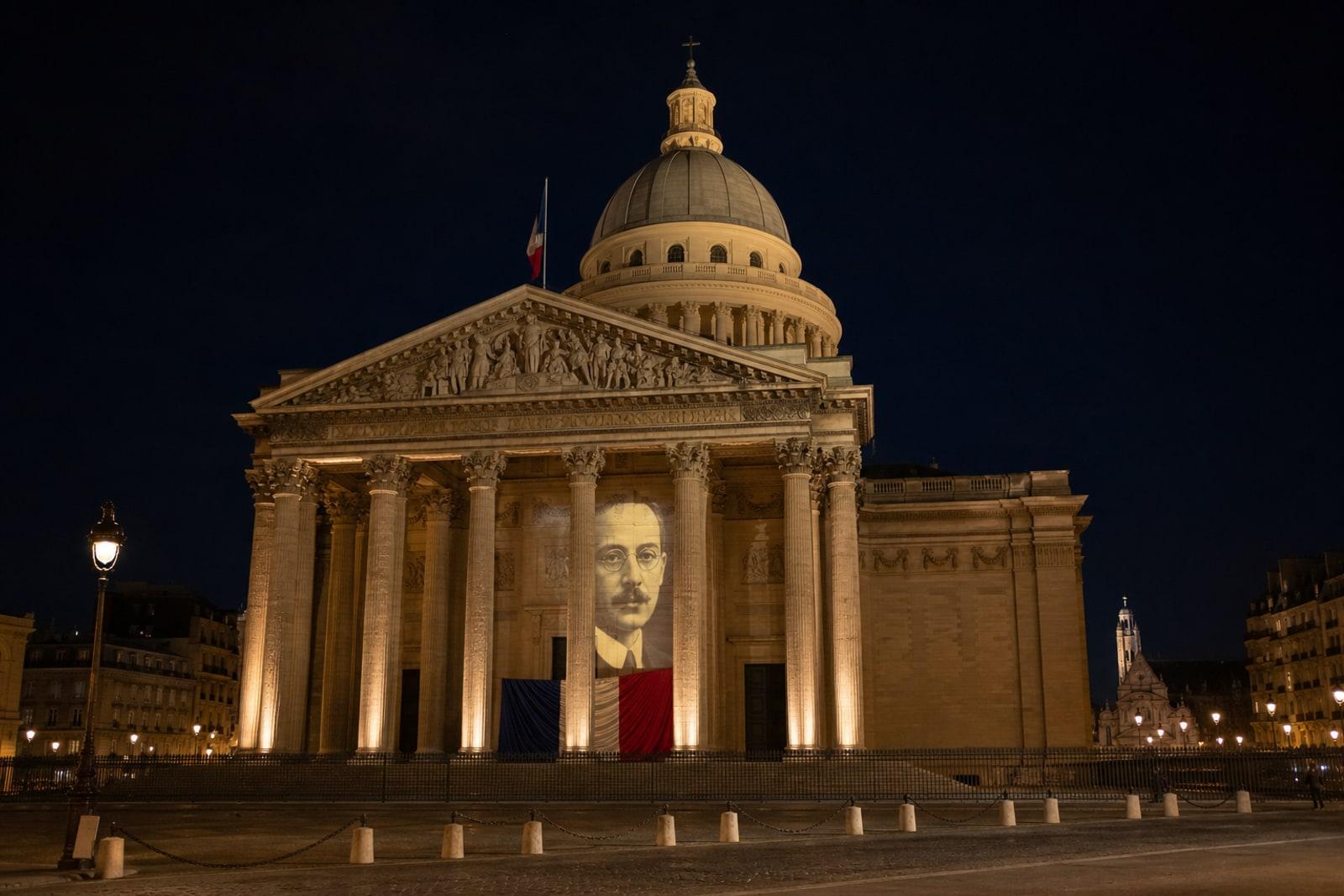
France inducted Marc Bloch into the Panthéon on Tuesday evening, laying the medieval historian, decorated soldier and Resistance fighter symbolically among the nation's heroes eighty-two years after a Gestapo firing squad cut him down in a meadow near Lyon. The co-founder of the Annales school becomes the first historian to be honoured in the Paris mausoleum under the Fifth Republic.
President Emmanuel Macron presided over the ceremony on 23 June, which began after nightfall as a casket bearing symbolic objects — medals, ferns evoking the family home, and the spiritual testament Bloch wrote in 1941 — was carried in procession up the rue Soufflot and into the domed former church. A casket for his wife, Simonne Vidal, accompanied his at the family's request, though she is not herself honoured there and her remains were never found. Bloch's own body stays buried in central France; the coffins are cenotaphs.
A giant portrait of the bespectacled scholar was projected between the Panthéon's columns as scenes from his life played out, before Macron delivered an address of roughly twenty minutes. The French defence ministry quoted the president honouring Bloch as "l'homme des Lumières dans l'armée des ombres" — a man of the Enlightenment in the army of the shadows, the phrase the Resistance used for its clandestine ranks. At the family's request, far-right politicians were excluded from the guest list.
The scholar who remade history
Born in Lyon on 6 July 1886 into a Jewish family of Alsatian origin, Bloch was educated at the École normale supérieure and made his name as a medievalist with studies such as Les Rois thaumaturges (The Royal Touch) and La Société féodale (Feudal Society). In 1929 he and Lucien Febvre founded the journal Annales d'histoire économique et sociale, launching what became one of the twentieth century's most influential schools of historiography.
The Annales approach broke with the narrow political and event-driven history of the day, insisting instead on the long-run study of societies — their economies, geographies and collective mentalities. Macron's office described Bloch as "a man of the Enlightenment" and "the thinker of the century", stressing that his scholarship was never detached from the world.
He was a man who reflected on the past in order to act in the present. He did not have a static view of history; for him, it had to serve action in the here and now.
That conviction was tested by catastrophe. A veteran of the First World War who won the Croix de Guerre and rose to captain, Bloch volunteered again in 1939. After France's collapse the following summer he wrote L'Étrange Défaite (Strange Defeat), a searing first-hand dissection of the political and military failures behind the 1940 rout, published only after his death.
From the lecture hall to the Resistance
Vichy's antisemitic laws stripped Bloch of his rights, forced him to give up his editorial role at the Annales, and saw his Paris apartment and library looted. Rather than flee abroad, he joined the Franc-Tireur movement in 1942 and rose to a regional leadership role in the unified Resistance for the Rhône-Alpes.
He was arrested in Lyon on 8 March 1944 and tortured at Montluc prison, the interrogation centre run by Klaus Barbie, the Gestapo officer later convicted of crimes against humanity. On the night of 16 June 1944, Bloch was driven to Les Roussilles, near Saint-Didier-de-Formans, and shot in groups of four alongside dozens of fellow resisters. Accounts say he cried out as the guns opened fire:
- Final words: witnesses recall Bloch shouting "Vive la France!"
- Age: he was 57
- The group: contemporary and historical accounts put the number of men killed with him at roughly 27 to 30
A European argument about memory
The induction is more than a national honour. By elevating a Jewish scholar-soldier, France is making a pointed statement at a moment when nationalism and antisemitism are resurgent across the continent. The Élysée tied Bloch explicitly to an Enlightenment idea of identity built "not on identity withdrawal but on openness to the other" — a deliberate intervention in Europe's contested memory of the war years.
Macron first announced the plan in November 2024, during a speech marking the 80th anniversary of the liberation of Strasbourg, the city where Bloch taught for much of his career. His entry into the Panthéon, alongside an exhibition titled Marc Bloch, l'esprit de l'Histoire, anchors a year of commemorations.
For a continent still arguing over who counts as a hero of the resistance — and over the place of its Jewish citizens in the story it tells about itself — the choice of Bloch is freighted with meaning. A man who insisted that the historian's task was to understand the present through the past now takes his place, in death, in the building France reserves for the consciences it most wants to remember.
Frequently asked
- When and how was Marc Bloch inducted into the Panthéon?
- On the evening of 23 June 2026, in a ceremony presided over by President Emmanuel Macron. A symbolic casket was carried in procession into the Panthéon; Bloch's actual remains stay buried in central France.
- Why is Marc Bloch's induction significant?
- He is the first historian honoured in the Panthéon under the Fifth Republic, and the rare induction of a Jewish scholar-soldier was framed as a defence of Enlightenment values and anti-fascist resistance at a time of resurgent nationalism.
- How did Marc Bloch die?
- Arrested in Lyon on 8 March 1944 and tortured at Montluc prison under Klaus Barbie's Gestapo, he was shot near Saint-Didier-de-Formans on 16 June 1944 alongside dozens of fellow resisters, reportedly shouting 'Vive la France!'.
- What was Marc Bloch's contribution to history?
- With Lucien Febvre he founded the Annales journal in 1929, launching a school that shifted history toward long-run social and economic structures. His works include 'Feudal Society' and the posthumous 'Strange Defeat'.
Sources(9)
- 1Resistance fighter and historian Marc Bloch enters Paris's PantheonModern Ghana / AFP · modernghana.com
- 2Historian and Resistance hero joins France's Pantheon greatsThe Local France · thelocal.fr
- 3Jewish resistance fighter and historian Marc Bloch enters Paris's PantheonEuropean Jewish Congress / RFI · eurojewcong.org
- 4France inducts Resistance fighter, soldier, historian Marc Bloch into its Panthéon of greatsFrance 24 · france24.com
- 5L'historien et résistant Marc Bloch entre au PanthéonMinistère des Armées et des Anciens combattants (defense.gouv.fr) · defense.gouv.fr
- 6Marc Bloch entre au Panthéonéduscol, Ministère de l'Éducation nationale · eduscol.education.gouv.fr
- 7Panthéonisation 2026 — Centre Marc BlochCentre Marc Bloch (Humboldt-Universität) · cmb.hu-berlin.de
- 8Marc Bloch (1886-1944) — L'Étrange défaite ou la vision d'un guerrierHerodote.net · herodote.net
- 9Marc BlochWikipedia · en.wikipedia.org
Related by topic