Monetary sovereignty
Digital euro reaches its decisive EU vote as Europe targets Visa and Mastercard dominance
MEPs take up the ECB's sovereign payment rail on 23 June, a strategic-autonomy bet with direct stakes for Luxembourg's banks, funds and payments industry.
By Jonas Thill · · 4 min read
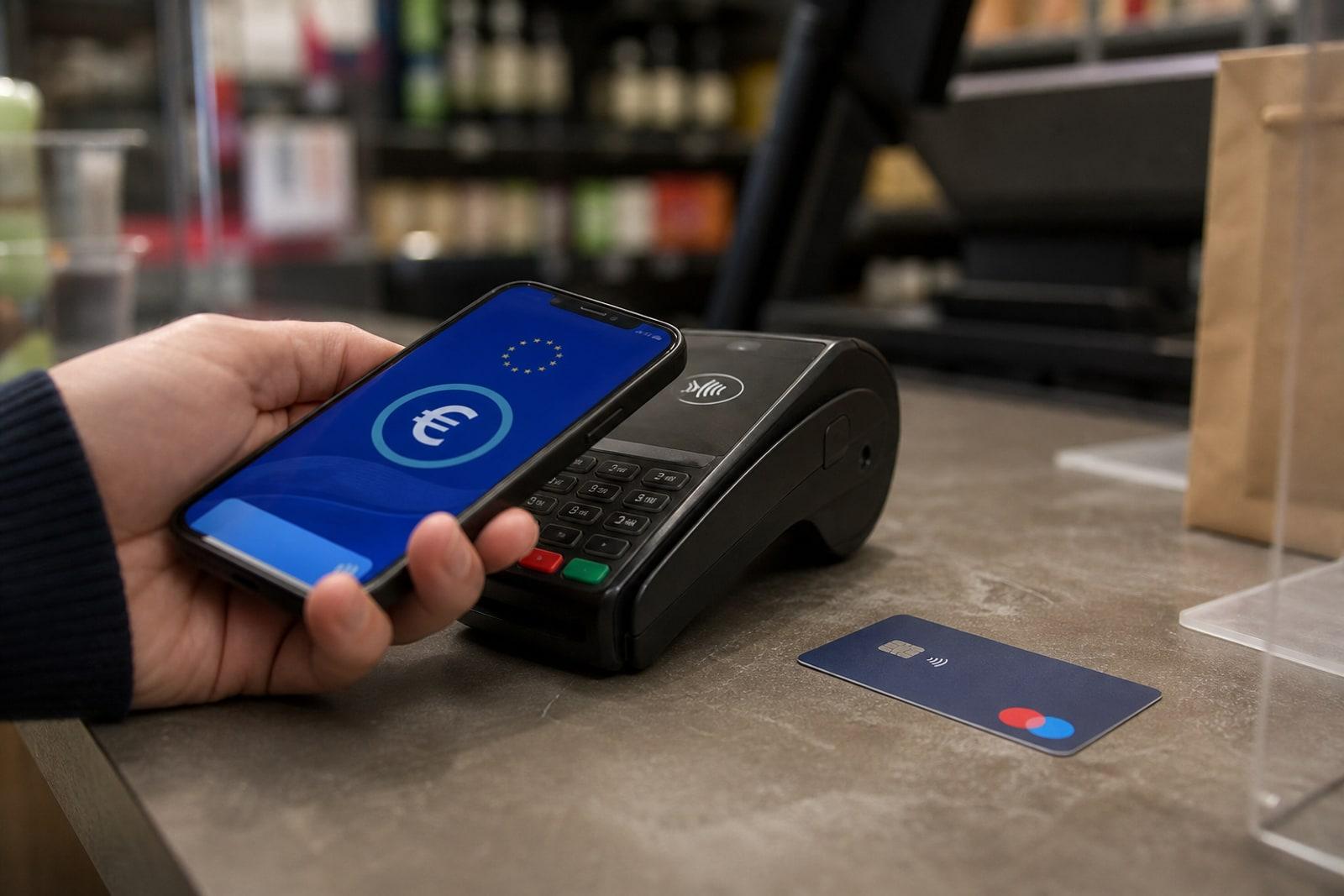
The European Union's long-debated plan for a central bank digital currency reaches a defining moment this week, as the European Parliament's Economic and Monetary Affairs (ECON) committee takes up the regulation that would clear the legal path for a digital euro. The committee was scheduled to vote on the file on 23 June, according to the European Parliament's legislative tracker and reporting by Agence Europe, with a plenary vote expected in July.
The proposal, first tabled by the European Commission on 28 June 2023, has become the centrepiece of Brussels' push for what officials call payment sovereignty. The pitch is blunt: Europe pays for too much of its daily commerce on infrastructure it does not own. The European Central Bank notes that nearly two-thirds of euro-area card payments are processed by non-European companies, chiefly the US networks Visa and Mastercard, while news agency AFP reports that 13 of the euro area's 21 members have no national card scheme of their own.
A sovereignty bet, not a market demand
ECB President Christine Lagarde has framed the dependence as a strategic vulnerability, drawing an implicit parallel with how Western sanctions severed Russia from Visa and Mastercard in 2022.
It's important for us to have digital payment under our control.
Lagarde made the remark on Newstalk's The Pat Kenny Show, arguing that whether Europeans tap a card or a phone, the transaction "typically goes through Visa, Mastercard, PayPal, Alipay" — infrastructure rooted in the United States or China. The digital euro, supporters say, would give the bloc a sovereign, pan-European rail that complements cash and private solutions rather than replacing them.
That logic is not universally accepted. Gilles Boyer, a centrist MEP, captured the political mood while warning that resolve has not matched rhetoric: "We, Europeans, have had many wake-up calls about our dependence on the US. We're fully awake now, but we're not always acting," he told AFP.
What lawmakers are actually deciding
The regulation does not oblige the ECB to issue the currency; it builds the legal framework without which no issuance is possible. The ECB's two-year preparation phase ended in October 2025, and on 30 October its Governing Council approved a move to the next stage, focused on technical readiness and supporting the legislative process. If co-legislators adopt the law during 2026, a pilot could begin in mid-2027, with potential issuance in 2029.
Parliament's negotiators, steered by rapporteur Fernando Navarrete, have converged on a design with several defining features:
- Online and offline use. Negotiators backed both formats, with offline payments initially limited to local transactions and free to use.
- Holding limits. Individuals would face a cap — debated around €3,000 — with holdings paying no interest, so the digital euro works as a means of payment, not a savings vehicle.
- A "waterfall" mechanism. Any payment that would push a user above the limit is automatically swept into a linked commercial bank account; businesses and public authorities face a zero limit, with incoming digital euros instantly converted to deposits.
- Merchant costs. Retailers should pay no more than they do today.
Banks count the cost
Lenders' central worry is disintermediation: that households shift deposits into central bank money, eroding the funding base banks use to lend. The holding cap, the absence of interest and the waterfall mechanism are all designed to blunt that risk. Cost is the second flashpoint. A study by PwC commissioned by European banking associations puts industry adaptation costs near €18 billion, while the ECB's own estimate ranges between €4 billion and €5.8 billion — a gap that has hardened positions ahead of the vote.
The political picture is muddied further because Navarrete, an EPP lawmaker, has at times signalled sympathy for private-sector solutions, leaving the file's timeline contested even as it advances.
Why Luxembourg is watching closely
For the Grand Duchy, the stakes are outsized. Banking and funds anchor an economy whose financial centre competes on infrastructure, trust and the deposit relationship — precisely the terrain the digital euro would touch. The Luxembourg Bankers' Association (ABBL) backs an intermediated model that keeps banks in the customer relationship, but has questioned the rationale for a retail digital euro at all.
Ananda Kautz, who leads innovation, digital banking and payments at the ABBL, has argued the impetus is top-down rather than commercial: "The need does not come from the market but from a strategic decision by the ECB."
Kautz has suggested the ECB might have done more good prioritising wholesale, business-to-business settlement, where she sees clearer value in cross-border efficiency. Luxembourg has form there: in the Eurosystem's 2024 exploratory work on settling tokenised assets in central bank money — an exercise involving 64 participants and more than 200 transactions worth roughly €1.59 billion — institutions including Clearstream, the state bank Spuerkeess and HSBC's Luxembourg arm ran live use cases, coordinated by the Banque centrale du Luxembourg.
Meanwhile the market is not standing still. Five Luxembourg banks are rolling out Wero, the European Payments Initiative's account-to-account wallet, expected to go live locally around June 2026 and pitched as a private European answer to Visa, Mastercard and PayPal. Whether the digital euro ends up an ally or a competitor to such schemes, the ABBL argues, will hinge on the holding limits and interoperability rules now being fought over in Brussels — making this week's vote a moment Luxembourg's banks will read line by line.
Frequently asked
- When is the digital euro vote and what does it decide?
- The European Parliament's ECON committee was scheduled to vote on the digital euro regulation on 23 June 2026, with a plenary vote expected in July. The law would create the legal framework for a digital euro but would not force the ECB to issue it.
- Why does the EU want a digital euro?
- To reduce dependence on non-European payment providers. The ECB says nearly two-thirds of euro-area card payments are processed by foreign firms, mainly Visa and Mastercard, which Brussels treats as a strategic vulnerability.
- How would it affect ordinary users and banks?
- Individuals could hold digital euros up to a cap debated around €3,000, with no interest; amounts above the limit sweep into a linked bank account. Banks worry about deposit flight and adaptation costs estimated by industry at about €18 billion.
- Why does it matter for Luxembourg?
- Luxembourg's economy leans on banking and funds. The ABBL supports an intermediated model and questions the retail rationale, while five local banks are launching the European Wero wallet as a private alternative to US networks.
Sources(11)
- 1Digital euro | Legislative Train ScheduleEuropean Parliament · europarl.europa.eu
- 2Progress on the digital euroEuropean Central Bank · ecb.europa.eu
- 3Eurosystem moving to next phase of digital euro projectEuropean Central Bank · ecb.europa.eu
- 4'Europeans are fully awake': Why the EU is pushing for a new 'digital euro'The Local (AFP) · thelocal.it
- 5Luxembourg bankers sceptical about digital euro, while ECB sees upsideDelano · delano.lu
- 6Europe must end reliance on US technology - Christine LagardeNewstalk · newstalk.com
- 7Digital Euro: ECON Vote June 23 and What It DecidesSpaziocrypto · en.spaziocrypto.com
- 8European Parliament's negotiations on digital euro pave way for end-of-June committee voteAgence Europe · agenceurope.eu
- 9Luxembourg banks join forces to test the ECB's digital euro for financial marketsABBL · abbl.lu
- 10The digital euro in a fragmenting world: ensuring Europe's resilience and autonomy in paymentsEuropean Central Bank · ecb.europa.eu
- 11EU Parliament endorses dual digital euro approachElectronic Payments International · electronicpaymentsinternational.com
Related by topic