Manufacturing
Goodyear pushes tyres past 50% sustainable materials as EU tightens recycling rules
A road tyre built from at least 50% sustainable materials marks a milestone for Goodyear, whose Colmar-Berg complex ranks among Luxembourg's largest employers and a European research hub.
By Marc Weber · · 4 min read
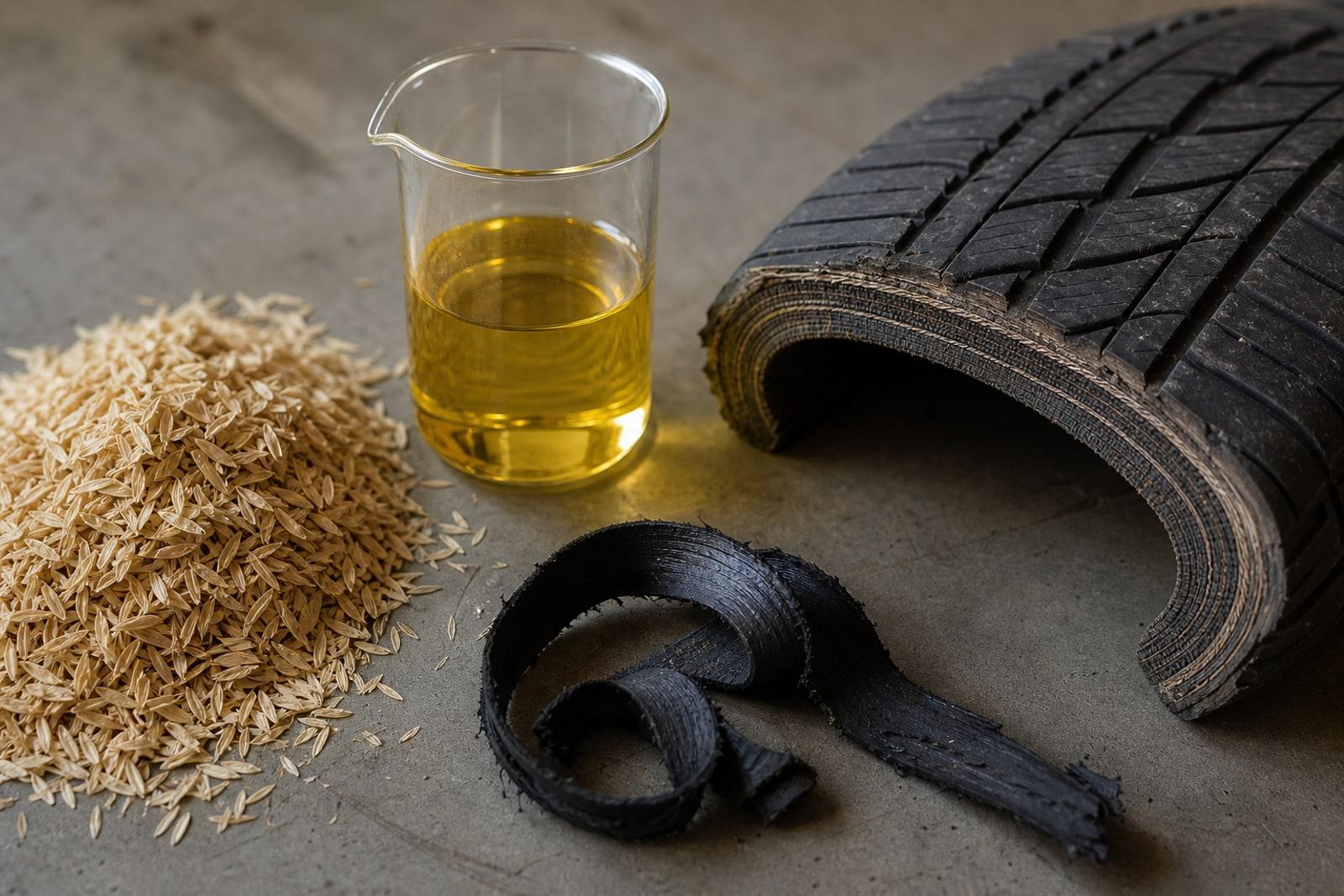
A modern tyre is mostly oil and soot. For more than a century the industry's basic recipe — natural and synthetic rubber, carbon black, silica, steel and reinforcing fabric — has leaned heavily on virgin, fossil-based inputs. Goodyear, the American manufacturer whose European nerve centre sits in the central Luxembourg commune of Colmar-Berg, says it has now crossed a threshold once treated as a distant ambition: selling road tyres in which more than half the materials are bio-based, renewable or recycled.
The company's ElectricDrive 2, introduced in January 2024, is designed with at least 50% sustainable materials by weight per tyre, according to Goodyear. The figure is built from ingredients that read more like a kitchen than a chemical plant: soybean oil in place of some petroleum-derived process oils, silica produced from rice husk ash, and natural rubber the company describes as sustainably sourced. Goodyear defines a sustainable material as one that is bio-based, renewable or recycled, or made using practices designed to conserve resources and cut emissions.
A milestone measured in soybean oil and rice husks
The 50% road tyre is the commercial edge of a longer research push. In January 2022 Goodyear demonstrated a tyre with 70% sustainable-material content; a year later it unveiled a 90% demonstration tyre that it said had passed regulatory and internal testing and was approved for road use. That prototype used 17 ingredients across 12 components, including four types of carbon black derived from methane, carbon dioxide, plant-based oil and the pyrolysis oil of end-of-life tyres, plus polyester recycled from used drinks bottles and steel made with high recycled content.
Goodyear has set itself a public target of producing the industry's first 100% sustainable-material tyre by 2030, and has begun seeding the chemistry into mainstream products — eight of its tyre lines now include soybean oil, and the company says its use of rice husk ash silica has more than doubled since 2018. A separate 55% sustainable-material tyre was developed for the FIA European Truck Racing Championship.
We continue to make progress toward our goal of introducing the first 100% sustainable-material tire in the industry by 2030.
That pledge, from Chris Helsel, Goodyear's senior vice president of global operations and chief technology officer, frames the 50% road tyre as a waypoint rather than a destination. "We know EV drivers prioritize performance and a more-sustainable tire," said David Reese, a vice president of product development at Goodyear Americas, when the ElectricDrive 2 launched. "The ElectricDrive 2 was designed with at least 50% sustainable materials, a focus on providing greater traction and maintaining a quiet ride."
Luxembourg's industrial anchor
The materials science behind those tyres is developed across Goodyear's two innovation centres — one in Akron, Ohio, the other at Colmar-Berg, where the company has manufactured and researched since the early 1950s. The Luxembourg complex is one of the country's largest private employers: the industry federation FEDIL lists 3,387 staff, while the company has described a wider research-and-industrial footprint of roughly 3,500 associates from more than 80 nationalities spread across Colmar-Berg, Bissen and Dudelange.
The site doubles as a European product-development hub. In March 2024 Goodyear inaugurated a driving-simulation centre there, built around a high-end motion simulator, that lets engineers test virtual concept tyres against vehicles still on the drawing board. Goodyear estimated the facility would spare 13,000 physical tyres and around 97,500 kilometres of test driving on its current project. Day-to-day manufacturing at the plants is overseen by Alex Schumann, the site's manufacturing director.
- Goodyear at Colmar-Berg: research-and-industrial complex operating since the early 1950s
- Workforce: 3,387 in Luxembourg (FEDIL); about 3,500 across the wider complex
- Role: one of two global Goodyear innovation centres, plus EMEA product development
Brussels rewrites the rulebook
The commercial logic for cleaner inputs is hardening into law. On 12 December 2025, the European Parliament and the Council reached a provisional agreement on a new regulation governing how vehicles are designed and scrapped — replacing the bloc's older end-of-life vehicles and type-approval rules. Under the deal, each new vehicle type will have to contain at least 15% recycled plastic within six years of the rules taking effect, rising to 25% within ten years, with a fifth of that drawn from a closed loop of old vehicles. The European Commission must also propose recycled-content targets for steel and aluminium within two years, subject to feasibility studies.
The agreement is pitched at an industry of scale: the EU counts 285.6 million motor vehicles on its roads, with about 6.5 million reaching the end of their lives each year. "We are taking important steps to boost the automotive sector's transition to a circular economy," the Parliament's co-rapporteurs, Jens Gieseke and Paulius Saudargas, said in a joint statement, adding that they had "secured realistic targets" to avoid overburdening manufacturers. The Council had set out its negotiating position in June 2025, and the deal still requires formal sign-off by both institutions.
For now, the regulation's binding recycled-content quotas focus on plastics — and prospectively steel and aluminium — rather than tyres themselves. But the direction of travel is unambiguous, and it converges with the bet Goodyear is making at Colmar-Berg: that carmakers, pressed by Brussels to strip virgin fossil inputs out of their supply chains, will increasingly demand the same of the rubber they roll on.
Frequently asked
- Does Goodyear really sell a tyre that is more than half renewable or recycled?
- Yes. Goodyear says its ElectricDrive 2 tyre, launched in January 2024, is designed with at least 50% sustainable materials by weight, including soybean oil, rice husk ash silica and sustainably sourced natural rubber. It has also demonstrated 70% and 90% prototypes.
- What role does the Colmar-Berg site play?
- Colmar-Berg in Luxembourg is one of Goodyear's two global innovation centres and a major manufacturing complex, employing roughly 3,400 people. It is one of the country's largest private employers and hosts the company's EMEA product development, including a driving-simulation centre opened in 2024.
- What are the new EU rules behind this shift?
- On 12 December 2025 the European Parliament and Council provisionally agreed a regulation on vehicle circularity and end-of-life vehicles. It requires 15% recycled plastic in new vehicle types within six years, rising to 25% within ten, with steel and aluminium targets to follow. The quotas currently cover plastics rather than tyres.
Sources(11)
- 1Goodyear introduces Goodyear ElectricDrive 2 with elevated performance capability and sustainable materialsGoodyear (newsroom) · news.goodyear.com
- 2Goodyear unveils 90% sustainable-material demonstration tire, approved for road useGoodyear EU (newsroom) · news.goodyear.eu
- 3Goodyear develops 70% sustainable-material tire with industry-leading innovationsGoodyear (newsroom) · news.goodyear.com
- 4Goodyear unveils 90% sustainable-material demonstration tire, approved for road usePR Newswire · prnewswire.com
- 5Introducing 55% sustainable-material truck racing tyres for the Goodyear FIA European Truck Racing ChampionshipGoodyear EU (newsroom) · news.goodyear.eu
- 6Circular economy: deal on new EU rules for the automotive sectorEuropean Parliament · europarl.europa.eu
- 7Circular economy: Council and Parliament strike deal on rules for vehicle circularity and management of end-of-life vehiclesCouncil of the EU (Consilium) · consilium.europa.eu
- 8Circular economy: Council adopts position on the recycling of vehicles at the end of their lifeCouncil of the EU (Consilium) · consilium.europa.eu
- 9Goodyear S.A. — member profileFEDIL · fedil.lu
- 10From tyres to data: Alex Schumann's strategic journeyPaperjam · en.paperjam.lu
- 11Goodyear inaugurates Simulation Center in Colmar-BergSilicon Luxembourg · siliconluxembourg.lu
Related by topic